Landmarks & Monuments
Igreja de Sao Roque: The Plainest Church, the Richest Chapel
The free church, the EUR8 museum, the Monday morning closure, and the chapel that was built in Rome, blessed by a pope and shipped to Lisbon in pieces.
In this guide
- Tickets and opening hours
- Why the outside looks like that
- The Chapel of St John the Baptist
- The other seven chapels
- Who owns it, and why that is an interesting story
- What survived 1755, and why it matters
- Is the museum worth €8?
- Getting there
- What to combine it with
- Practical notes
- Frequently asked questions
- Bottom Line
The Igreja de São Roque has the plainest façade of any significant church in Lisbon and, behind it, what was once described as the most expensive chapel in the world. That gap between outside and inside is the whole point of the place, and it is why São Roque is the best free thing to do in the city centre — the church costs nothing to enter, and most visitors walk past the door without a glance.
This guide covers the free church and the €8 museum next to it, the opening hours (including the Monday morning closure), what to look at in each of the eight chapels, and the story of the chapel that was built in Rome, blessed by a pope, taken apart and shipped to Lisbon.
Tickets and opening hours
The church — free
- October to March: Monday 13:00–18:00; Tuesday to Sunday 10:00–18:00
- April to September: Monday 13:00–19:00; Tuesday to Sunday 10:00–19:00
- Mass: Tuesday to Sunday at 12:30. Visits pause during services.
Note the Monday morning: the church does not open until 13:00 on Mondays year-round, which catches out anyone building a Monday itinerary around the Bairro Alto.
The Museu de São Roque — €8
- Adult: €8
- Guided tour: €12
- Combined with Casa Ásia: €12
- Half price for over-65s, students, Lisboa Card holders and family tickets
- Free for children under 12, and for residents on Sundays and public holidays until 14:00
- Hours: Tuesday to Sunday, 10:00–18:00, with last access to the permanent exhibition 30 minutes before closing
The important thing to understand is that the church and the museum are separate. You do not need the museum ticket to see the chapels — those are in the church, and the church is free. The museum holds the silver, vestments and liturgical objects associated with them, in a building next door.
Why the outside looks like that
São Roque was built for the Jesuits between 1565 and 1587, on a site that had held a shrine to Saint Roch, protector against plague, put up after an outbreak in 1505. It was the first Jesuit church in Portugal and one of the earliest anywhere.
The original Mannerist façade came down in the 1755 earthquake. What replaced it is deliberately austere — flat, unadorned, with nothing to suggest what is behind it. Standing in Largo Trindade Coelho you would take it for a parish hall.
Inside, the church survived 1755 almost intact, which is why it holds some of the best pre-earthquake decoration left in Lisbon. Most of what the city had in 1755 is gone; this is what it looked like.
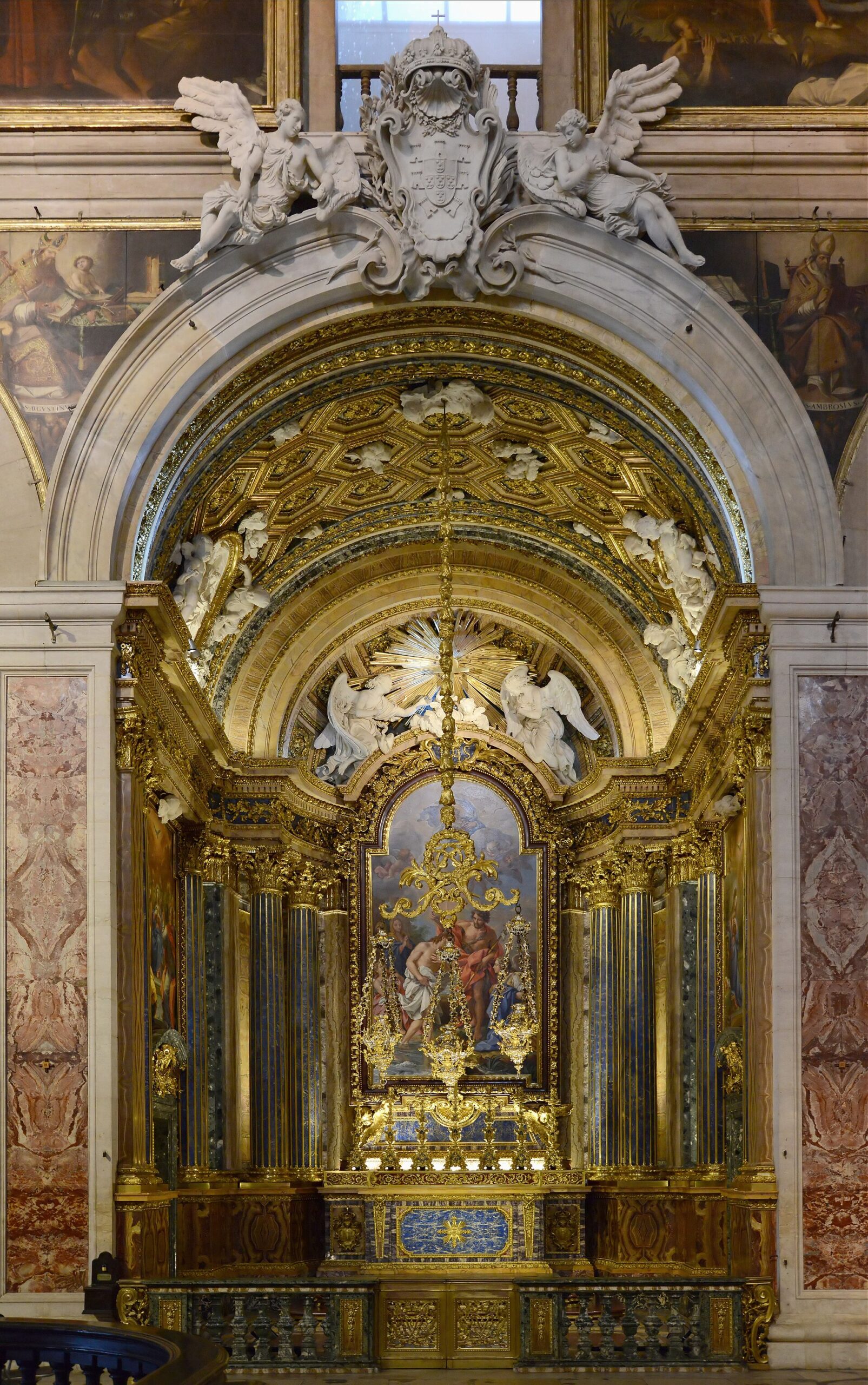
The Chapel of St John the Baptist
Last chapel on the left, and the reason people who know come here.
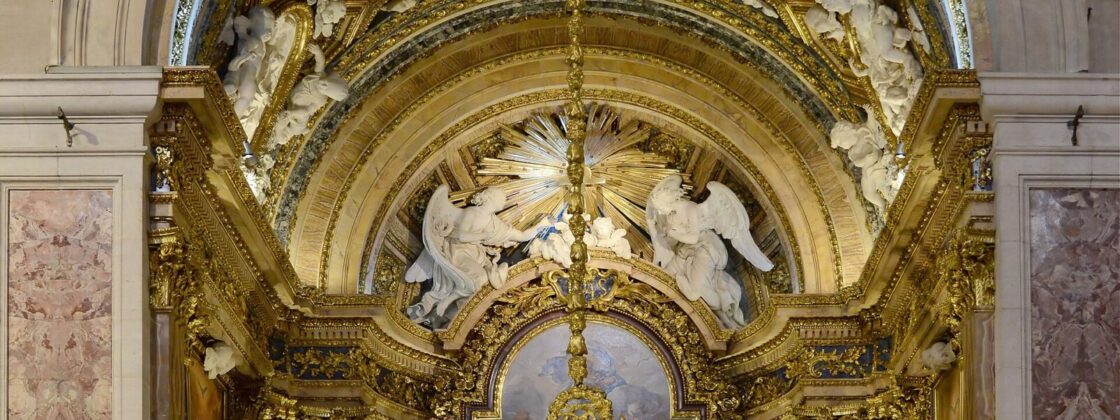
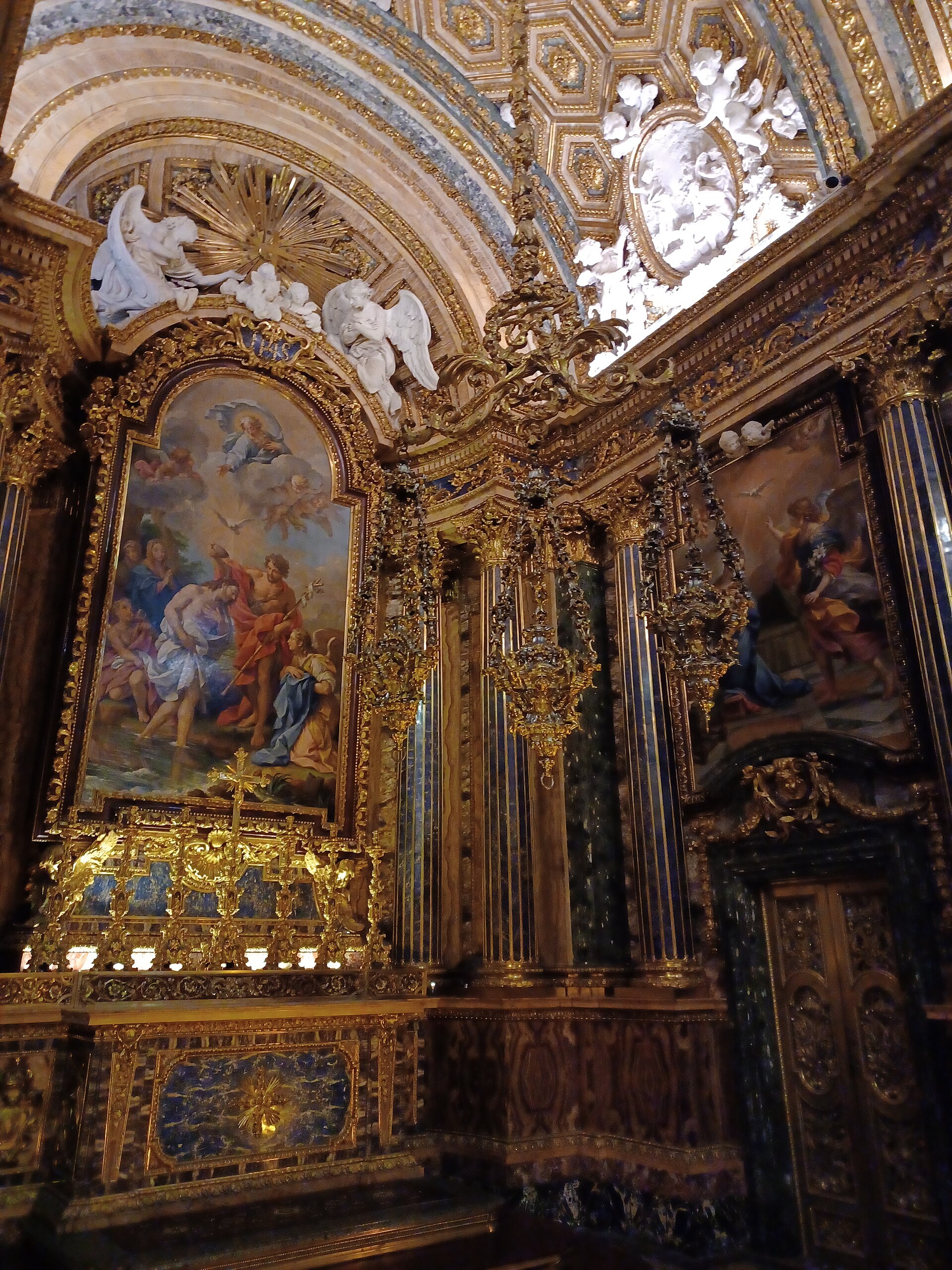
In 1740 João V, flush with Brazilian gold and determined to demonstrate Portuguese piety to Rome, commissioned a chapel to be built in Rome, by Roman architects Luigi Vanvitelli and Nicola Salvi, out of the most expensive materials obtainable: lapis lazuli, amethyst, agate, alabaster, Carrara marble, porphyry, gilt bronze and ivory. It was assembled in Rome, blessed by Pope Benedict XIV in 1744, then dismantled, packed into three ships and reassembled here in 1747.
What makes it extraordinary rather than merely expensive is the mosaic work. The three altarpieces — the Baptism of Christ, the Annunciation and the Pentecost — are not paintings. They are micro-mosaics made from thousands of tiny tesserae in the Vatican workshops, so finely worked that visitors standing a metre away consistently mistake them for oils. Get as close as the rail allows and look at the Baptism: the tonal transitions in the water and the sky are the whole achievement.
Contemporary accounts made it the most costly chapel in Europe, and there is no obvious rival for the claim. It cost more than the ships that carried it.
The other seven chapels
The Baptist chapel overshadows the rest, which is a shame — any of them would be the highlight of a lesser church.
- Chapel of the Holy Sacrament — heavy gilt woodwork, talha dourada, the Portuguese Baroque speciality of carving wood into foliage and covering it in gold leaf.
- Chapel of Our Lady of Doctrine — holds the tomb of Francisco Tristão, and some of the earliest azulejo work in the building.
- Chapel of St Roch — the original dedication, with a sixteenth-century painted panel of the saint and one of the church’s oldest tile schemes.
- Chapel of the Nativity — an eighteenth-century nativity group in terracotta by Machado de Castro, the sculptor responsible for the equestrian statue in Praça do Comércio.
And look up. The ceiling is flat, not vaulted, and painted in trompe l’oeil to suggest a vault that is not there — a Mannerist device and one of very few such ceilings surviving in Portugal from before the earthquake.
Who owns it, and why that is an interesting story
São Roque has not belonged to the Jesuits since 1768. In that year the Marquês de Pombal — the man rebuilding Lisbon after the earthquake, and no friend of the order — expelled the Jesuits from Portugal and its empire, confiscated their property, and handed this church to the Santa Casa da Misericórdia de Lisboa.
The Misericórdia is a charitable brotherhood founded in 1498 by Queen Leonor, and it still runs the church and the museum today. It is also, and this is the part visitors never expect, the organisation that operates the Portuguese national lottery: the Totoloto and the Euromilhões tickets sold in every café in the country fund social care through the same institution that keeps the gilt on these chapels. When you look at the ticket desk in the museum, you are looking at one of the oldest continuously operating charities in Europe.
That transfer in 1768 is also why the building survives so well. It became institutional property with an endowment behind it at exactly the moment when a great deal of Lisbon’s ecclesiastical heritage was being dispersed. Our history of Lisbon covers the Pombaline period in more detail.
What survived 1755, and why it matters
It is worth pausing on how unusual this interior is. The earthquake of 1 November 1755, the tsunami that followed it and the fire that burned for days destroyed most of central Lisbon and with it the bulk of the city’s Renaissance and early Baroque church decoration. The earthquake guide sets out the scale.
São Roque, up on the Bairro Alto hill and built on solid ground, lost its façade and very little else. The trompe l’oeil ceiling, the sixteenth-century azulejo panels, the talha dourada, the painted altarpieces and the Baptist chapel — which had arrived only eight years earlier — all came through.
The practical consequence for a visitor is this: if you want to see what a wealthy Lisbon church looked like before the city was flattened and rebuilt in Pombaline plainness, there is essentially one place to do it, and this is it. The Carmo Convent shows you the destruction; São Roque shows you what was destroyed.
Is the museum worth €8?
Honestly: for most visitors, no.
The Museu de São Roque holds the treasury of the Baptist chapel — the silver-gilt altar frontal, the candlesticks, the vestments woven with gold thread, and the reliquaries — along with sixteenth-century Portuguese painting and Jesuit-related material. It is a good, serious collection and it is well displayed.
But you have just seen the chapel itself for nothing, and the museum is objects in cases rather than a continuation of the experience. If you are the kind of traveller who reads every label in a decorative arts museum, go: €8 is fair and the silver is exceptional. If you are working through Lisbon at pace, look at the chapels, spend twenty-five minutes in the church, and put the €8 towards lunch.
Where it does become good value: with a Lisboa Card it is €4, and the €12 combined ticket with Casa Ásia is worth it if you were going to visit that anyway. Our Lisboa Card guide runs the wider arithmetic, and the museums guide ranks Lisbon’s collections against each other.
Getting there
São Roque stands on Largo Trindade Coelho in the Bairro Alto, at the top of the hill above Chiado. From Rossio it is a steep eight-minute walk. The Elevador da Glória funicular from Praça dos Restauradores used to be the easy way up, but it has been closed since its fatal derailment in September 2025 and is not expected back before the first half of 2029; Carris runs bus 51E in its place. Our funiculars and lifts guide covers the closures.
From Chiado metro station it is five minutes uphill. Tram 24E stops nearby. The Miradouro de São Pedro de Alcântara, one of the best free viewpoints in the city, is a short walk away, beside the top station of the closed Glória funicular — see the miradouros guide.
What to combine it with
São Roque sits at the top of the best free half-day in central Lisbon. The sequence we would use:
- Up from Restauradores on foot, or on bus 51E while the Glória funicular is closed.
- Miradouro de São Pedro de Alcântara for the view across to the castle. Free.
- São Roque, twenty-five minutes. Free.
- Down through the Bairro Alto to Largo do Carmo.
- The Carmo Convent, €7 — the roofless nave, and the natural counterpoint to São Roque.
- Chiado for coffee. Leave out the Santa Justa lift: it has been closed since September 2025, with no reopening date.
That is a morning, one paid admission at €7, and three of the better things in the city. Our Bairro Alto and Chiado guide covers the neighbourhood, and the free things to do guide goes further on the no-cost version.
Tickets and hours for the second stop: our Carmo Convent guide.
Practical notes
Dress and behaviour
This is an active church with daily mass at 12:30. Shoulders and knees covered, hats off, phones silent. If you arrive during a service, wait outside or sit quietly at the back; do not walk the chapels.
Photography
Permitted in the church without flash. The chapels are dark and the gilt is high-contrast, so a phone will struggle — brace against a pillar rather than raising the ISO. The museum’s silver room has restrictions, which are signposted.
Lighting and time of day
Morning, when light comes through the south windows and reaches into the chapels on the left, including the Baptist. By late afternoon that side of the church is in shadow and the mosaics lose most of their depth. This is a genuine difference, not a marginal one.
Accessibility
Largo Trindade Coelho is on a slope but the church has level access at the main door and the nave is flat throughout, which makes it one of the more accessible historic churches in Lisbon. The museum has lift access to its upper floor. See our accessibility guide for the approach routes, since the walk up from Chiado is steep.
How long to allow
Twenty-five to thirty minutes for the church, taking the chapels slowly. Another forty-five if you do the museum.
Where to eat nearby
Largo Trindade Coelho and the streets immediately around it are tourist-priced, and the cafés with tables on the square charge accordingly. Walk two streets west into the Bairro Alto proper and prices fall by a third. Most of the neighbourhood’s restaurants open in the evening rather than at lunchtime — the Bairro Alto is a night district — so a lunchtime visit is better served by walking downhill into Chiado. Our tascas guide and the coffee and cafés guide both list places within ten minutes.
The statue on the square
In the middle of Largo Trindade Coelho stands a bronze statue of a cauteleiro, a lottery-ticket seller — a nod to the Misericórdia connection and one of the more quietly affectionate pieces of public sculpture in Lisbon. Visitors rub the ticket for luck. It is two metres from the church door and almost nobody photographs it.
Frequently asked questions
Is Igreja de São Roque free?
Yes. The church, including all eight side chapels and the Chapel of St John the Baptist, costs nothing to enter. Only the adjoining museum charges, at €8.
What are the opening hours?
The church opens Tuesday to Sunday from 10:00, closing at 18:00 from October to March and 19:00 from April to September. On Mondays it opens at 13:00. The museum runs Tuesday to Sunday, 10:00–18:00, and is closed Mondays.
What is so special about the Chapel of St John the Baptist?
It was built in Rome from lapis lazuli, amethyst, alabaster, gold and ivory, blessed by Pope Benedict XIV in 1744, then dismantled and shipped to Lisbon in three vessels and reassembled in 1747. Its altarpieces are Vatican micro-mosaics that look convincingly like oil paintings. It was reputed to be the most expensive chapel in the world.
Do you need to book?
No. Neither the church nor the museum requires booking, and queues are rare.
How does it compare to Lisbon’s other churches?
For interior decoration it is the best in the city — nothing else has survived from before 1755 in this condition. The Sé is older and more austere, and the Carmo Convent is more atmospheric, but neither approaches São Roque for sheer richness. See our landmarks guide for the full ranking.
Is the museum included in the Lisboa Card?
Not free, but half price: €4 rather than €8.
Can you photograph inside?
Yes in the church, without flash. Parts of the museum are restricted and signposted as such.
Bottom Line
São Roque is the best-value hour in central Lisbon precisely because it costs nothing. Go in the morning, when the light reaches the left-hand chapels, walk straight to the last chapel on that side, and get close enough to the Baptism of Christ to see that it is made of stone rather than paint.
Skip the museum unless silver and vestments genuinely interest you or you have a Lisboa Card. And do not turn up before 13:00 on a Monday — that is the one thing that will waste the walk up the hill.