Getting Around Lisbon
Lisbon’s Historic Funiculars & Elevators: Complete Guide (2026)
Complete guide to Lisbon's funiculars and elevators—Bica, Glória, Lavra, and Santa Justa. How to ride, where they go, and what to pay.
In this guide
- Lisbon’s Four Historic Ascensores
- Quick Comparison: Which One to Ride?
- Elevador da Bica
- Elevador da Glória
- Elevador do Lavra
- Elevador de Santa Justa
- How to Pay
- Accessibility
- Best to Ride First
- Practical Notes on Timing
- Photography Tips
- How the Funiculars Fit into the Wider Transport Network
- FAQ: Lisbon Funiculars
- Bottom Line
Lisbon’s funiculars and elevators are the city’s most charming public transit — three 19th-century cliff-climbing yellow funiculars and one extraordinary 1902 wrought-iron elevator that connect the lower city to the steep upper neighborhoods. They’re functional transport, photogenic landmarks, and small mechanical marvels.
Two minutes from the top of the Gloria funicular stands the church with the most extravagant chapel in Portugal. Our Igreja de Sao Roque guide has the hours and what to see.
Most visitors ride Elevador da Bica for the photo and stop there. That’s fine. But the full story — four different machines, four different neighborhoods, 140 years of engineering and city history — is more interesting than the Instagram version. This guide covers all four of Lisbon’s historic ascensores with how to ride, what to pay, which one to prioritize, and what you actually see from each upper station. Updated for 2026.
Lisbon’s Four Historic Ascensores
| Name | Type | Year | Where |
|---|---|---|---|
| Elevador da Bica | Funicular | 1892 | Cais do Sodré → Bairro Alto |
| Elevador da Glória | Funicular | 1885 | Restauradores → São Pedro de Alcântara |
| Elevador do Lavra | Funicular | 1884 | Anunciada → Torel |
| Elevador de Santa Justa | Vertical lift | 1902 | Baixa → Largo do Carmo |
All four are operated by Carris, Lisbon’s municipal transport authority. They accept the same Viva Viagem card as trams, buses, and the metro. Check current timetables and ticketing at carris.pt.
Quick Comparison: Which One to Ride?
| Funicular | Best for | Tourist Traffic | Upper Destination |
|---|---|---|---|
| Elevador da Bica | The iconic photo + Cais do Sodré access | Very high | Calhariz / Bairro Alto edge |
| Elevador da Glória | Quick Bairro Alto access + viewpoint | High | São Pedro de Alcântara viewpoint |
| Elevador de Santa Justa | Vertical experience + Carmo views (see note) | Very high | Largo do Carmo / Chiado |
| Elevador do Lavra | Authenticity + no queue | Very low | Torel garden viewpoint |
Elevador da Bica
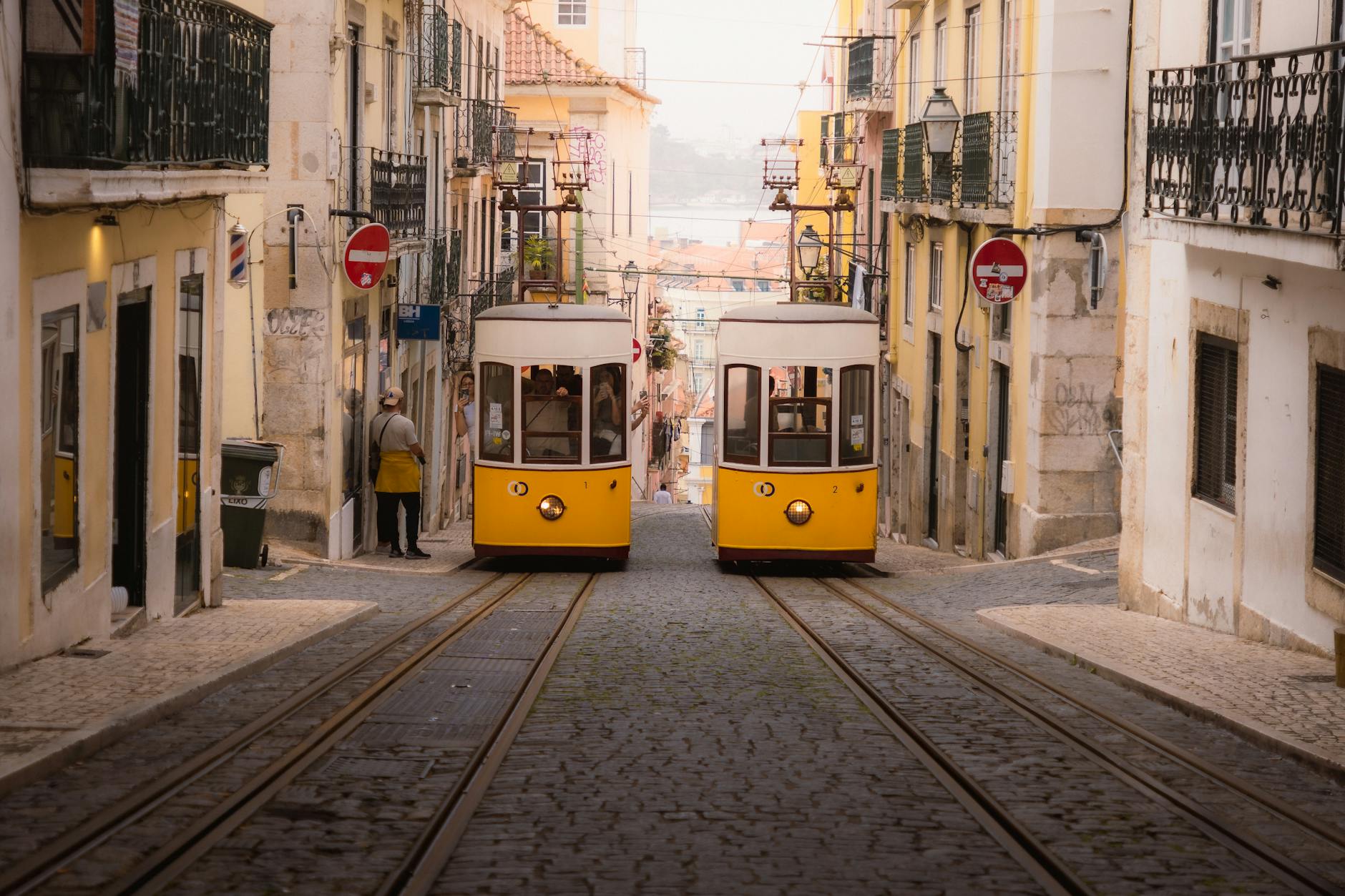
The most photographed funicular in Lisbon. The bright yellow car climbs a steep narrow street between tightly packed buildings — the iconic Bica image you’ve seen in Lisbon postcards. The street it climbs, Rua da Bica de Duarte Belo, is barely wide enough for the tracks and two people walking side by side. Buildings press in from both sides. At the top, the Tagus is visible if you look back.
The Bica opened on June 28, 1892 — the third of Lisbon’s funiculars to open, designed by engineer Raoul Mesnier du Ponsard (the same man behind Santa Justa). It originally ran on a water-counterbalance system, filling and emptying rooftop reservoirs to create the movement. Converted to steam in 1896, then electrified in 1924 with the two carriages that still run today. In 2002, it was classified as a National Monument.
- Where: Rua de São Paulo (lower, Cais do Sodré area) to Largo de Calhariz (upper)
- Length: 245–283 metres (the street is 245m of track; the full ascent slightly longer)
- Gradient: Average 11% — the least steep of Lisbon’s three funiculars
- Hours: 7 AM – 9 PM (some variation by day)
- Cost: €4 round trip or €1.80 with Viva Viagem day pass
The neighborhood between the lower and upper stations is worth exploring on foot. The Bica bairro is a tightly packed residential area — small bars, no tourist infrastructure, cats on the steps, locals hanging laundry from upper-floor windows. Most visitors ride up, photograph, and leave. Walk around before you descend.
Photography: The most-photographed angle is from the bottom looking up — the yellow car framed by the buildings on either side, Tagus just visible at the top. Best light is early morning (8–10 AM) before crowds. Photographers stake out the position below the lower station; arrive before 9 AM on a summer morning to have it relatively quiet. The car runs every few minutes, so you get multiple attempts.
Elevador da Glória
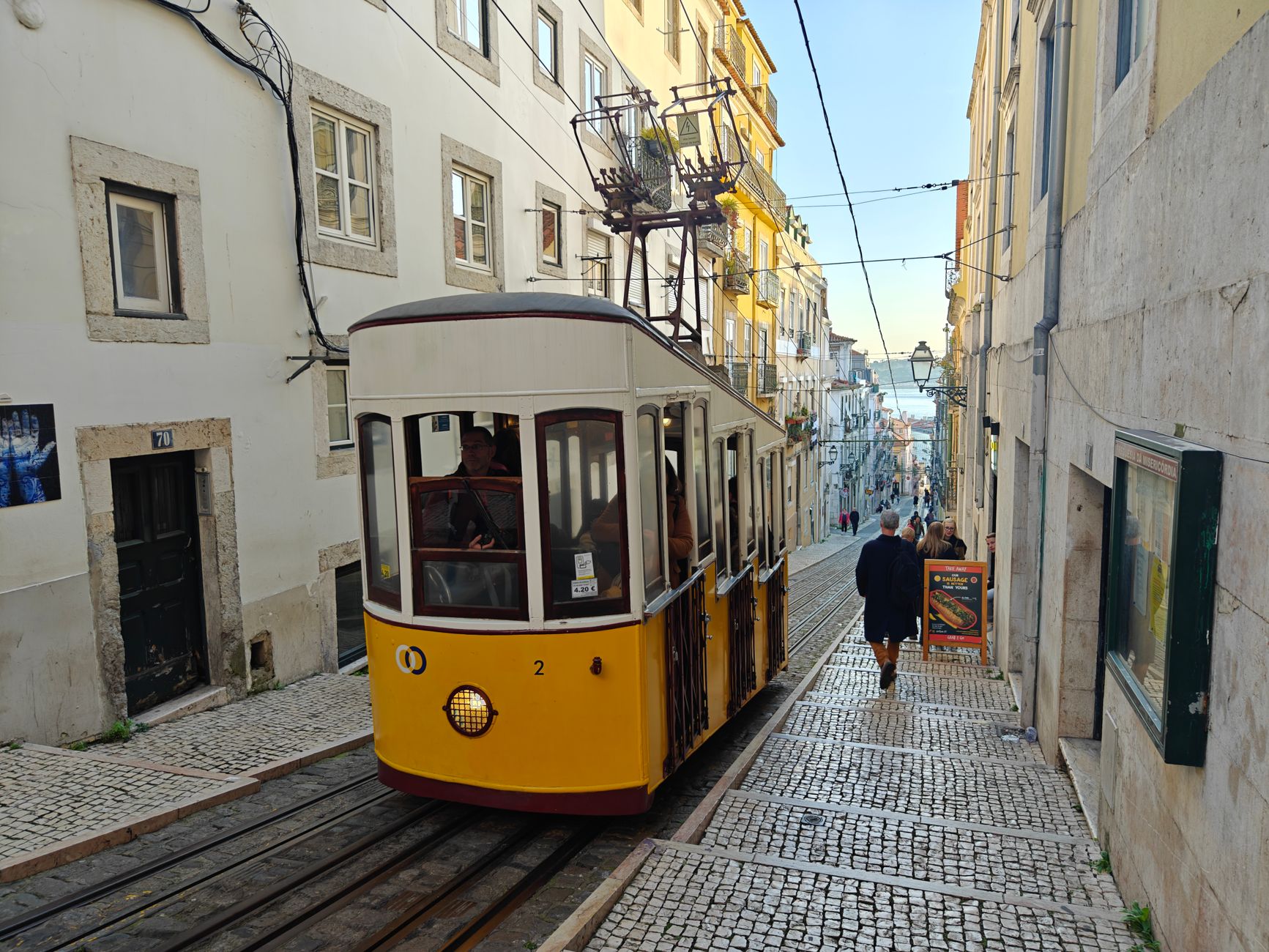
The second-most-touristed funicular, and arguably the most useful one. Glória climbs from Praça dos Restauradores — one of Lisbon’s main transport hubs — to Bairro Alto, ending directly at Miradouro de São Pedro de Alcântara, one of the city’s better viewpoints with a clear sight line straight across to the castle.
Glória opened on October 24, 1885, with fireworks and a crowd typical of the era. It’s Lisbon’s second-oldest funicular, also designed by Raoul Mesnier du Ponsard. Like the Bica, it started on a water-balance system, converted to steam, and was electrified in 1915. The current yellow carriages date from the 1920s. At a 17% gradient, it’s steeper than the Bica, which you feel in the ride. Classified as a National Monument in 2002 alongside the other ascensores.
- Where: Praça dos Restauradores (lower) to Rua São Pedro de Alcântara (upper)
- Length: 265–275 metres along Calçada da Glória
- Gradient: Average 17%
- Hours: 7 AM – midnight
- Cost: €4 round trip or included in day pass
The practical case for Glória is strong: if you’re heading from downtown to Bairro Alto and don’t want to climb the steep pedestrian streets, this is faster and uses a Viva Viagem card tap. The São Pedro de Alcântara viewpoint at the top has benches, decent city views, and a kiosk. It’s not the most spectacular miradouro in Lisbon — Portas do Sol and Santa Luzia in Alfama have better atmosphere — but arriving by funicular adds something a cable car to the top in other cities doesn’t have: the sense that this is a working machine serving a working city, not just a tourist ride.
Photography: The São Pedro de Alcântara viewpoint gives a clean shot across the valley to São Jorge Castle. Early morning or golden hour light falls well from this direction. The funicular itself is most photogenic on the Calçada da Glória — stand at the bottom of the slope and shoot up as the car approaches.
Nearby: At the top, you’re a short walk from the Solar do Vinho do Porto — a quiet wine bar run by the Port Wine Institute that pours hundreds of ports by the glass. It’s one of those places locals know and visitors walk past.
Elevador do Lavra
The least-touristed funicular and Lisbon’s oldest. Lavra opened on April 19, 1884 — the first funicular railway in the city — and has been running for over 140 years with only brief interruptions. Like its siblings, it was designed by Raoul Mesnier du Ponsard and started life as a water-balance funicular before conversion to steam, then electricity in 1915. National Monument status since 2002.
Lavra connects Largo da Anunciada (a quiet street a short walk from Avenida da Liberdade) to Rua Câmara Pestana near the Jardim do Torel at the top. At 23%, it’s the steepest of the three funiculars — you notice the angle from the inside. On a weekday morning you may be the only non-local on board.
- Where: Largo da Anunciada (lower) to Rua Câmara Pestana (upper, near Jardim do Torel)
- Length: 188 metres
- Gradient: Average 23% — steepest of the three funiculars
- Cost: €4 round trip or included in day pass
- Worth riding for its industrial-design charm and almost-no-tourist atmosphere
The Torel garden at the top is genuinely lovely — small, quiet, with city views, a café, and almost no foot traffic compared to the major miradouros. It’s the kind of place Lisboetas use, not one that exists for visitors. Come here if you want a break from the Alfama viewpoint crowds.
Lavra is the least convenient of the four — the lower station is a short walk from the metro, and the upper garden is not on any major sightseeing circuit. That’s exactly why it’s worth going. The mechanical engineering is visible in the station and the car feels older, heavier, more honest than the others. The station building at the bottom has an authentically faded tile-work aesthetic that the more touristed ascensores have long since polished away.
How to reach the lower station: From Avenida metro (blue line), walk north on Avenida da Liberdade for about 5 minutes, then turn left onto Rua Câmara Pestana — you’ll see the lower station at the foot of the slope.
Elevador de Santa Justa
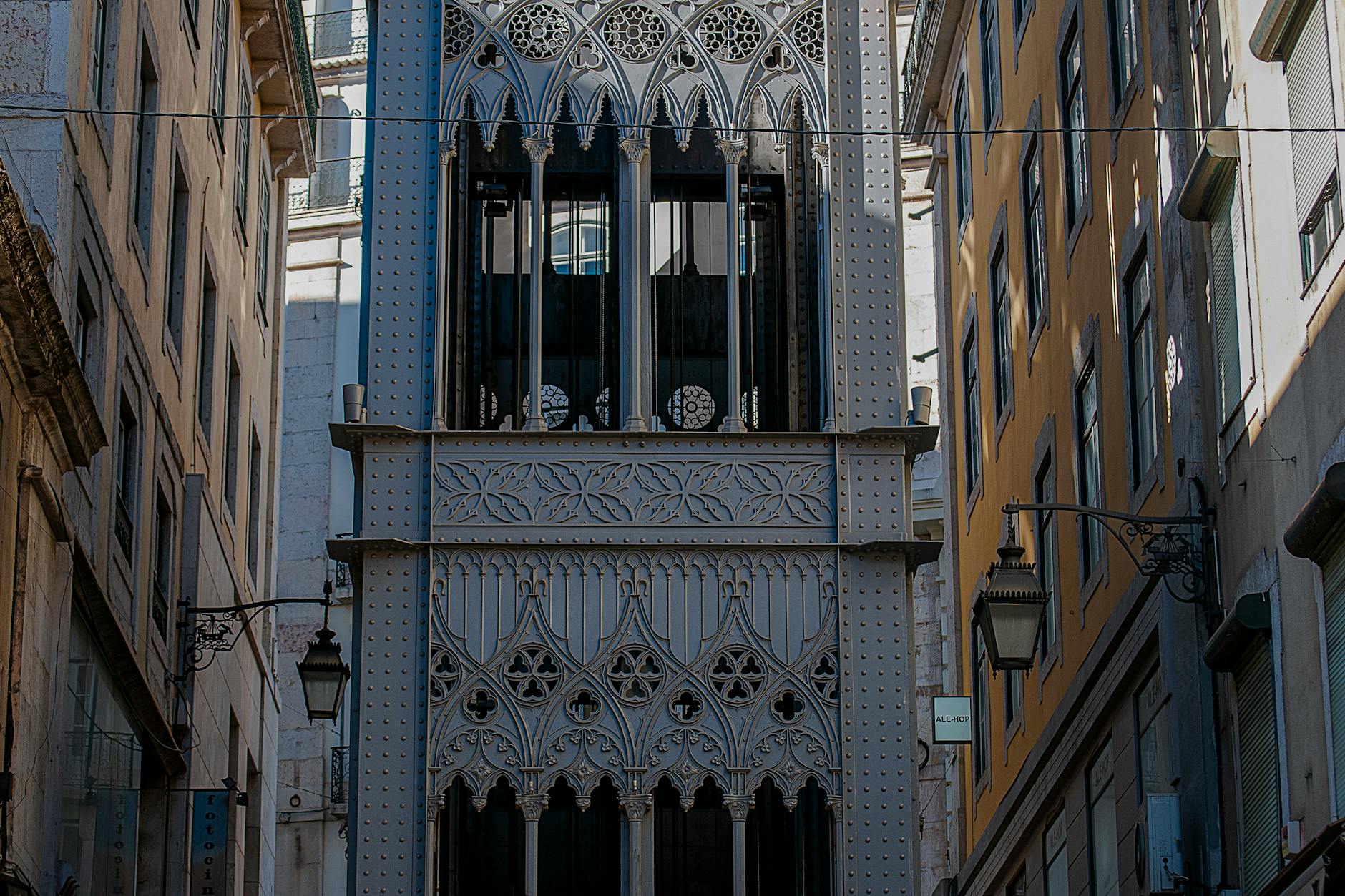
Lisbon’s only vertical elevator and a 1902 wrought-iron landmark — 45 metres of neo-Gothic iron that looks like it belongs in a steampunk novel. The elevator was designed by Raoul Mesnier du Ponsard (the same engineer behind all three funiculars), who studied under Gustave Eiffel. It was inaugurated on July 10, 1902 — over 3,000 tickets were sold on opening day despite a freak storm with torrential rain and lightning. Construction had started in 1900; King Carlos I opened the walkway and tower in August 1901, the lift itself the following July.
Originally steam-powered (pumping water into tanks beneath each cabin to create counterbalance), it transitioned to electricity in 1907. The current two polished wood cabins date from the early electric era. The exterior’s neo-Gothic arches and geometric ironwork are unlike anything else in the city — Eiffel’s aesthetic influence is visible even though Eiffel himself had no direct hand in this structure.
- Height: 45 metres
- Connects: Rua do Ouro (Baixa) to Largo do Carmo (Chiado)
- Designer: Raoul Mesnier du Ponsard, 1900–1902
Important 2026 note: The Elevador de Santa Justa is temporarily closed for refurbishment works as of 2026, with no confirmed reopening date. The observation/viewing deck at the top of the tower has also been closed for renovation. Before visiting, check the official page at visitlisboa.com or the operator carris.pt for current status.
When operating, the queue for Santa Justa is the longest of the four and moves slowly. Summer mornings can mean 30+ minutes. The smarter move — and still valid during the closure — is to walk to Largo do Carmo via Chiado (5 minutes from Baixa up Rua do Carmo) and enter the upper level. You get the platform view without the wait, and the Carmo Convent ruins (partially open-air, roofless since the 1755 earthquake) are worth a proper visit in their own right.
When the lift reopens: riding the elevator itself — the slow hydraulic lift, the iron lattice above you, the Baixa grid spreading out below — is an experience worth doing once. The upper walkway bridge connects to Largo do Carmo at roof level. On a clear day you can see across to the castle and south to the Tagus.
See our Santa Justa Elevator complete guide.
How to Pay
All four use the standard Carris transit system. Tap your Viva Viagem card at the boarding kiosk. Cash purchase available on funiculars (€4 round trip) but not Santa Justa (when operating).
The 24-hour Viva Viagem day pass (€7.25) covers all four plus all metro, tram, and bus rides — the best value if you’ll ride more than two and use any other public transit during the day. For current fares and timetables, check carris.pt.
The Viva Viagem card itself costs €0.50 and is reloadable. Buy at any metro station. You can load individual trips or the day pass onto the same card. If you’re using the metro at all during your stay, you’ll want the card anyway — the funiculars are essentially free at that point.
Accessibility
The three funiculars have limited accessibility — the cars have steps at the entrance, and the stations are on steep grades with no ramp alternatives. If you have reduced mobility, the funicular cars themselves are difficult to board. The upper stations similarly involve cobblestone approaches.
The Santa Justa Elevator (when operating) is more accessible — the lift itself has flat entry and the cabins are spacious. That said, the immediate surroundings (Baixa streets, Largo do Carmo) involve some uneven surfaces. The upper walkway bridge is flat once you exit the cabin.
For any specific accessibility requirements, contact Carris directly via carris.pt.
Best to Ride First
- Elevador da Bica — most iconic; the first one to ride if pressed for time
- Elevador da Glória — second-best; ends at a beautiful viewpoint
- Elevador de Santa Justa — different experience (vertical lift), worth riding once when it reopens; check status before visiting in 2026
- Elevador do Lavra — for return visitors and completionists
Practical Notes on Timing
All four funiculars run less frequently in the evenings and on Sundays. The published timetables are on carris.pt but the practical advice is: for the Bica and Glória, go between 9 AM and 6 PM on a weekday if you want smooth access. The Lavra has lighter traffic at any time. Santa Justa queues (when it reopens) are worst between 10 AM and 2 PM in summer — go early morning or after 5 PM.
Breakdowns are not unusual. All four ascensores are old machines running steep grades in a humid coastal city. If one is closed when you arrive, check the others — they operate independently and it’s rare for more than one to be down at once. Closures for maintenance are announced on carris.pt.
Photography Tips
The Bica funicular is most photogenic from the bottom looking up — the yellow car framed by buildings, with the Tagus visible at the top of the climb. Best light is early morning (8–10 AM) before tourist crowds. Photographers stake out the position from below the bottom station.
For Santa Justa (exterior photography still worthwhile even during the closure), the best shots are from Rua Áurea looking up through the wrought-iron lattice. Best with low afternoon sun. The tower appears in background shots from Largo do Carmo — useful for context without queuing.
The Glória’s São Pedro de Alcântara viewpoint gives a clean shot across the valley to São Jorge Castle. Early morning or golden hour works best from this direction.
How the Funiculars Fit into the Wider Transport Network
The funiculars are part of Carris’s city-wide network that also includes Tram 28, the Belém trams, and dozens of bus lines. They’re not tourist rides grafted onto the transport system — they’re the transport system in neighborhoods where buses can’t climb the grades. Locals use them daily.
If you’re already using the metro and trams, the funiculars add almost nothing to your daily transport cost. If you’re relying on taxis and Ubers, a Viva Viagem day pass will save you money and give you access to everything. See our Transportation Guide pillar for the full picture, our complete metro guide, and our guide to riding Lisbon’s trams.
FAQ: Lisbon Funiculars
What’s the difference between a funicular and an elevator?
A funicular is a cable-driven railway with two cars that counterbalance each other on parallel tracks. An elevator is a vertical lift. Lisbon has 3 funiculars and 1 elevator.
How much does a funicular cost?
€4 round trip with cash, or €1.80 with Viva Viagem card. Free with the 24-hour day pass (€7.25).
Are the funiculars worth riding?
Yes — they’re working public transit but also charming small attractions. The Bica especially is one of Lisbon’s most iconic experiences, and the ride itself (245 meters up a steep street) is genuinely fun.
Are funiculars wheelchair accessible?
Limited. The funicular cars have steps; the upper/lower stations involve steep cobblestone approaches. Santa Justa Elevator is more accessible when operating.
Which Lisbon funicular is best?
For the photo and the experience, Elevador da Bica. For practical transport with a good payoff (viewpoint), Elevador da Glória. For something no other tourist has seen, Elevador do Lavra.
Can I walk instead of taking the funiculars?
Yes — there are always steep pedestrian alternatives. The funiculars save a hard climb and cost less than €2 with a Viva Viagem card. Walking the alternative routes is interesting in its own right, especially around the Bica neighborhood.
Is the Santa Justa queue worth it?
The lift itself is worth riding once when it reopens. As of 2026 it is temporarily closed for refurbishment — check visitlisboa.com or carris.pt for current status before visiting.
Is the Santa Justa observation deck open in 2026?
No. The observation/viewing deck at the top of Santa Justa is closed for renovation in 2026 with no confirmed reopening date. The elevator itself is also temporarily closed. Check the official pages above for updates.
Who designed the Santa Justa Elevator?
Raoul Mesnier du Ponsard, a Portuguese engineer who studied under Gustave Eiffel. He designed all four of Lisbon’s historic ascensores.
Bottom Line
Ride Elevador da Bica for the iconic photo, Elevador da Glória for practical Bairro Alto access plus a viewpoint, Elevador de Santa Justa for the 1902 wrought-iron experience (when it reopens — check status in 2026), and Elevador do Lavra for a genuine local moment with almost no tourist competition. Use a Viva Viagem 24-hour pass to ride them all included with metro, tram, and bus.
The funiculars are a transport network that happens to be a century old, and the ticket that covers them covers everything else too. The transportation pillar explains the passes, the metro guide and tram guide cover the rest of the same Viva Viagem card, and the airport guide is where most people buy their first one.