Landmarks & Monuments
Carmo Convent: The Roofless Ruin Above Chiado
The EUR7 ticket, the Sunday closure, what happened here in 1755 and again in 1974, and the EUR1.80 trick that gets you the Santa Justa view with no queue.
In this guide
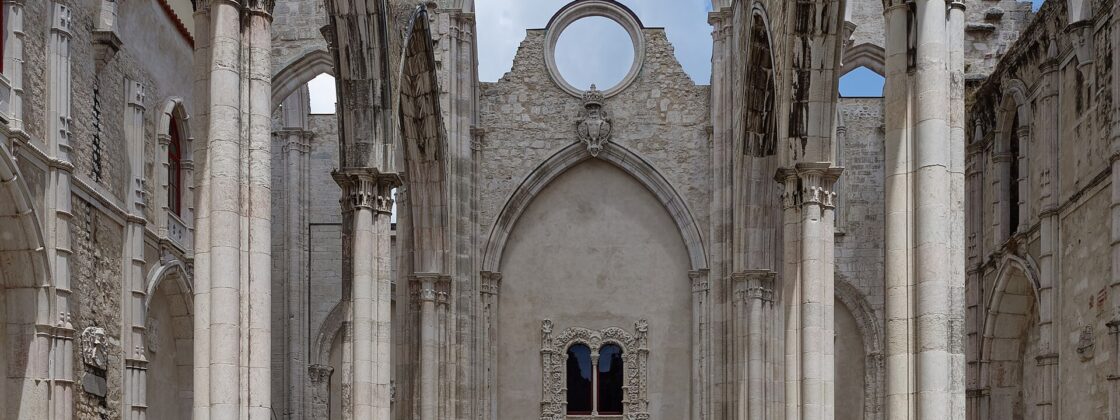
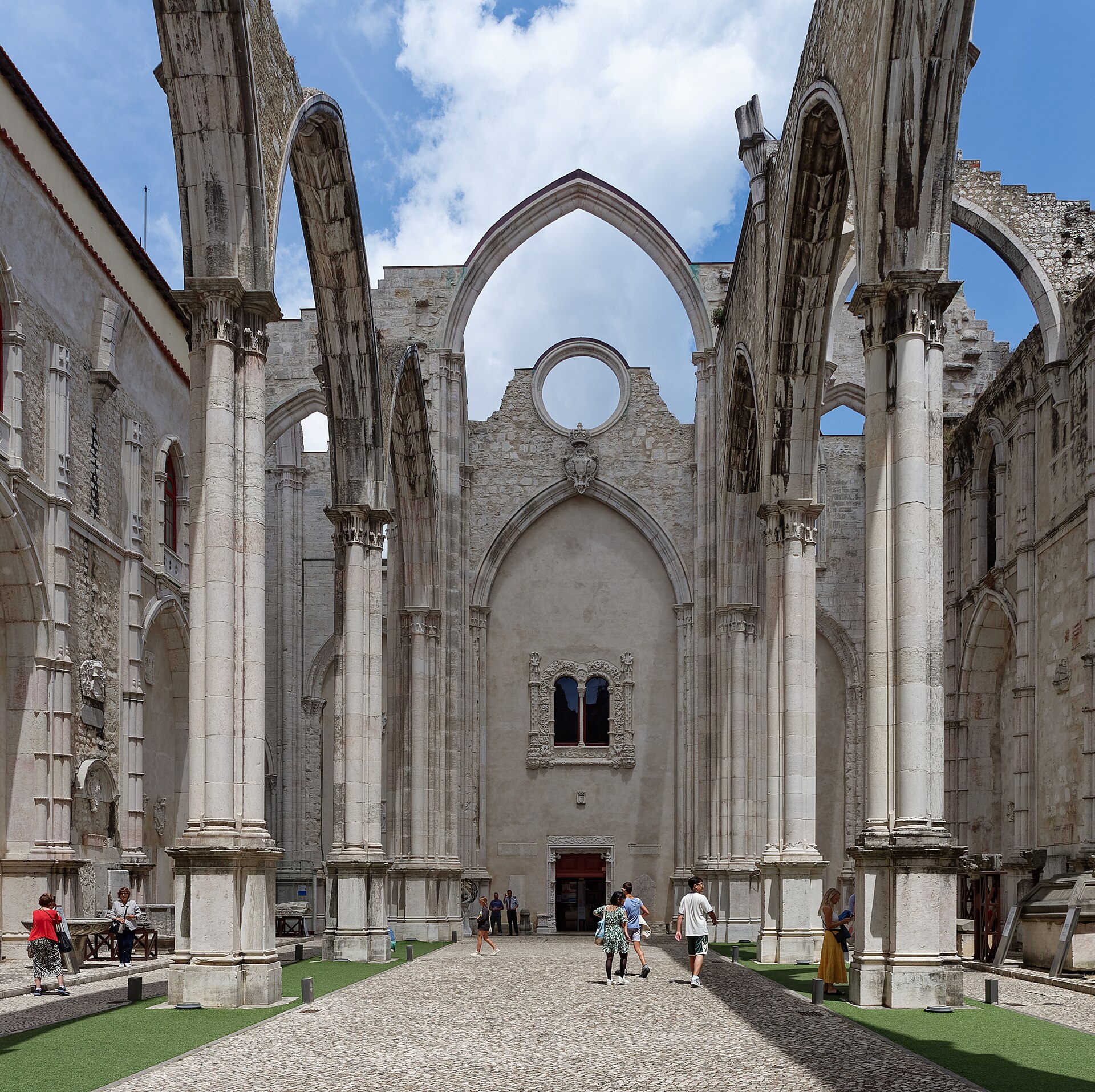
The Carmo Convent is a Gothic church with no roof, standing in the middle of Chiado exactly as the 1755 earthquake left it. Its arches frame open sky. Grass grows between the paving. It is the most affecting place in Lisbon, it costs €7, and it takes an hour.
The Carmo is the earthquake’s actual ruin; the explanation of what caused it is down in Belém at the Quake museum, which we compare directly with a €7 ticket to these arches.
This guide covers the ticket, the opening hours and the Sunday closure, what happened here on the morning of 1 November 1755 and again on the afternoon of 25 April 1974, what is inside the archaeological museum at the east end — including the two mummies nobody warns you about — and how to combine it with the free viewpoint next door.
Tickets and hours
- Adult: €7
- Students with ID, over-65s with ID, and Lisboa Card holders: €5
- November to April: Monday to Saturday, 10:00–18:00, last entry 17:40
- May to October: Monday to Saturday, 10:00–19:00, last entry 18:40
- Closed: Sundays, 1 January, 1 May and 25 December
- Payment: cash in euros, debit and credit cards, or MB Way
Take the Sunday closure seriously. Unlike most Lisbon monuments, which close on Mondays, the Carmo closes on Sundays — so a weekend visitor who plans the Sé for Saturday and the Carmo for Sunday will find both shut on the wrong day. If you have one weekend, do the Carmo on the Saturday and the cathedral too.
No booking is needed and there is rarely a queue longer than a few minutes at the desk.
What happened here
1 November 1755
The Convento do Carmo was founded in 1389 by Nuno Álvares Pereira, the general who had won the battle of Aljubarrota against Castile four years earlier and who later gave away his fortune and entered the order as a lay brother. By the eighteenth century it was the largest Gothic church in Lisbon.
All Saints’ Day 1755 fell on a Saturday. The church was full for morning mass, candles lit throughout, when the first shock struck at about 09:40. The vault came down on the congregation. The fire that swept the city afterwards took what was left of the timber and the fittings.
Reconstruction was begun and then abandoned. In the nineteenth century the decision was taken to stabilise the ruin and leave it, and that decision is the reason the building is worth visiting: everything else in central Lisbon was rebuilt in Pombaline regularity, and this is the one place where the event itself is still visible. Our 1755 earthquake guide gives the wider context; this building is the evidence.
25 April 1974
Largo do Carmo, the square outside, has a second date attached to it. On the afternoon of the Carnation Revolution, Marcelo Caetano — the last prime minister of the Estado Novo — was holed up in the National Republican Guard barracks on this square. Crowds filled the square. Captain Salgueiro Maia took the surrender here, and the regime that had run Portugal for 48 years ended on this cobbled slope, in front of the ruined church.
There is a plaque, and it is easy to miss. Stand in the square for a minute before you go in.
Inside the ruin
You enter through the west door into what was the nave. Five bays of pointed arches survive, springing from clustered columns, with nothing above them. The apse chapels at the east end kept their vaults and now house the museum.
The effect is hard to describe and easy to underrate from photographs. It is a large Gothic interior with weather in it — swallows, sun, occasionally rain — and the contrast between the formality of the architecture and the openness above it does something no intact church manages. Sit on one of the benches along the north side for five minutes rather than walking straight through.
The Museu Arqueológico do Carmo
The archaeological museum occupies the surviving chapels and is one of the odder collections in Portugal, assembled from the 1860s by the Association of Portuguese Archaeologists on a principle best described as accumulation. It runs, roughly chronologically and very loosely, from prehistory to the nineteenth century.
What is worth finding:
- The two Peruvian mummies, in glass cases, brought back in the nineteenth century and displayed with a matter-of-factness that catches everyone off guard. Small children find them fascinating; be aware if yours will not.
- The Egyptian material, including a sarcophagus — again, in a Gothic ruin in Lisbon, with no particular explanation offered.
- Visigothic and Roman stonework, including inscriptions and column capitals recovered from around the country.
- Medieval royal tombs, notably that of Fernando I, moved here after the dissolution of the monasteries.
- Azulejo panels and architectural fragments salvaged from buildings demolished across Lisbon.
It is not a well-organised museum by modern standards, and the labelling is thin in places. That is part of the charm: it feels like a nineteenth-century cabinet of curiosities that nobody has had the heart to rationalise.
What the building was before
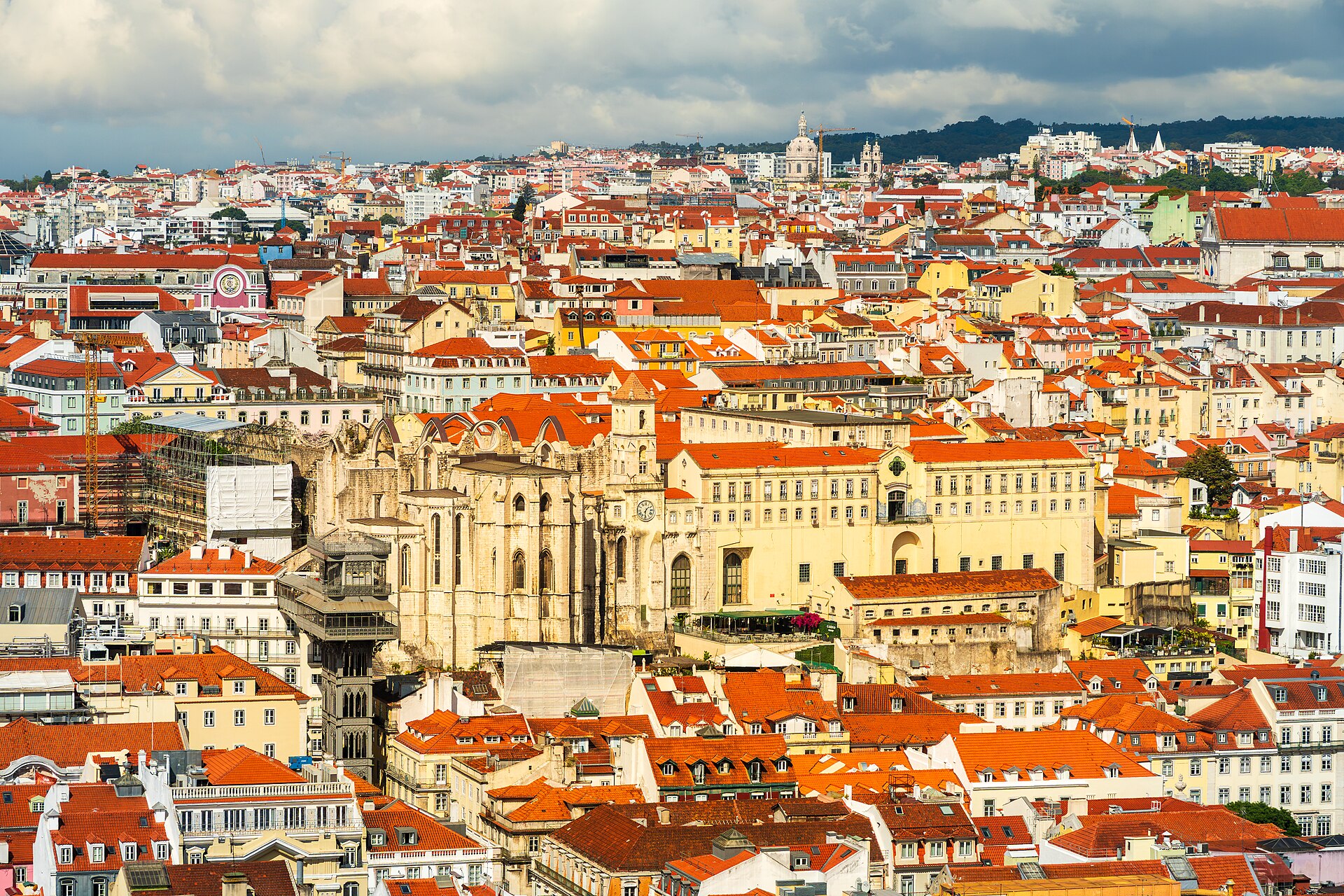
It helps to know what you are looking at the ruin of. The Carmelite convent complex was one of the largest religious foundations in medieval Lisbon: the church you stand in, a cloister, a chapter house, dormitories and a library, occupying most of the hill above the Baixa. The church alone was around 70 metres long, which put it in the same league as the cathedral.
The architecture is Portuguese Gothic in its plainer register — no flying buttresses, no elaborate tracery, but well-proportioned arcades and the tall clustered piers that carry them. What survives above the arcade line on the north side gives you the height the vault reached, and the rose window in the west front, now empty of glass, tells you the rest.
After the earthquake the surviving conventual buildings were taken over by the military; the National Republican Guard barracks that Marcelo Caetano surrendered from in 1974 stand on the old convent land, which is why the two dates attach to the same address. The Association of Portuguese Archaeologists took on the ruined church in 1864 and has run it ever since.
The nineteenth-century restorations
The ruin you see is not quite untouched. The arcades were reinforced with steel ties in places, the west front was consolidated, and the apse chapels were roofed and glazed to house the collection. Twentieth-century work added the paved central path and the drainage that stops the nave flooding. It is a stabilised ruin rather than a preserved one — but the decision was consistently to hold the building at the moment of collapse rather than to complete it, and the effect is unaltered.
The Santa Justa connection
Here is the single most useful practical fact on this page, and it saves you money and about forty minutes of queueing.
The Santa Justa Elevator connects the Baixa to Largo do Carmo. Its viewing platform sits at the top, and the queue to ride up from the Baixa side regularly runs 45 minutes or more for a ticket costing €5.50 return. But you can walk into Largo do Carmo from Chiado on the level, and reach that same viewing platform from the top for €1.80 — no queue at all.
So the sensible order is: walk up through Chiado, do the Carmo Convent, then step out into the square and go up to the Santa Justa platform for €1.80. You get the ruin, the view and the ironwork, and you have skipped the worst queue in central Lisbon. Our Santa Justa Elevator guide has the detail.
Is it worth €7?
Yes, and we would go further: at €7 the Carmo is the best-value ticket in Lisbon. Compare it with €21 for Jerónimos, €15 for São Jorge Castle and €15 for Belém Tower. It is a third of the price and, for many visitors, the more memorable hour.
Who should skip it: nobody, really, unless you have a single day in Lisbon and no time for anything beyond Belém. It is central, it is cheap, it is quick, and it is unlike anything else in the city. Our landmarks and monuments guide ranks it second on value behind only São Roque, which is free.
One honest caveat: if ruined buildings and a slightly chaotic small museum do not appeal to you at all, this is a twenty-minute visit rather than an hour, and you may come away thinking €7 was a lot for a roofless room. Most people do not. But it is fair to say the appeal is atmospheric rather than spectacular.
Getting there and what to pair it with
Largo do Carmo is in Chiado, a five-minute walk from Rossio or from Chiado metro station on the green and blue lines. From the Baixa, either climb the stepped streets or take the Santa Justa Elevator — see above for why you should walk.
Within ten minutes on foot:
- Igreja de São Roque, up in the Bairro Alto. Free, and the perfect counterpoint: São Roque shows you what pre-earthquake Lisbon looked like, the Carmo shows you what happened to it.
- The Miradouro de São Pedro de Alcântara, free, at the top of the Glória funicular.
- Chiado proper — Livraria Bertrand, A Brasileira, the shops on Rua Garrett. Our Bairro Alto and Chiado guide covers the neighbourhood.
- The Baixa grid and Praça do Comércio, downhill.
Hours and what to look at in the eight chapels: our Igreja de São Roque guide.
Practical notes
Weather
This is an outdoor site in all but name. The nave has no roof, there is very little shade, and the paving is uneven. In July and August the middle of the day is hot and unshaded; in a winter downpour the nave empties and the museum chapels become the only shelter. The best conditions are a bright morning in spring or autumn. Our month-by-month weather guide has the seasonal picture.
Photography
Permitted throughout. The nave is a hard exposure — bright sky through the arches, dark stone below — so meter for the stone and let the sky blow out slightly, or come on a lightly overcast day when the range is narrower. Mid-morning light comes in from the south-east and rakes across the columns, which is when the arches read best.
Accessibility
Better than most Lisbon monuments. The nave is on one level with a paved central path, and the museum chapels at the east end are reached without steps. The approach through Chiado is the difficult part — the streets around Largo do Carmo are steep and cobbled from most directions, though the route in from Rua Garrett is the flattest. See our accessibility guide.
How long to allow
An hour: twenty minutes in the nave, thirty in the museum, ten sitting down. Add another twenty if you go up to the Santa Justa platform afterwards.
With children
It works well. The ruin is safe and open, there is room to walk about, and the mummies are the kind of thing children remember from a trip. It is short enough not to exhaust anyone. See our Lisbon with kids itinerary.
Best time of day
Mid-morning, shortly after opening at 10:00, when the light is good and the Chiado walking tours have not yet arrived. The second-best window is the last hour before closing, which is quiet but flatter for photographs. Avoid 12:00 to 14:00 in summer — the nave is unshaded and it is the busiest stretch of the day.
Evening events
The ruin is used occasionally for concerts and open-air screenings in summer, when the nave is lit and the effect is genuinely striking. These are advertised locally rather than internationally, so check the museum’s own site or the festivals and events calendar if you are in Lisbon between June and September.
Frequently asked questions
How much does the Carmo Convent cost?
€7 for adults, €5 for students and over-65s with ID, and €5 with a Lisboa Card. Payment by cash, card or MB Way.
What are the opening hours?
Monday to Saturday, 10:00–18:00 from November to April and 10:00–19:00 from May to October, with last entry twenty minutes before closing. Closed on Sundays, and on 1 January, 1 May and 25 December.
Why does the Carmo Convent have no roof?
The vault collapsed during the earthquake of 1 November 1755, while the church was full for All Saints’ Day mass. Reconstruction was started and abandoned, and in the nineteenth century the ruin was stabilised and deliberately left as it stood.
How long does a visit take?
About an hour, including the archaeological museum in the surviving apse chapels.
Is the Carmo Convent the same as the Santa Justa Elevator?
No, but they are next to each other. The elevator’s upper walkway comes out into Largo do Carmo, the square where the convent stands. You can reach the elevator’s viewing platform from that side for €1.80 rather than €5.50 from the Baixa, with no queue.
Are there really mummies inside?
Yes — two Peruvian mummies in glass cases in the archaeological museum, along with an Egyptian sarcophagus. They arrived in the nineteenth century when the collection was being assembled and have stayed ever since.
Is it worth visiting in the rain?
Less so. The nave is open to the sky and there is almost nowhere to shelter, so heavy rain makes the main experience unpleasant. The museum chapels stay dry, but they are the smaller half of the visit.
Bottom Line
The Carmo Convent is €7 for the best hour in central Lisbon. Go on a bright morning, sit down in the nave for a few minutes rather than walking straight through, find the mummies, and read the plaque in the square outside about the day the dictatorship ended there.
Then walk out into Largo do Carmo and take the €1.80 walk-up to the Santa Justa platform instead of joining the queue at the bottom. That combination — ruin, revolution and view, for under €9 — is the best-value morning the city offers. Just do not come on a Sunday.