Landmarks & Monuments
Basílica da Estrela and Jardim da Estrela
A queen's vow, a marble dome, a 500-figure nativity scene and the best garden in Lisbon — all free or nearly free, and all with no queue.
In this guide
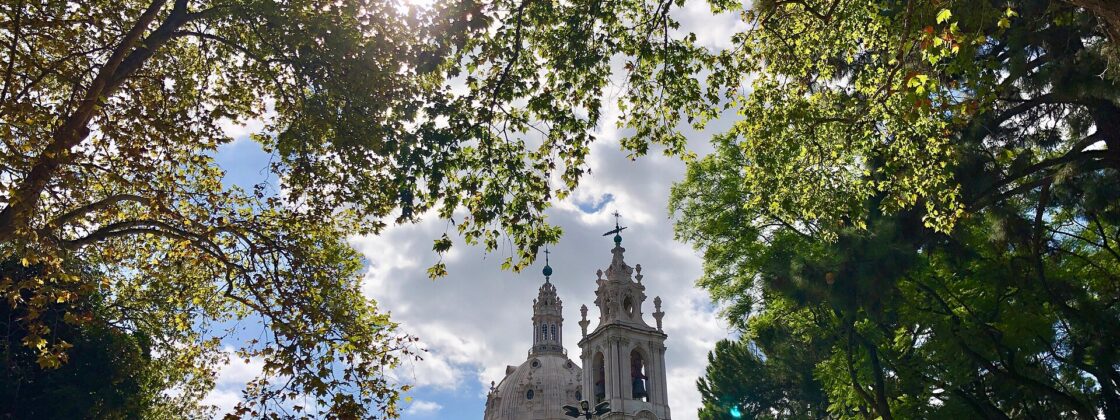
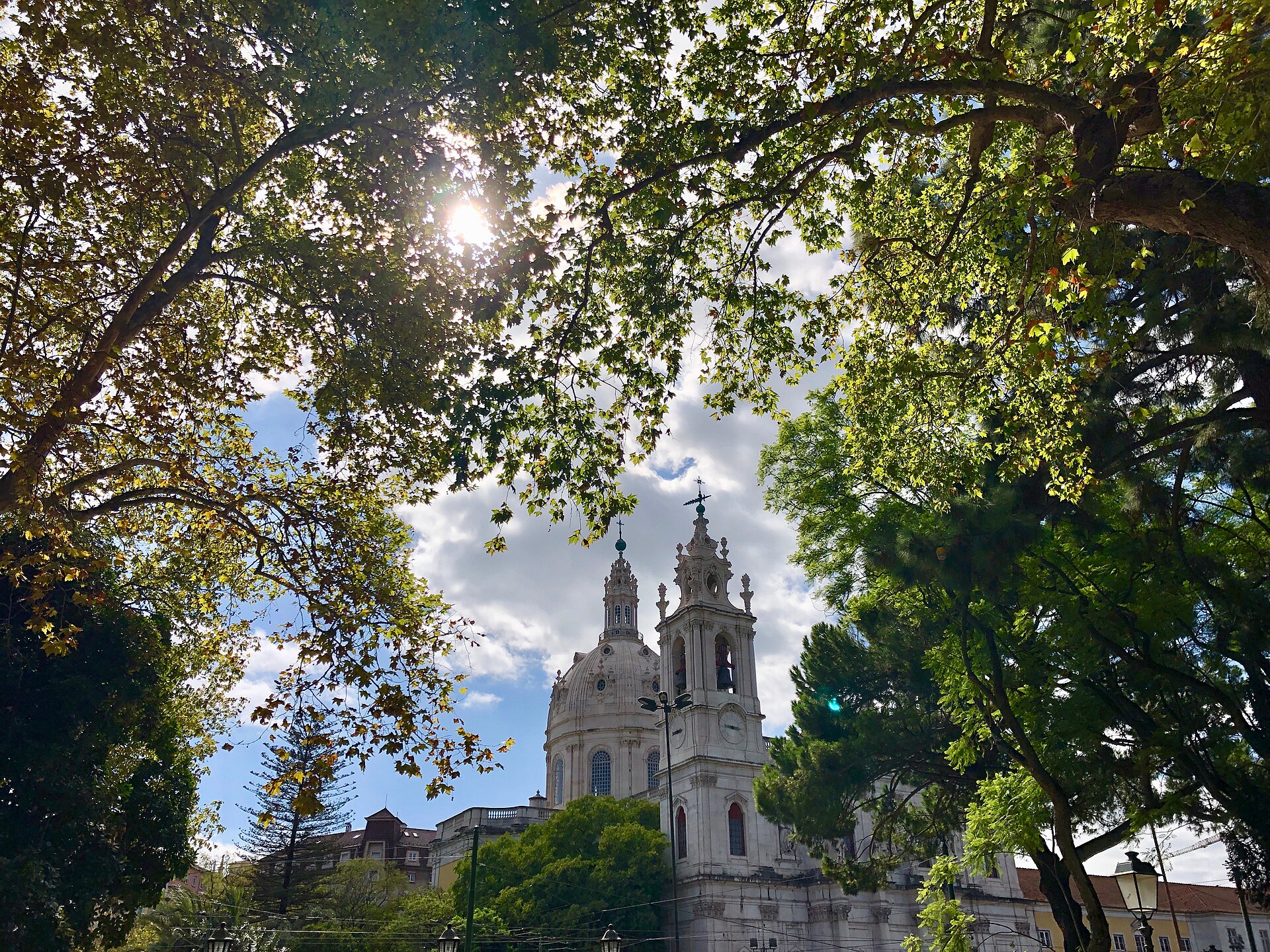
The Basílica da Estrela is the great white dome you keep seeing on the skyline from every miradouro on the other side of the city, and almost nobody walks up to it. That is the point of this page. It is free to enter, it has one of the finest interiors in Lisbon, it has a roof terrace with a view most visitors never get, and directly opposite it is the best public garden in the city. Together they make an easy, unhurried half-day in a part of Lisbon that has no queues at all.
The essentials
- The church: free to enter.
- The roof terrace: a small charge, generally quoted at around €4–€5, with reductions. Published figures vary between sources, so take cash and check at the desk.
- The nativity scene (presépio): about €1.50, and open only on a restricted schedule — typically Tuesday to Saturday, late morning and mid-afternoon.
- Hours: the church keeps long daily hours, roughly from early morning to mid-evening, with a midday break reported at some periods. The terrace runs roughly 10:00 to 18:40.
- Getting there: tram 25 and 28 both stop at Estrela; buses run along Calçada da Estrela. Nearest metro is Rato, about 12 minutes’ walk.
- Time needed: 30–45 minutes inside, plus as long as you like in the garden.
Because the opening arrangements here are set by a working parish rather than a heritage body, they move around — feast days, weddings and funerals all close parts of the building at short notice. Treat the times above as a guide and the church’s own noticeboard as the authority.
The story behind it
The basilica exists because of a promise. Maria I, Portugal’s first queen regnant, vowed to build a church if she were granted a son and heir. She was — José, Prince of Brazil, born in 1761 — and construction began in 1779.
The building took eleven years and was completed in 1790. The prince did not live to see it: he died of smallpox in 1788, two years before the church that celebrated his birth was finished. There is no way to walk into this building knowing that and not feel it slightly.
Maria I is buried here, in a tomb on the right of the transept. Her later years were spent in a mental collapse that eventually made government impossible; the court fled to Brazil in 1807 ahead of Napoleon’s invasion and she died in Rio in 1816, her body returned to Lisbon and to the church she had built. It is a considerable amount of Portuguese history contained in one white building on a hill in Campo de Ourique.
What you are looking at
The architecture
The Estrela is late Baroque tipping into neoclassicism — the last major church built in Lisbon in the old manner, and a direct architectural descendant of the enormous basilica at Mafra, which Maria’s grandfather had put up half a century earlier. Twin bell towers flank a broad drum and dome, with statues of saints and allegorical figures ranged across the facade.
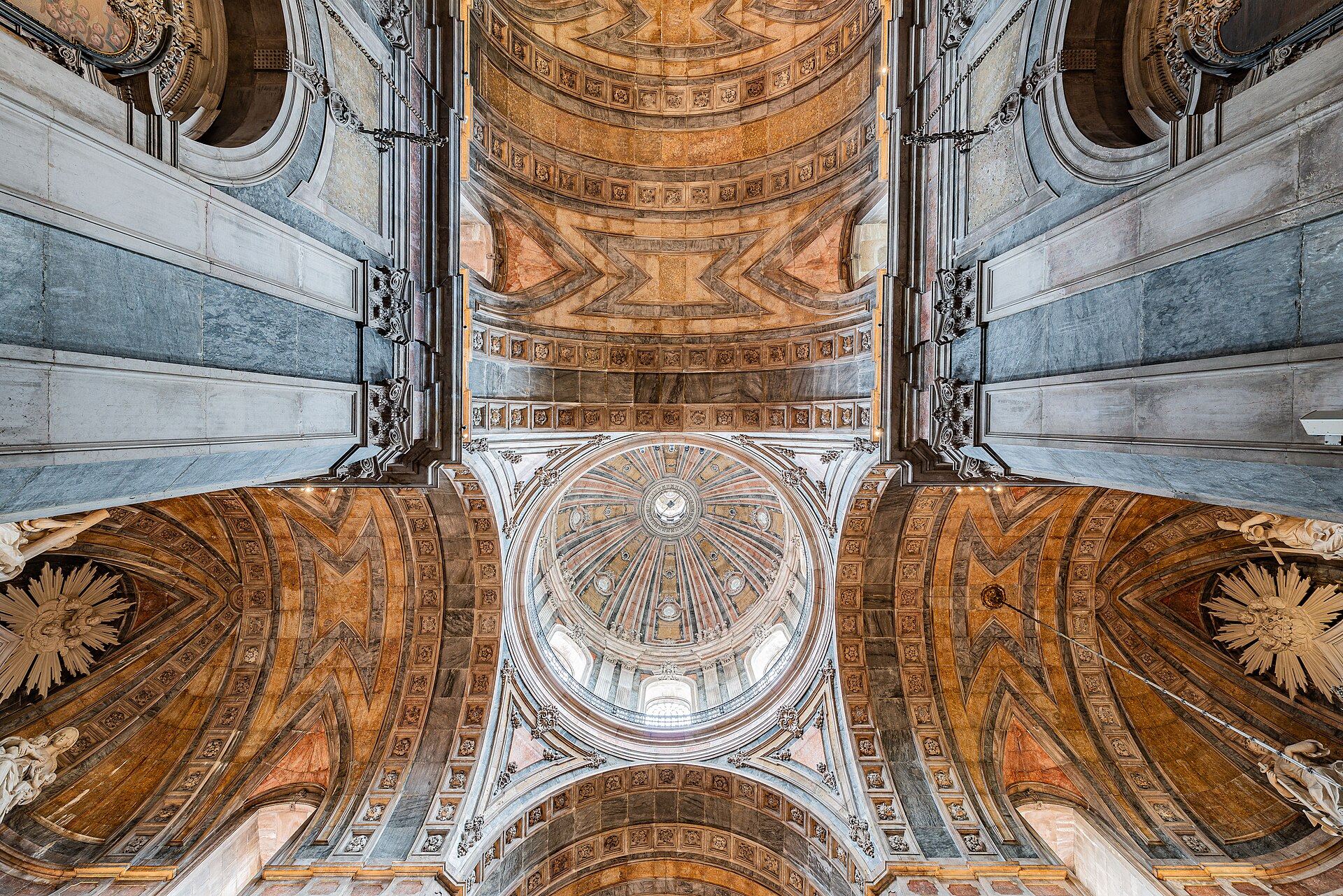
What makes the interior remarkable is the stone. The whole thing — walls, floor, pilasters, the entire vault — is faced in Portuguese marble in grey, rose, yellow and white, laid in geometric patterns that pull your eye down the nave and up into the dome. There is almost no gilding and very little paint. After the gold-drenched interiors of Lisbon’s other great churches, the effect is startlingly calm, and the dome from directly beneath it is one of the best things to look at in the city.
What else to look for inside
Beyond the dome and the presépio, three things repay a slow walk round the nave. The organ, in the choir above the entrance, is a substantial eighteenth-century instrument and is still used for concerts — worth checking the parish noticeboard, because hearing it in that marble acoustic is a different experience from looking at it.
The sculpture is unusually good for a Lisbon church of this date. Much of it came from the same workshops that supplied Mafra, and the saints ranged around the nave and across the facade are carved with a confidence that the building’s relative obscurity does not prepare you for.
And the light. The dome is pierced by windows at its base and the drum takes sun for most of the day, which means the marble changes colour depending on when you come. Late afternoon, when the west light hits the rose-coloured stone in the transept, is the best of it — and is also when the church is emptiest.
The presépio
The basilica’s treasure is an eighteenth-century nativity scene by Joaquim Machado de Castro, the sculptor responsible for the equestrian statue of José I in Praça do Comércio. It contains more than 500 figures in terracotta and cork — not just the holy family but an entire populated landscape of shepherds, animals, buildings and bystanders, arranged as a miniature world.
It is genuinely extraordinary and it is very easy to miss, because it is shown on a restricted schedule for a separate small charge and there is no great fanfare about it. If your visit falls on a day it is open, pay the €1.50. It is the single most interesting object in the building.
The roof terrace
You can climb to a walkway around the base of the dome. The stairs are narrow and there are a lot of them, and the reward is a 360-degree view over Campo de Ourique, Estrela, the Tagus and — on a clear day — right across to the far bank.
Honest assessment: this is not the best view in Lisbon, and it is not free like the miradouros. What it is, is a completely uncrowded one. You will frequently have it to yourself, which is not a sentence that can be written about Santa Justa or São Jorge. If you have already fought the crowds at the famous viewpoints, this is a pleasant corrective. See our miradouros guide for how it compares.
The Jardim da Estrela
Directly across the road is the garden, and for a lot of visitors it will be the better half of the visit.
Laid out in the 1840s in the English romantic manner, the Jardim da Estrela is Lisbon’s most complete nineteenth-century public park: mature subtropical planting, a duck pond with a small bridge, enormous fig and dragon trees, a wrought-iron bandstand moved here from Passeio Público, a decent café with tables under the trees, and a playground that is genuinely good by Lisbon standards.
It is also, crucially, flat — a rare and undervalued quality in this city — and full of Lisboetas rather than visitors. Old men playing cards, prams, dog walkers, students reading. If you have spent three days climbing staircases in Alfama, an hour here is exactly the right thing to do next.
Our free things to do in Lisbon page has more in this vein, and Lisbon with kids makes the case for the playground.
The English Cemetery, if you have another twenty minutes
A short walk from the basilica, behind an unmarked wall on Rua de São Jorge, is the Cemitério dos Ingleses — the Protestant burial ground established for Lisbon’s British merchant community. It is small, overgrown in the best way, cypress-shaded and almost silent.
Its famous occupant is Henry Fielding, author of Tom Jones, who came to Lisbon in 1754 hoping the climate would restore his health, died within two months of arriving, and is buried here under a tomb erected some years later. Opening hours are irregular and it is often necessary to ring the bell. If it is open, go in; if not, you have lost nothing.
Is it worth the trip?
Yes — with the honest caveat that the Basílica da Estrela is not a headline sight and you should not treat it as one. If you have two days in Lisbon, Jerónimos and the castle come first, and nobody who skips the Estrela has made a mistake.
Where it earns its place is on a third or fourth day, or on any day when you have had enough of queues. It costs nothing to enter, the interior is legitimately one of the two or three finest in the city, the terrace is empty, and the garden opposite is the best in Lisbon. As a two-hour block it is close to unbeatable value, and it takes you into a residential neighbourhood most visitors never reach.
How it compares:
- Versus the Panteão Nacional (€10): the Panteão’s dome terrace has the better view and costs more. The Estrela’s interior is warmer and the atmosphere less museum-like. If you only climb one dome, climb the Panteão’s; if you only enter one church, enter this one.
- Versus São Roque: São Roque is the gilt-and-marble jewel box and the more astonishing single room. The Estrela is the more impressive building.
- Versus the Sé: the Sé has the age and the location; the Estrela has the better interior by a distance and no admission charge.
- Versus Carmo (€7): completely different propositions — Carmo is a roofless ruin and a piece of earthquake history. Do both.
The neighbourhood around it
Estrela is worth understanding as a place rather than a single building. It sits on the ridge west of Bairro Alto, between Príncipe Real and Campo de Ourique, and it is one of the parts of central Lisbon that has stayed residential — embassies, nineteenth-century apartment blocks, a hospital, schools, and shops that sell things people actually need.
The practical consequence for a visitor is that prices here are Lisbon prices rather than tourist prices. A coffee at a counter near the basilica costs what it costs anywhere in Portugal; lunch in Campo de Ourique’s market hall, ten minutes uphill, is a fraction of what the same food would cost in Baixa. If you are in Lisbon for four days or more, an afternoon spent in this quarter tells you more about the city than another monument would.
Practical advice
- Combine it with tram 28. Estrela is on the route, near the western end, and it is the stop most day-trippers stay on the tram past. See our tram 28 guide.
- Dress appropriately. This is an active parish church, not a monument. Shoulders covered, hats off, quiet during services.
- Go on a weekday if you want the presépio and the terrace, since the restricted schedules make weekends unreliable.
- Bring a few euros in cash for the terrace and the presépio; card acceptance at the small desks is not guaranteed.
- Walk on to Campo de Ourique afterwards — ten minutes uphill, a genuinely residential neighbourhood with a good market hall and no tourists to speak of.
- Combine with Príncipe Real in the other direction for one of the better walking afternoons in the city. Our Príncipe Real guide covers that side.
Frequently asked questions
Is the Basílica da Estrela free?
Entry to the church is free. The roof terrace and the nativity scene each carry a small separate charge — around €4–€5 for the terrace and about €1.50 for the presépio, though published figures vary, so bring cash and check at the door.
Can you climb the dome at the Basílica da Estrela?
Yes. A narrow staircase leads to a walkway around the base of the dome, open roughly 10:00 to 18:40, for a small fee. The view takes in Campo de Ourique, Estrela and the Tagus, and you will often have it entirely to yourself.
Who is buried in the Basílica da Estrela?
Queen Maria I, who commissioned the church in fulfilment of a vow made before the birth of her son. She died in Rio de Janeiro in 1816 and her remains were returned to Lisbon. Her tomb is in the transept.
How do you get to the Basílica da Estrela?
Trams 25 and 28 both stop directly outside, buses run along Calçada da Estrela, and it is about a twelve-minute walk from Rato metro station. It is roughly 25 minutes on foot from Chiado, mostly uphill.
Is the Jardim da Estrela worth visiting?
It is the best public garden in central Lisbon and it is free. Flat, shaded, full of residents rather than visitors, with a duck pond, a bandstand, a good café and a proper playground. Visit it in the same trip as the basilica — they are directly opposite each other.
How long do you need at the Basílica da Estrela?
Half an hour for the church, forty-five minutes if you climb the terrace, and an hour more if you cross the road into the garden, which you should.
Bottom Line
The Basílica da Estrela is a queen’s promise to a son who died before it was finished, faced floor to dome in coloured Portuguese marble, containing a five-hundred-figure nativity scene by one of the country’s great sculptors — and it costs nothing to walk into.
It will not make anyone’s two-day Lisbon shortlist, and it should not. But if you have a third day, or if the queue at Jerónimos has broken your spirit, take the 28 to Estrela, spend half an hour under that dome, pay the few euros to go up to the roof, and then sit under the fig trees across the road with a coffee. It is one of the calmest good hours the city has.