Things to Do in Lisbon
Santa Justa Elevator: How to Visit (& Free Alternatives) (2026)
Visit the Santa Justa Elevator without long queues—history, tickets, the free Chiado entrance, and best photo angles.
In this guide
- Santa Justa Elevator at a Glance
- Tickets, Hours, and the Smart Entry Option
- The View from the Top
- The History
- Architectural Details
- Best Time to Visit
- Photography Tips
- Combining the Santa Justa Elevator with Nearby Sights
- Getting There
- Practical Tips
- Is the Santa Justa Elevator Worth It?
- FAQ: Santa Justa Elevator
- Bottom Line
The Santa Justa Elevator (Elevador de Santa Justa) is Lisbon’s only vertical lift and one of the city’s most distinctive landmarks — a 1902 wrought-iron tower designed by a student of Eiffel that connects the lower Baixa district to the upper Largo do Carmo. The viewing platform at the top offers one of central Lisbon’s best 360-degree panoramas.
The square at the top of the lift holds the best-value ticket in Lisbon. Our Carmo Convent guide covers the EUR7 ruin next door and how to combine it with the EUR1.80 walk-up to the viewing platform.
This guide covers everything: ticket prices, the free alternative, history, photography tips, and how to visit without losing an hour in a queue. Updated for 2026.
2026 closure note: As of mid-2026, the Santa Justa Elevator is temporarily closed for maintenance with no confirmed reopening date. Check carris.pt for the latest service status before visiting. The upper viewing platform, accessible from Largo do Carmo on the Chiado side, may have separate hours — see below.
Santa Justa Elevator at a Glance
- Where: Rua de Santa Justa, Baixa (lower entrance); Largo do Carmo, Chiado (upper entrance)
- Built: 1902 by Raoul Mesnier du Ponsard (a student of Gustave Eiffel)
- Height: 45 meters
- Operated by: Carris (Lisbon’s public transit company)
- Hours when open: 7 AM – 11 PM (summer); 7 AM – 9 PM (winter)
- Lift ticket: Around €6 round trip including viewing platform (verify at carris.pt for current pricing)
- Viewing platform only (Chiado side): Around €5 independently; 9 AM–9 PM; max 20 visitors at once
- Lisboa Card: Free entry when open
- Current status: Temporarily closed — check carris.pt before visiting
Tickets, Hours, and the Smart Entry Option
From the Baixa Side (Bottom Entrance)
The famous photogenic entrance from Rua de Santa Justa, Rua Áurea / Rua do Ouro. This is where most tourists queue. When the elevator is operating, the round-trip ticket including the viewing platform runs around €6. The queue can be 30–60 minutes during peak summer hours (10 AM–5 PM). Lisboa Card holders enter free.
From the Chiado Side (Upper Entrance — The Smarter Move)
Walk to Largo do Carmo from Chiado and you’ll find a small entrance to the elevator’s upper walkway bridge. From here, you can access the viewing platform independently of the lift ride for a lower fee — when operating, typically around €1.80 with a Viva Viagem transport card or slightly higher as a standalone ticket. This bypasses the Baixa-side queue entirely.
This is the smart move. Most tourists don’t know about it. The same panoramic view, no queue, lower cost. The Chiado-side approach also puts you right next to the Carmo Convent ruins — so you can combine both in one stop.
Is the Elevator on the Lisboa Card?
Yes — Lisboa Card holders enter free. The 72-hour card costs €62 and includes unlimited transit plus free entry to 50+ attractions. If you’re visiting the elevator alongside other ticketed sights, the card can more than pay for itself. Check visitlisboa.com for current Lisboa Card inclusions and to purchase.
The View from the Top
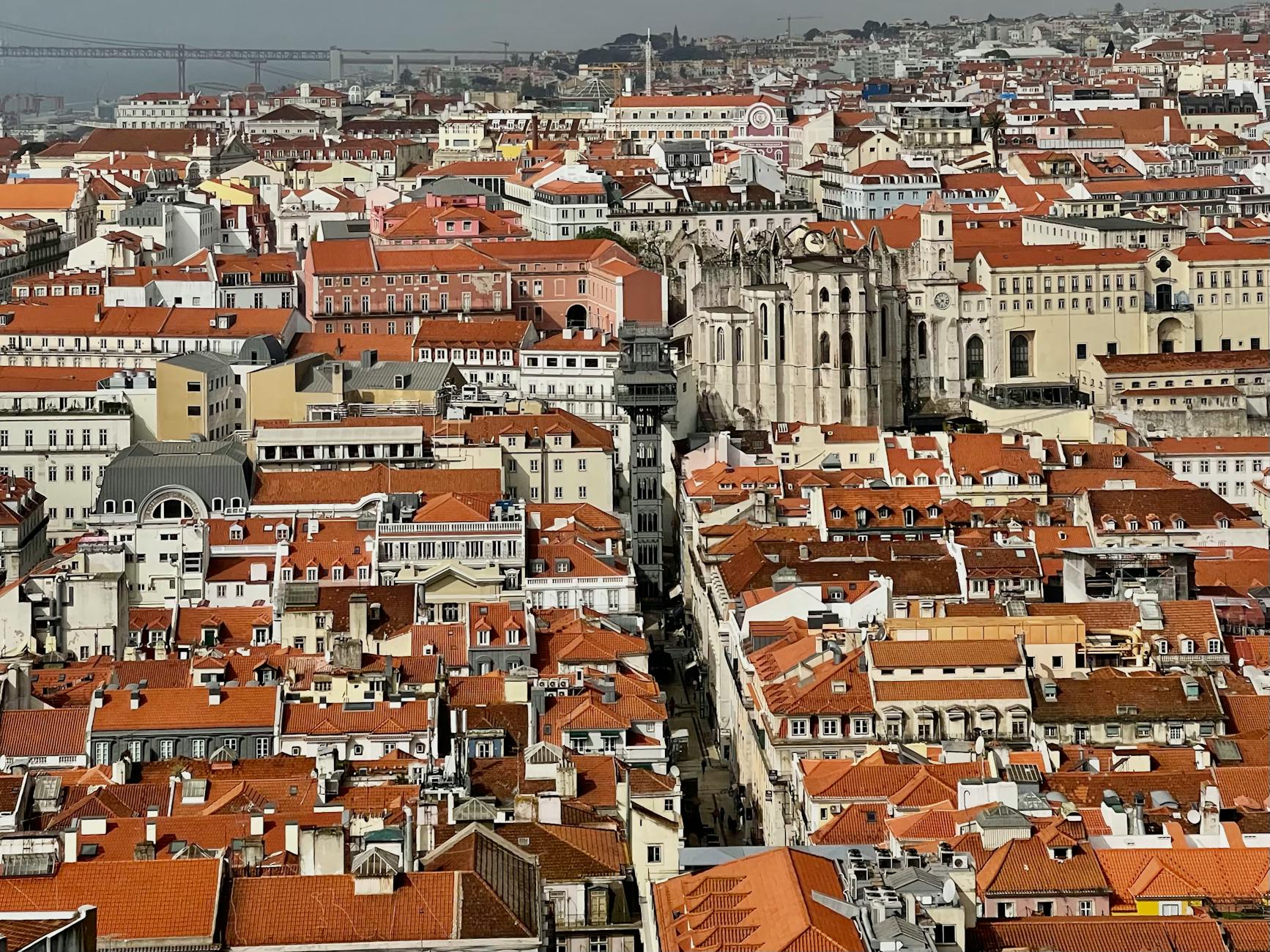
The 45-meter viewing platform offers a 360-degree panorama that’s hard to beat in central Lisbon:
- East: São Jorge Castle and Alfama’s layered rooftops climbing the hillside
- South: The Tagus River stretching to the horizon, the 25 de Abril Bridge visible on clear days
- West: Bairro Alto and Chiado, the dome of the Estrela Basilica beyond
- North: The ruins of the Carmo Convent directly adjacent — the roofless Gothic nave is dramatic from above
- Below: The entire Baixa grid, Pombal’s earthquake-resistant layout suddenly obvious from height
The eastern view toward São Jorge Castle is the most photographed. The southern view of the Tagus is the most dramatic at golden hour. Worth noting: the platform is small (maximum 20 visitors at once), so even when the elevator is busy, you typically get a few minutes with an unobstructed view before the next group arrives.
The History
The Santa Justa Elevator was built between 1900 and 1902 by Raoul Mesnier du Ponsard, a Portuguese architect of French origin who had studied under Gustave Eiffel in Paris. The influence is obvious in the wrought-iron lattice framework, the filigree decorative elements, and the sheer verticality of the structure — it looks, frankly, like a piece of the Eiffel Tower dropped into a Pombaline street grid.
Originally steam-powered when it opened in 1902; converted to electricity in 1907. The original name was Ascensor Ouro-Carmo, after the two streets it connected. The two wooden passenger cabins — still in service today — carry up to 24 passengers each. They are fitted with the original brass mechanisms and are among the oldest continuously operating wooden elevator cabins in Europe.
The elevator was built to solve a very specific Lisbon problem: the city sits on seven hills, and the gap between the flat Baixa grid below and the Chiado/Bairro Alto neighborhoods above is about 32 meters of vertical rock. Before the elevator, you walked up steep stairs or took a roundabout route. Carris, the city transit company, still operates it today and classifies it as a public transit route (line 54E).
Architectural Details
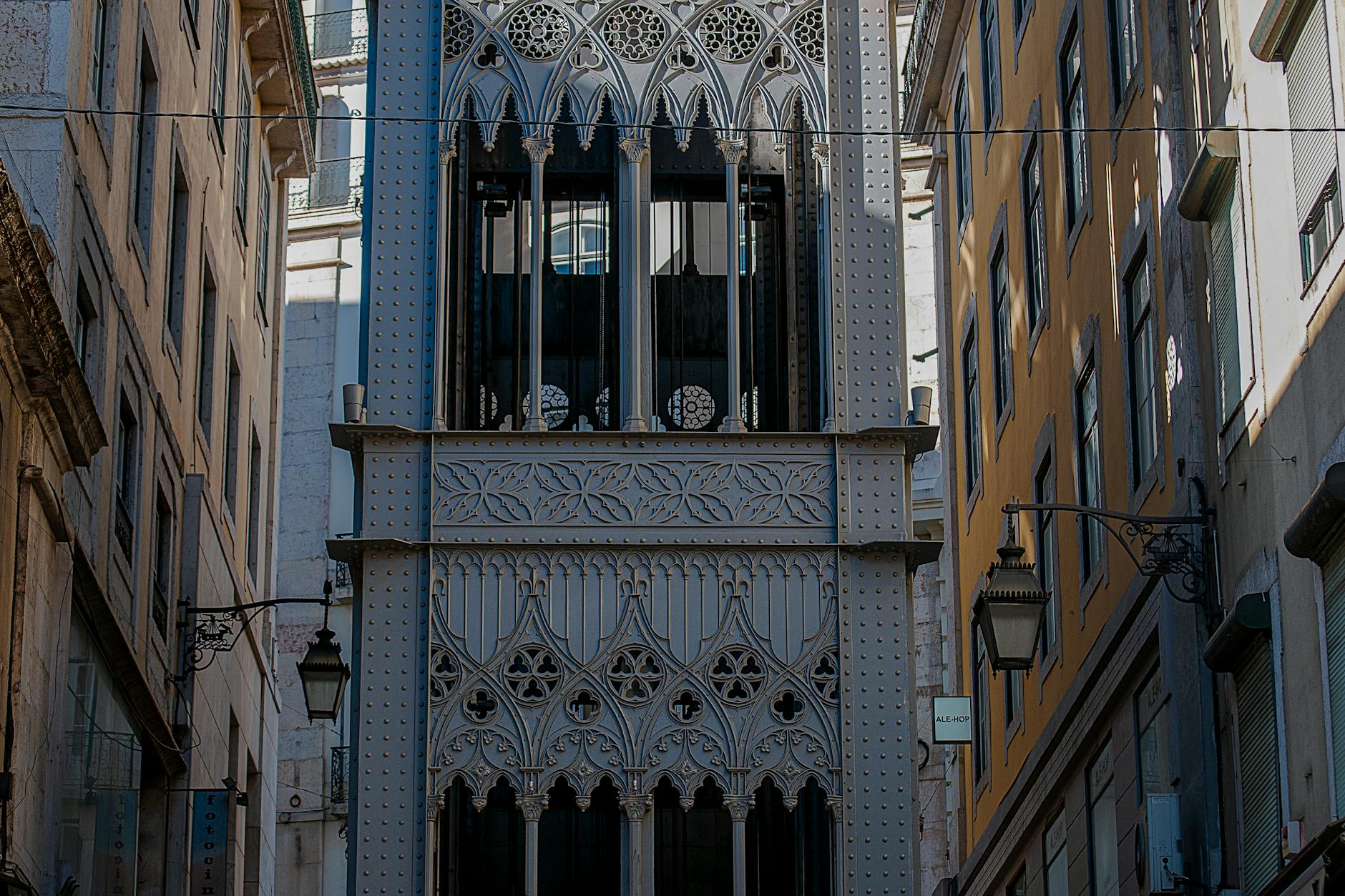
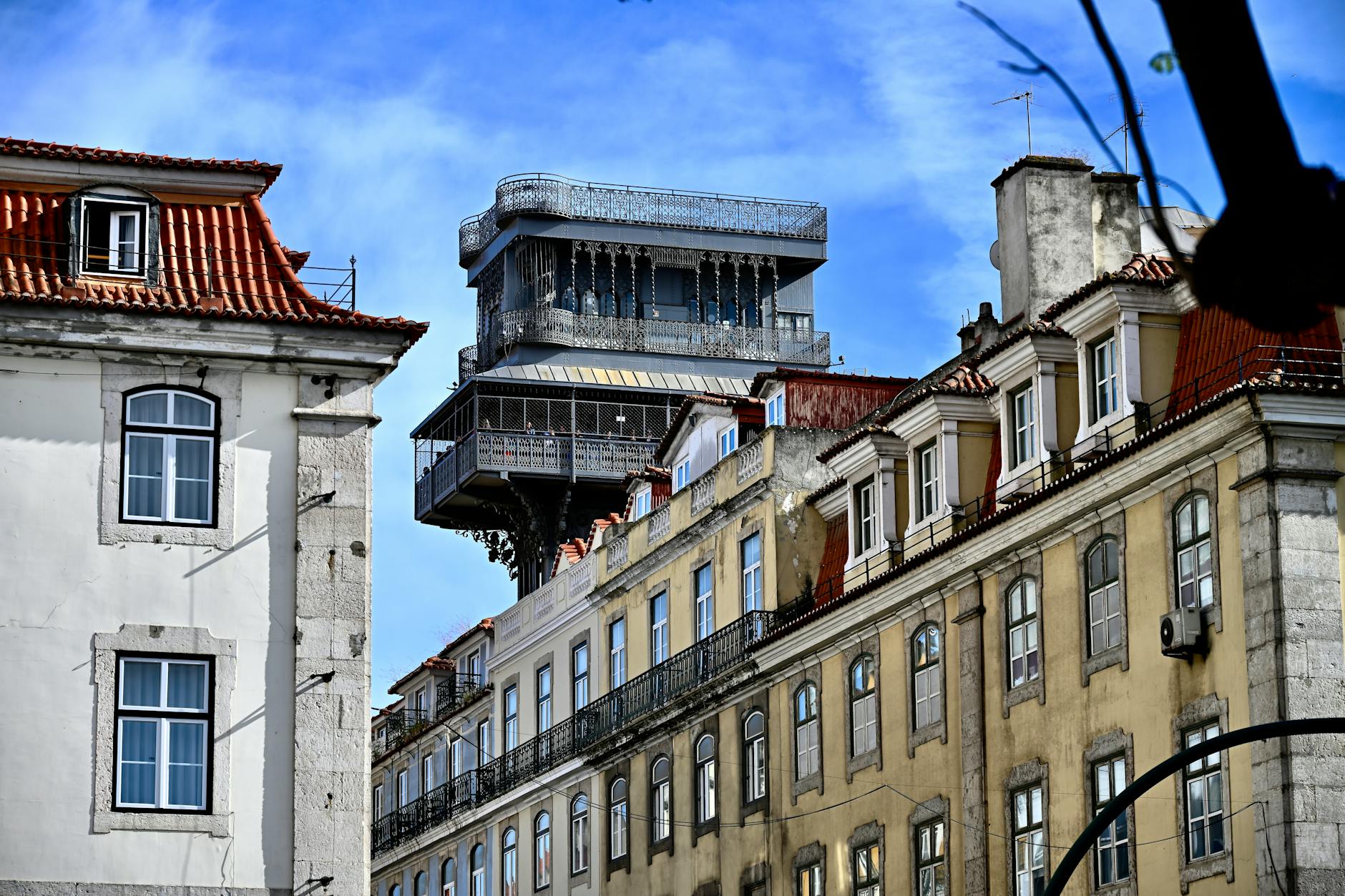
- Wrought-iron framework showing clear Eiffel Tower influences — designed to flex rather than crack
- Neo-Gothic decorative elements on the upper viewing platform, added for aesthetic distinction from the functional structure below
- Wooden interior cabins with brass fittings — original from 1902, maintained rather than replaced
- Filigree balconies and arches visible from the street, particularly beautiful in low afternoon light
- The footbridge connecting the top of the elevator shaft to Largo do Carmo — an iron walkway suspended between the tower and the natural hillside
The design was controversial when built. Some Lisboetas found the industrial aesthetic jarring against the Pombaline architecture below. Today it’s inseparable from the city’s visual identity — a fact no one disputes.
Best Time to Visit
Early morning (8–9 AM) or after 7 PM for the shortest queues. Avoid 11 AM–4 PM peak — this is when tour groups arrive and the queue at the Baixa entrance can stretch to 45–60 minutes.
For photography, the late afternoon two hours before sunset gives the best light on the elevator’s wrought-iron lacework from street level. From the viewing platform, sunrise and golden hour both work beautifully — the castle turns orange and the Tagus takes on its silver-gold shimmer.
January and February are the quietest months. The elevator runs year-round (when not under maintenance), and winter crowds at the Baixa entrance are negligible.
Photography Tips
The best exterior shots are from Rua Áurea looking north, with the elevator framed between the uniform Pombaline facades on either side. Low afternoon sun in summer creates dramatic shadows through the ironwork. A wide-angle lens captures the full structure from street level; a telephoto from a distance (try from across Praça da Figueira) compresses the tower against the Alfama hillside behind it.
From inside the cabin, the original wooden interior with brass fittings makes for atmospheric close-up shots — but the cramped space and other passengers make this challenging during busy hours. Early morning visits give the best chance of a more spacious cabin.
The view from the top is dramatic in every direction. The eastern view toward São Jorge Castle is the classic composition. For the best Tagus panorama, step to the south-facing edge of the platform. Both are stronger in morning or evening light than midday flat white.
Combining the Santa Justa Elevator with Nearby Sights
The elevator connects two distinct halves of central Lisbon — and the sights immediately around both entrances are worth lingering at:
- Carmo Convent (Museu Arqueológico do Carmo) — directly adjacent to the upper entrance. The Gothic convent was left roofless after the 1755 earthquake by deliberate choice (or structural necessity — history is ambiguous). Today the open-sky nave houses archaeological exhibits from Portugal and its former colonies. Entry around €7. One of Lisbon’s most evocative interiors.
- Chiado shopping — walk five minutes from Largo do Carmo to Rua Garrett. Café A Brasileira (the famous literary café with the Fernando Pessoa statue outside), Bertrand bookshop (the world’s oldest continuously operating bookstore, founded 1732), and dozens of independent shops.
- Praça do Rossio — five minutes from the lower Baixa entrance. The traditional heart of Lisbon, with its wave-pattern calçada and neo-Manueline train station. See our full Baixa and Rossio guide.
- Praça da Figueira — adjacent to the lower entrance. A slightly less-tourist square with decent cafés and Tram 28 stops. Good for a coffee while the queue ahead of you clears.
- Bairro Alto — from Largo do Carmo, walk five minutes uphill into the dense network of Bairro Alto’s bar-and-restaurant streets. Good for evening visits after the elevator.
A natural half-day itinerary: metro to Baixa-Chiado → walk to Largo do Carmo from the Chiado side → Carmo Convent → Santa Justa upper platform → walk Rua Garrett → coffee at A Brasileira → down Rua Augusta to the riverfront.
Getting There
The Baixa (lower) entrance is on Rua de Santa Justa, one block from Rua Áurea / Rua do Ouro in central Baixa. The closest metro is Baixa-Chiado (blue and green lines), a 3-minute walk.
The Chiado (upper) entrance is at Largo do Carmo. From Baixa-Chiado metro, walk up Rua Garrett (5 minutes) — or take the Glória Funicular from Praça dos Restauradores to the top of Bairro Alto and walk across (10 minutes total). See our funiculars and elevators guide for the full picture of Lisbon’s hillside transit options.
The Tram 28 stops at Praça Luís de Camões, a short walk from Largo do Carmo. Worth noting: Tram 28 is heavily targeted by pickpockets — hold bags in front and keep valuables secure. See our trams guide.
Practical Tips
- Check current status before visiting — the elevator periodically closes for maintenance (most recently in early 2025 and again in 2026). The carris.pt website lists current service changes.
- The elevator is wheelchair accessible (modern alterations were made while preserving the original cabin aesthetic)
- No bathrooms on the elevator itself; nearest public facilities are at the Lisboa Story Centre in Praça do Comércio
- Photography permitted; tripods allowed outside peak hours (check with staff)
- Pickpockets are active in the Baixa-side queue — standard precautions (front pockets, zipped bags)
- The viewing platform maximum capacity is 20 people at once — even busy days involve only short waits at the top
Is the Santa Justa Elevator Worth It?
The view is excellent — genuinely one of the best central Lisbon panoramas, and the only one that puts you at exactly the right height to see both the Baixa grid below and the Alfama hillside above. The wrought-iron architecture, the wooden cabins, the industrial-Gothic detailing — it’s all as remarkable up close as it looks in photographs.
What it isn’t worth: a 45-minute queue at the Baixa entrance during July. Use the Chiado-side upper entrance for the same view at lower cost and zero queue. Or visit early morning. The elevator experience itself (the 45-second ride in a wooden cabin) is charming but brief — don’t make it the centrepiece of a day; fit it into a broader Baixa-Chiado morning.
FAQ: Santa Justa Elevator
Is the Santa Justa Elevator worth visiting?
The view is excellent and the architecture is remarkable. Use the Chiado-side upper entrance (Largo do Carmo) for the same panorama at lower cost and no queue. Don’t queue 45 minutes at the Baixa entrance — that’s not worth it. Check carris.pt for current closure status before planning your visit.
How much does the Santa Justa Elevator cost?
When operating, around €6 round trip from the Baixa entrance including the viewing platform. The upper viewing platform accessed from the Chiado side is separately ticketed at around €5. Lisboa Card covers both. Check carris.pt for current verified pricing.
How do I avoid the Santa Justa Elevator queue?
Walk to Largo do Carmo from Chiado and enter through the small upper-side entrance. Same view, no queue, lower cost. Alternatively, visit before 9 AM or after 7 PM from the Baixa side.
How tall is the Santa Justa Elevator?
45 meters from base to viewing platform.
Who designed the Santa Justa Elevator?
Raoul Mesnier du Ponsard, a Portuguese-French architect who trained under Gustave Eiffel, completed in 1902.
Is the Santa Justa Elevator on the Lisboa Card?
Yes — Lisboa Card holders enter free when the elevator is operating.
Is the Santa Justa Elevator currently open?
As of mid-2026 it is temporarily closed for maintenance with no confirmed reopening date. Check carris.pt for current service status.
Bottom Line
The Santa Justa Elevator is genuine Lisbon — 1902 wrought-iron engineering, wooden cabins with brass fittings, and a panoramic view that earns its reputation. Before you visit, check carris.pt for current closure status. When it’s open, the smart move is the Chiado-side upper entrance (Largo do Carmo) — same view, fraction of the cost, and no queue. The wrought-iron lacework photographs best from Rua Áurea looking up.
The Santa Justa is really a viewpoint with a queue attached. The miradouros guide covers the ones that cost nothing and are usually better, São Jorge Castle has the highest view in the centre, Jerónimos and Belém Tower are the tickets genuinely worth queueing for, and the things to do guide ranks them honestly.