Things to Do in Lisbon
Football in Lisbon: Benfica, Sporting and Stadium Tours
Matches, tickets and stadium tours at the Luz and Alvalade — where to sit, what the tours are actually like, and which one to do if you only do one.
In this guide
Football in Lisbon is not a sideshow to the sightseeing — it is one of the few things the city does at a genuinely world level, and a Benfica night at the Estádio da Luz is as much a Lisbon experience as fado or Belém. Two giants share the city, a third club plays in the shadow of a monastery with a river view, and the national stadium out at Jamor is where Celtic won the European Cup in 1967. This guide covers matches, tickets, stadium tours, what each one is actually like, and what to skip.
The clubs
Benfica
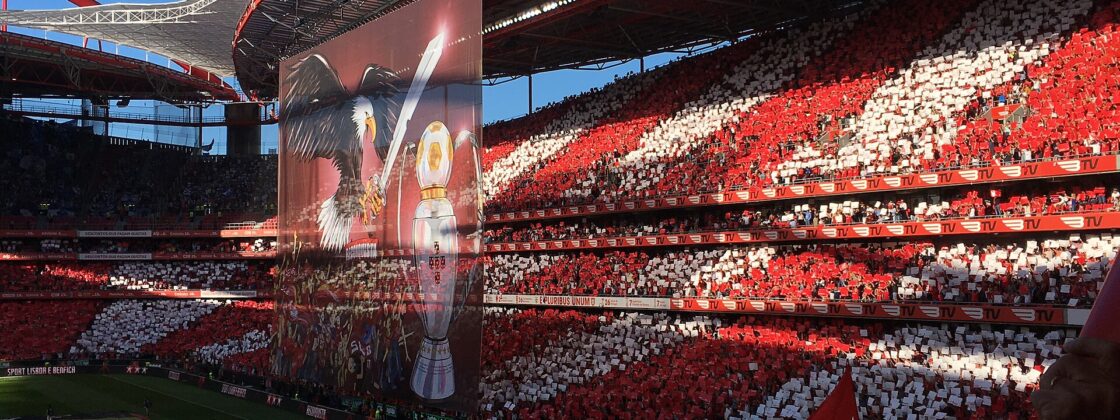
Sport Lisboa e Benfica — the Águias (Eagles), red and white, and the biggest club in Portugal by membership and by some distance the biggest in Lisbon. They play at the Estádio da Luz, capacity around 64,600, opened in 2003 and among the better modern stadiums in Europe: steep, loud and roofed in a way that keeps the noise in.
Two European Cups in 1961 and 1962, Eusébio, and a subsequent sixty-year wait that has become part of the club’s identity. Before every home game a live eagle called Vitória is flown around the stadium, which sounds like a gimmick and is genuinely something to see.
Getting there: Blue Line metro to Colégio Militar/Luz, then a five-minute walk. The station is enormous because it also serves the Colombo shopping centre, and on match nights it is a river of red. Our metro guide covers the network.
Sporting CP
Sporting Clube de Portugal — the Leões (Lions), green and white hoops, and Benfica’s city rival. Home is the Estádio José Alvalade, also opened in 2003, seating roughly 50,000, with a bright multicoloured seat pattern that reads better in person than on television.
Sporting’s distinguishing feature is its academy. Cristiano Ronaldo, Luís Figo, Nani, Ricardo Quaresma and João Félix all came through it, and the club museum leans hard on that lineage — reasonably, because few clubs anywhere can match it.
Getting there: Yellow Line metro to Campo Grande, then a short walk.
Belenenses
The third Lisbon club, and the one most visitors have never heard of. They play at the Estádio do Restelo in Belém, a partly open bowl set on the hillside above the monastery with a view down over the Tagus that no other ground in Portugal can match.
The level is lower and the crowds are small, but tickets are cheap, easy to get on the day, and the whole thing is friendly and unfussy. If you are already spending a day in Belém and there is a home fixture, it is one of the better-value hours in Lisbon.
Estádio Nacional
Out at Jamor in Oeiras, west of the city, the national stadium is an open-ended 1940s bowl in a park, largely unchanged since the day Celtic beat Internazionale 2–1 here in the 1967 European Cup final — the game that made the Lisbon Lions. It still hosts the Portuguese Cup final.
It is a pilgrimage rather than a sight, and mostly of interest to Scottish visitors, who make the trip in steady numbers. The setting in the Jamor sports park is pleasant, the architecture is austere and evocative, and it is a genuine hidden corner of greater Lisbon.
Going to a match
The season and kick-off times
Liga Portugal runs from August to May, with a winter break around Christmas and New Year. European nights add midweek fixtures from September.
Kick-offs are late by northern European standards — weekend league games frequently start at 20:30 or later, and Sunday-evening slots are common. This matters for planning: a match will consume your entire evening, and you will be leaving the ground close to midnight. Check the fixture list before you assume you can fit dinner around it.
Getting tickets
Buy from the club’s own website. Both Benfica and Sporting sell online in English, and both give members a presale window before general release.
- Ordinary league games against mid-table opposition are easy — tickets are usually available up to the day, and prices are reasonable by European standards.
- The Lisbon derby, matches against Porto, and Champions League nights sell out. Plan weeks ahead and expect to pay considerably more.
- Resale sites mark up heavily and carry a real risk of a ticket being voided at the turnstile, because both clubs put names on tickets for big games.
- Touts outside the ground are not worth the risk.
Take your passport or ID; it is sometimes checked against the ticket for high-category matches.
Where to sit
The ultras’ ends — Benfica’s No Name Boys and Diabos Vermelhos, Sporting’s Juventude Leonina — are where the noise, the flags and the tifo displays come from. They are also standing, singing, densely packed and not the right place for young children or anyone who wants to see the whole pitch calmly.
For a first visit, take a side stand or a corner. You get the full spectacle of the end without being inside it, and the atmosphere in a full Luz reaches everywhere in the ground anyway.
Is it safe?
Yes, for a visiting fan behaving normally. Portuguese football has an ultra culture with pyrotechnics and heavy policing, and derby days are tense, but ordinary spectators are not the target of any of it. The sensible precautions are the ones that apply anywhere: do not wear the away colours in the home end, do not get involved in anything outside the ground, and leave with the crowd rather than lingering. Our Lisbon safety guide covers the city more generally.
The derby
Benfica against Sporting is one of Europe’s great city derbies and one of the more intimidating tickets to obtain. If you happen to be in Lisbon for one and can get in legitimately, do it. If you cannot, watching it in a packed neighbourhood bar is a genuinely good second best — the city empties into cafés and the reaction to a goal travels down the street. Our bars guide and nightlife guide point to the places with a television and a crowd.
Stadium tours
If you are not in Lisbon during the season, or you cannot get a ticket, both big clubs run tours of their stadium and museum. These are the reliable year-round option and both are done properly.
Benfica: the Luz tour and the Cosme Damião museum
The tour takes you through the stands, the press area, the tunnel, the dressing rooms and pitchside, and combines with the club museum, which is one of the better football museums in Europe — well designed, generous with the Eusébio material, and not merely a trophy corridor.
Guided tours run frequently through the day, roughly every twenty minutes and every half hour over the lunch period, and there is an audio-guide app with English, Portuguese, French, German, Spanish and Chinese. Tickets are sold for the tour, the museum, or both together, and the combined option is the one to take — the museum on its own leaves you outside the interesting part.
Sporting: the Alvalade tour and museum
A guided visit of about an hour and a half covering the stadium and the museum. The museum is open daily from 10:00 to 18:00, except on match days and event days, which is the detail that catches people out — turning up on a matchday means no tour.
The Sporting museum’s strength is the academy story, and if you have any interest in how Ronaldo and Figo were produced it is more interesting than the trophy count suggests.
What they cost
Both clubs price their tours in the region you would expect for a European stadium tour, with combined stadium-and-museum tickets costing more than museum-only entry, and various add-on packages with scarves and hospitality that inflate the figure considerably. Buy from the club’s own site rather than a reseller — the third-party listings carry a markup and quote in a confusing mix of currencies. Prices and schedules change with the season, so check the official page for the current figure before you go.
Which tour should you do?
If you are doing one, do Benfica. The stadium is bigger and better, the museum is stronger, the tours run more often, and the metro connection is simpler. Do Sporting if you have a specific interest in the academy, or if you are doing both and want the comparison.
Neither is worth doing if you have no interest in football at all. This is not a case where the architecture or the history carries a disinterested visitor — it is a football day, and it works on those terms.
Why football matters here
To understand why two clubs of this size sit five kilometres apart in a city of half a million people, it helps to know that Portuguese football is organised around three institutions — Benfica, Sporting and Porto — that between them have won virtually every league title ever contested. Supporting one is not a hobby picked up in adulthood; it is inherited, along with the family’s politics and its recipe for bacalhau.
Benfica’s membership is among the largest of any sports club in the world, and the club is a genuine mass organisation with a stake in almost every Lisbon family. Sporting’s identity is built on producing players rather than buying them, which is why the academy occupies so much of its museum. The result is a city where a Sunday-night result changes the mood of Monday morning, and where a stranger asking which club you support is making conversation rather than starting an argument.
That context is also why the football is worth an evening even if you do not follow the sport at home. You are not watching a match so much as watching a city do the thing it cares most about, which is a reasonable definition of travel. The same logic applies to fado, and the two are more alike than either set of enthusiasts would admit.
Women’s football and other sports
Both clubs run women’s teams playing in the Campeonato Nacional, with tickets that are cheap and easy to get, and both are multi-sport organisations — futsal, handball, basketball, roller hockey, athletics — playing in pavilions beside the main stadiums. A Benfica or Sporting futsal night is a genuinely good small-scale alternative if the football fixture list does not line up with your dates, and the standard in Portugal is high.
Watching a game without a ticket
Portuguese football is a bar culture as much as a stadium culture, and a big match in a neighbourhood tasca or café is an experience in its own right: a beer for a couple of euros, a room of people who have supported the same club since childhood, and a level of commentary volume that has to be heard.
Look for the ordinary local places rather than the sports bars aimed at visitors. Anywhere with a scarf on the wall, plastic chairs and an over-loud television will do. Bairro Alto and Cais do Sodré have the tourist-facing versions; the residential neighbourhoods have the real ones.
Practical notes
- Getting home. The metro runs until about 01:00, which covers a 20:30 kick-off comfortably. After that you need a taxi or a ride-hail car, and surge pricing outside a stadium of 64,000 people is exactly what you would expect. Our transport guide has the alternatives.
- Eat before or after, not during. Stadium catering in Portugal is basic. There are decent places around Colombo near the Luz and along Campo Grande near Alvalade.
- Club shops are open on non-match days and are the reliable place for a genuine shirt. Street-stall versions near the ground are fakes, which is fine if you know that is what you are buying.
- Kids. A stadium tour is an easy win with football-mad children — see our family itinerary. A night derby is not.
- Budget. A league ticket, the metro and a beer comes to less than a mid-range dinner. Football is one of the better-value things in the city — our budget guide has the wider picture.
A match-night timeline
For a 20:30 kick-off at the Luz, this is roughly how the evening runs:
- 18:30 — eat, in town or near Colombo. Do not leave it until afterwards, because the kitchens you want will have closed.
- 19:15 — metro to Colégio Militar/Luz. Trains fill from about this point; earlier is calmer.
- 19:45 — through the turnstiles. The concourses are busy but move quickly, and being in your seat early means you see the ground fill.
- 20:20 — Vitória the eagle flies, the stands do their display, and this is the part people remember.
- 22:20 — full time. Do not sprint for the exit; the metro station absorbs the crowd faster if it comes in waves.
- 23:00 — back in the centre with time for a drink.
What to skip
Three honest verdicts.
Do not buy an expensive hospitality package for an ordinary league fixture. The premium buys a seat and a meal, not atmosphere, and the atmosphere is the entire point of going.
Do not travel out to the Estádio Nacional unless the 1967 final means something to you. It is a forty-minute round trip to look at an empty concrete bowl in a park, and there is nothing else out there.
Do not do both big stadium tours in one day. They are on opposite sides of the city, they cover similar ground, and by the second dressing room you will have stopped caring. Pick one, and spend the other half-day on something that is not a stadium.
Frequently asked questions
Which football teams play in Lisbon?
Benfica at the Estádio da Luz, Sporting CP at the Estádio José Alvalade, and Belenenses at the Estádio do Restelo in Belém. The Estádio Nacional at Jamor, outside the city, hosts the Portuguese Cup final.
How do I buy tickets for a Benfica or Sporting match?
Through the club’s own website, which sells in English. Ordinary league games are usually available close to the date; derbies, matches against Porto and Champions League nights sell out well in advance. Avoid resale sites and touts — tickets for big games can be named and checked.
How much is the Benfica stadium tour?
Prices vary by package and change seasonally, with combined stadium-and-museum tickets costing more than the museum alone and add-on packages costing considerably more again. Book on the club’s own site for the current price rather than through a reseller.
Can you visit the Estádio da Luz without a match?
Yes. Guided tours run through the day, roughly every twenty minutes and every thirty minutes over lunchtime, taking in the stands, tunnel, dressing rooms and pitchside, combined with the Cosme Damião museum.
Is the Sporting museum open every day?
It is open daily from 10:00 to 18:00, but closes on match days and event days. Check the fixture list before you travel out to Alvalade.
How do I get to the Estádio da Luz?
Blue Line metro to Colégio Militar/Luz, then about five minutes on foot. For Alvalade, take the Yellow Line to Campo Grande.
Is it safe to go to a football match in Lisbon?
Yes for an ordinary spectator. Avoid the ultras’ ends if you want a calm view, do not wear away colours in the home sections, and leave with the crowd. Policing is heavy and visiting fans are not a target.
When does the Portuguese football season run?
August to May, with a winter break over Christmas and New Year. Weekend kick-offs are often 20:30 or later, so a match will take up your whole evening.
Bottom Line
If you are in Lisbon during the season and you like football at all, go to a game — a league night at the Luz costs less than dinner, the eagle flies before kick-off, and 64,000 people in a roofed bowl is a different order of experience from a stadium tour. If your dates fall outside the season, take the Benfica tour and museum rather than Sporting’s, unless the academy story is what draws you. Skip the hospitality packages, skip doing both grounds in one day, and if you cannot get a ticket for the derby, find a neighbourhood bar instead — you will not have missed much of the noise. More things worth an evening are in our things to do guide.