Things to Do in Lisbon
Monument to the Discoveries: Guide to Padrão dos Descobrimentos 2026
Visit the Monument to the Discoveries in Belém—tickets, rooftop views, the compass rose mosaic, and the fascinating history of Portugal's Age of Exploration.
In this guide
- Quick Reference
- The History
- The 33 Figures (Don’t Miss)
- The Compass Rose Mosaic
- What’s at the Top (Rooftop View)
- Tickets: The Full Breakdown
- Photography Tips
- How to Visit
- Combining With Other Belém Sights
- Practical Tips
- The Monument in Context: Age of Discovery, Then and Now
- Belém vs the Monument: How Much Time to Allocate
- What’s Nearby: The Immediate Area Around the Monument
- The Age of Discovery: What the Monument Actually Represents
- Visiting With the Lisboa Card
- FAQ: Monument to the Discoveries
- Bottom Line
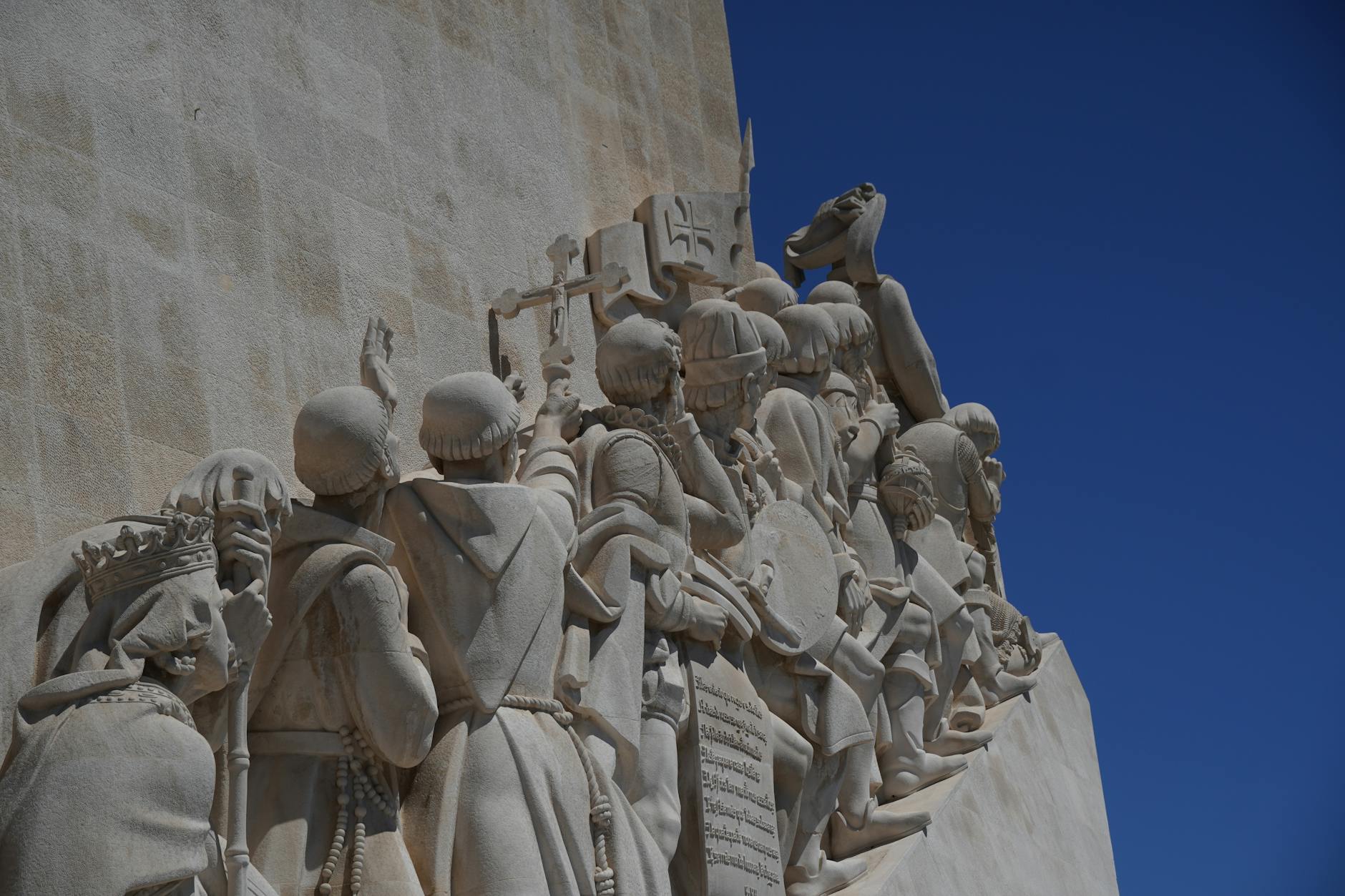
The Monument to the Discoveries Lisbon (Padrão dos Descobrimentos) is the city’s most distinctive 20th-century landmark — a 52-metre limestone sculpture shaped like a Portuguese caravel ship’s prow, lined with 33 historical figures from Portugal’s Age of Discovery, with a rooftop viewing platform that delivers Belém’s best panorama.
This guide covers everything: the history, the sculptural details, verified ticket prices, what’s at the top, and how to fit it into your Belém day. Updated for 2026 with prices confirmed from the official site.
Quick Reference
| Detail | Info |
|---|---|
| Address | Avenida de Brasília, Belém (riverside) |
| Height | 52 metres (170 feet) |
| Built | 1940 (temporary), 1960 (permanent) |
| Adult ticket | €10 (viewpoint + exhibition + film) |
| Hours (Mar–Sep) | 10:00–19:00 (last entry 18:30) |
| Hours (Oct–Feb) | 10:00–18:00 (last entry 17:30) |
| Closed | Jan 1, May 1, Dec 24, 25, 31 |
| Lisboa Card | Free entry for cardholders |
| Time needed | 30–60 minutes |
The History
Why It Was Built
Originally erected in 1940 for the Portuguese World Exhibition celebrating the 500th anniversary of Henry the Navigator’s death. The temporary version was so popular it was rebuilt permanently in 1960 — exactly 500 years after Henry’s death. Designed by architect Cottinelli Telmo and sculptor Leopoldo de Almeida, the structure takes the form of a caravel’s prow charging into the Tagus, with Henry the Navigator at the very tip holding a small model ship.
The Era It Commemorates
The monument celebrates Portugal’s Age of Discovery — the 15th and 16th centuries when Portuguese sailors methodically mapped the African coastline, rounded the Cape of Good Hope (Bartolomeu Dias, 1488), reached India (Vasco da Gama, 1498), stumbled across Brazil (Cabral, 1500), reached Japan (1543), and established what became Europe’s first global maritime empire. The trade routes they opened — in spices, gold, and later, catastrophically, enslaved people — reshaped the world economy.
Modern Controversy
The monument’s framing — Portugal as heroic discoverer — has drawn increasing scrutiny for presenting only one side of a story that also included colonial violence, forced conversion, and the Atlantic slave trade. Visitors today often see it as both an architectural icon and a complicated statement about how nations choose to remember their history. The on-site exhibition engages with some of this complexity.
The 33 Figures (Don’t Miss)
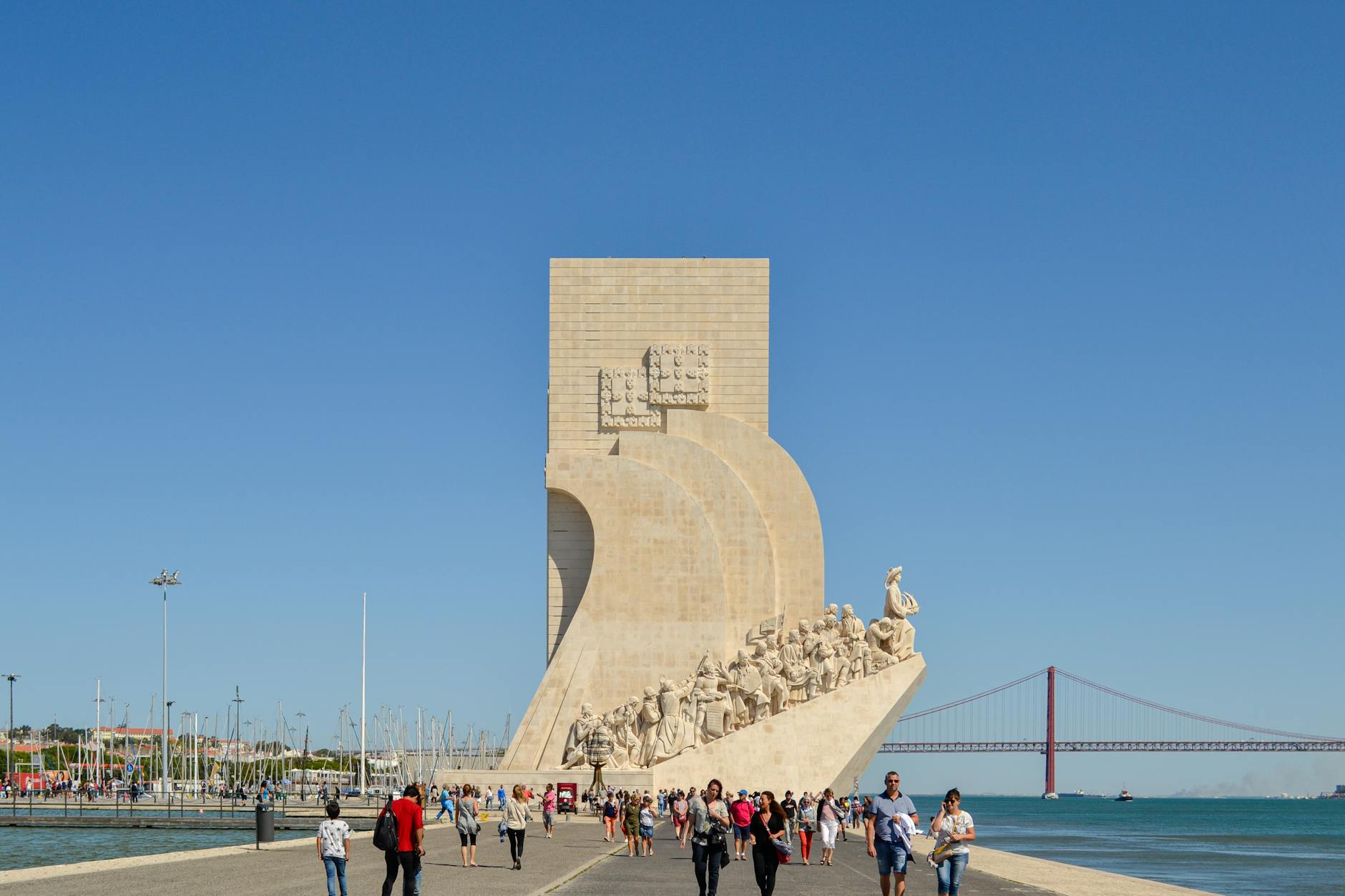
Look closely at the ramp descending on either side of the central Henry the Navigator figure at the prow. Sixteen figures on each side, 33 in total, representing the key people of Portugal’s Age of Discovery. Each carries an attribute identifying their role.
Notable Figures
- Henry the Navigator — At the prow, holding a model caravel
- Vasco da Gama — Reached India 1498; holds a globe
- Pedro Álvares Cabral — Discovered Brazil 1500
- Bartolomeu Dias — First to round the Cape of Good Hope, 1488
- Ferdinand Magellan — Led the first circumnavigation of the globe
- Afonso de Albuquerque — Governor of Portuguese India; conquered Goa and Malacca
- Luís de Camões — Poet of Os Lusíadas, the epic that canonised the voyages in verse; holds a book
- King João II — “The Perfect Prince”; the strategic mind behind the African exploration programme
- King Manuel I — Reigned during the peak of the empire; the Manueline style across Belém bears his name
- Philippa of Lancaster — Mother of Henry the Navigator. The only woman among the 33 figures
- Padre Henrique de Portugal — Missionary to Brazil
- Cristóvão da Gama — Led the Portuguese military expedition to Ethiopia
The Symbolism
Looking up at the figures as they descend the prow ramp creates the impression of a procession heading to the sea. Each carries something — a caravel, a cross, a sphere, a book — that identifies their contribution to the enterprise. Spend five minutes identifying them; the monument becomes much more engaging once you know who’s who.
The Compass Rose Mosaic
In the plaza in front of the monument stands one of Lisbon’s most impressive — and most underappreciated — outdoor artworks: a 50-metre-wide compass rose mosaic in calçada portuguesa style (the same black and white polished limestone you see on Lisbon’s pavements).
What’s on It
- A central wind rose (compass star)
- A world map showing the Portuguese discovery routes and their dates
- Caravels, sea creatures, and ornamental motifs filling the surrounding space
Origin
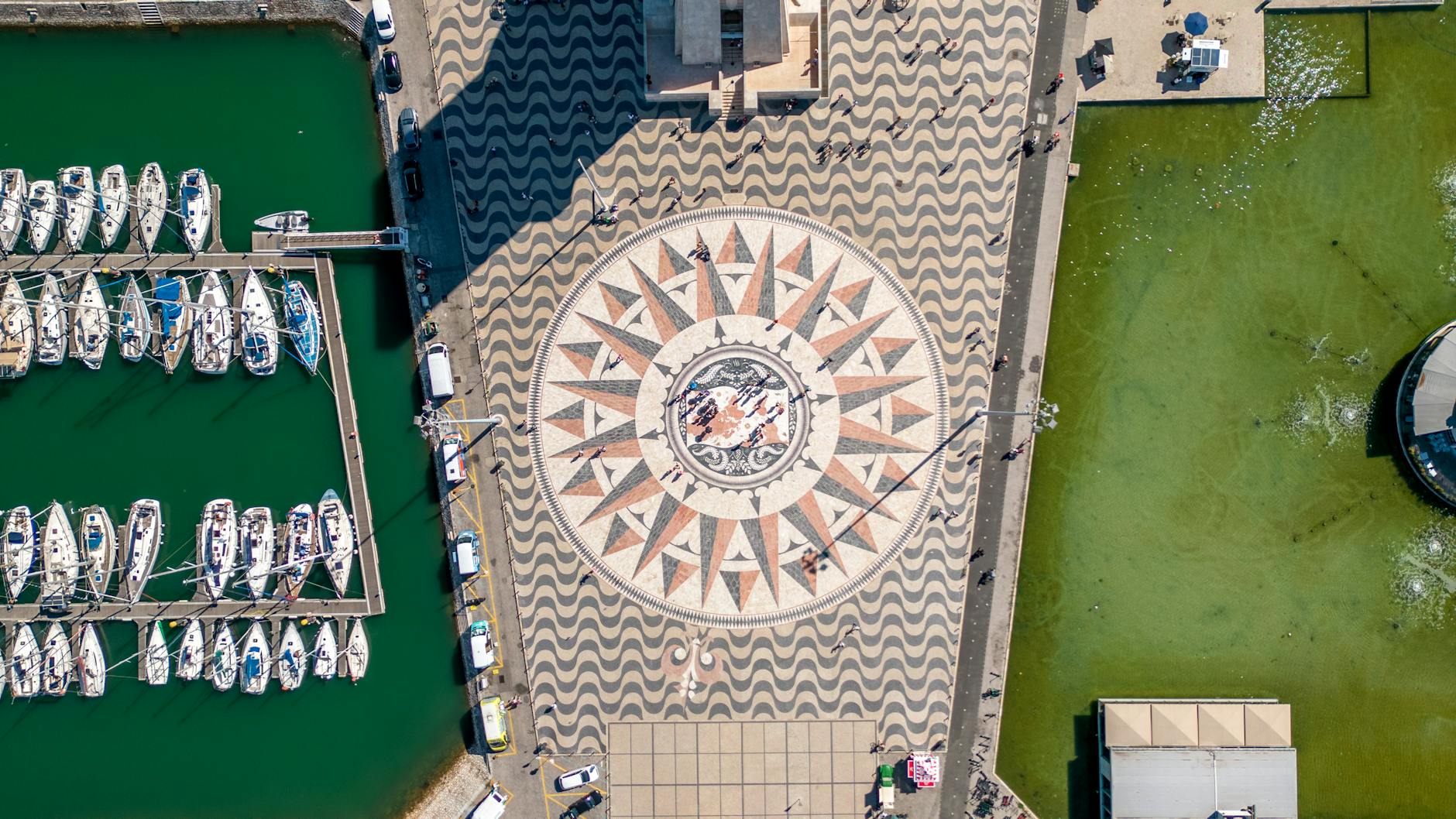
The compass rose was a gift from the Republic of South Africa in 1960, timed to coincide with the permanent reconstruction of the monument. Designed by Cristino da Silva. Walk across it at ground level, then go up the monument to see it properly — from below, the scale is impressive but the full design only becomes clear from the rooftop.
What’s at the Top (Rooftop View)
For €10, you can ride the elevator (or climb the 260+ steps) to an open-air viewing platform 52 metres above the riverfront. On a clear day, this is the best elevated view in Belém — better than the Tower, better than anywhere else in the district.
Best Views From the Top
- Compass rose mosaic directly below — the only way to see the full design
- Tagus River spreading west toward the Atlantic
- 25 de Abril Bridge — the suspension bridge that looks uncannily like the Golden Gate
- Cristo Rei — arms-spread statue on the south bank
- Belém Tower to the west along the river
- Jerónimos Monastery just to the north across the gardens
- MAAT Museum and the modern riverfront architecture nearby
What’s Inside
The monument houses the Centro Cultural das Descobertas — exhibition space, a small auditorium, and information panels about Portugal’s exploration history. The exhibition changes periodically. A documentary film is screened on Saturdays, Sundays, and holidays at 11:15 AM and 4:00 PM.
Tickets: The Full Breakdown
Prices confirmed from the official site at padraodosdescobrimentos.pt:
| Ticket type | Full price |
|---|---|
| Adult (viewpoint + exhibition + film) | €10.00 |
| Youth 13–25 (non-Lisbon residents) | €5.00 |
| Persons with specific needs | €7.00 |
| Seniors 65+ (non-Lisbon residents) | €8.50 |
| Children under 12 | Free |
| Lisboa Card holders | Free |
| Lisbon residents (Sundays + public holidays until 2 PM) | Free |
| Exhibition only (without viewpoint) | €5.00 |
Buy tickets online at the BOL platform (the only authorised e-commerce agent) or at the on-site ticket office. For Lisboa Card holders, the monument is free — making the card even better value if you’re visiting Belém and multiple other museums.
Photography Tips
- Best angle: From the riverside walkway looking up toward the prow — frames the sculpture against sky with the figures visible
- Sunset: The west-facing pale limestone glows orange in golden hour; late afternoon (5–7 PM summer) is best
- Compass rose: Best photographed from the monument’s rooftop — the full design is invisible from ground level
- Wide context shots: Include the 25 de Abril Bridge in the background for scale and setting
- Figure detail shots: Walk up to the base and shoot individual figures from below for unusual angles
How to Visit
Getting There
From central Lisbon:
- Tram 15E to the “Belém” or “Largo dos Jerónimos” stop (10-min walk to monument)
- Train from Cais do Sodré to “Belém” station (5-min walk along the river)
- Bus 728 to “Praça do Império”
- Uber/Bolt approximately €8–12 from central Lisbon
When to Go
Mornings (10 AM–noon) for best light from the east and smaller crowds. Late afternoons for golden-hour photography of the limestone façade. Avoid Mondays — the monument is closed. Rainy days mean a wet open-air viewing platform; worth rescheduling if possible.
Combining With Other Belém Sights
The monument is the western anchor of Belém’s monumental row. A logical full Belém day:
- 9:30 AM — Jerónimos Monastery (crowds thinnest early); see our Jerónimos guide
- 11:30 AM — Pastéis de Belém (the queue moves fast; worth it)
- 12:30 PM — Walk the riverside path to Belém Tower exterior (closed for restoration in 2026, but worth photographing); see our Belém Tower guide
- 1:30 PM — Lunch at a riverside café
- 3:00 PM — Monument to the Discoveries (elevator to rooftop for the compass rose view)
- 4:30 PM — MAAT museum
- 6:00 PM — Tram 15E back to Lisbon
See our full Belém guide for the complete district breakdown.
Practical Tips
- Bring water — limited shade at the monument; the rooftop is exposed
- Sun protection — open-air rooftop with no shade
- Photography permitted throughout; tripods are fine in the open plaza
- Bathrooms available inside; small fee
- Café on the ground floor — basic but convenient
- Wheelchair access — to ground level; rooftop accessible via elevator
- Audio guide available separately for a small additional fee
- Monday closure — a common trip-planning mistake; build this into your Belém day planning
The Monument in Context: Age of Discovery, Then and Now
Standing at the base and looking up at those 33 figures, it’s hard not to feel the ambition of the era they represent. In the span of roughly 80 years (1420s–1500s), Portugal — a country of fewer than 1.5 million people — mapped the coastlines of two continents, established sea routes to India and East Asia, and built a commercial empire stretching from Lisbon to Malacca. Henry the Navigator financed much of the early exploration from his base at Sagres; the pattern he established was followed by successors for generations after his death.
The monument was built during the Salazar dictatorship as an exercise in national mythology, which partly explains why it presents the story so cleanly. The figures don’t include the enslaved Africans whose forced labour made the empire’s wealth possible, nor the populations of Brazil, India, and Africa whose worlds were upended by the arrivals commemorated here. Modern visitors increasingly see both things at once: the extraordinary maritime achievement and the cost at which it came. The monument doesn’t resolve that tension, but it’s worth bringing to it.
Belém vs the Monument: How Much Time to Allocate
A common first-timer mistake is underestimating Belém and rushing the Monument to the Discoveries as a quick tick-box stop. The monument itself takes 30–60 minutes depending on whether you queue, go up, explore the exhibition, and read the panels. But the context makes it richer.
Jerónimos Monastery across the gardens was built with revenues from the spice trade — the direct commercial result of the voyages the monument commemorates. The connection between the two sites is not incidental. Walking from Jerónimos to the Monument (about 10 minutes along the formal garden and then the riverside) with that context in mind gives both places more weight.
If you only have a morning in Belém, the sequence that works best: Jerónimos first (less crowded at 9:30 AM), then Pastéis de Belém for a break, then the Monument to the Discoveries with the rooftop view, then walk the riverside west to see the Belém Tower exterior. That’s about 4–5 hours and covers the essential Belém story in chronological and geographical order.
What’s Nearby: The Immediate Area Around the Monument
Within a five-minute walk:
- MAAT (Museum of Art, Architecture and Technology) — One of Lisbon’s best contemporary art venues, housed in a striking riverside building. The rooftop walk over the old Tejo Power Station is free and worth doing for the views.
- Belém Cultural Centre (CCB) — Large arts complex with performance spaces, a design museum, and a decent café. Worth checking the programme if you’re spending several days in Lisbon.
- Jardim de Belém — The formal garden between Jerónimos and the riverside. A good place to sit after the monument if you’ve been on your feet all morning.
- Pastéis de Belém — About 800 metres east on Rua de Belém. The original pastel de nata bakery since 1837. The queue looks worse than it is; it moves quickly and the tarts come out fresh from the oven every few minutes.
For the full Belém district breakdown including all the museums and how to plan a full day, see our Belém guide.
The Age of Discovery: What the Monument Actually Represents
It helps to understand the scale of what Portugal pulled off. In 1415, Portugal captured Ceuta in North Africa — the first move in what became a century-long push southward along the African coast, island-hopping into the Atlantic, and eventually finding sea routes to India and the Americas. The country was small, the ships were tiny by later standards, and the navigational knowledge was being built from scratch.
Henry the Navigator — who stands at the monument’s prow — never actually sailed on any of the famous voyages. His role was strategic: he financed and organised expeditions from the court at Sagres, collected geographic intelligence, and attracted navigators and cartographers from across Europe to the Portuguese enterprise. The discoveries were the result of that institutional investment over decades, not individual heroics.
By 1500, within 60 years of Henry’s death, Portuguese ships had:
- Mapped the entire west and east African coastline
- Established trading posts from West Africa to India to Japan
- Made first European contact with Brazil
- Enabled the first circumnavigation of the globe (completed under Magellan/Elcano in 1522)
For a country of roughly 1.5 million people in the 15th century, the scale is genuinely extraordinary — which is partly why the monument commands such weight on Lisbon’s riverfront.
Visiting With the Lisboa Card
The Lisboa Card is one of the few tourist cards that genuinely delivers value in Lisbon, and the Monument to the Discoveries is one of the reasons. Lisboa Card holders enter free (confirmed by the official site), so if you’re planning to visit Jerónimos Monastery, the National Tile Museum, the Monument, and using public transport, the 48-hour card breaks even easily. The card is available from the tourist offices at the airport, Praça do Comércio, and Figueira square.
For a full cost comparison and breakdown of whether the card is worth it for your itinerary, see our dedicated guide on the things to do in Lisbon page.
FAQ: Monument to the Discoveries
How tall is the Monument to the Discoveries?
52 metres (170 feet). Built in 1940 as a temporary structure for the Portuguese World Exhibition, then rebuilt permanently in 1960 to mark the 500th anniversary of Henry the Navigator’s death.
How much does entry cost?
€10 for adults (viewpoint + exhibition + film). Reduced rates for youth (€5), seniors 65+ (€8.50), and people with disabilities (€7). Children under 12 free. Lisboa Card holders enter free.
Can I climb to the top?
Yes — by elevator or 260+ steps. The open-air viewing platform at 52 metres gives the best panorama of Belém and the Tagus, including a bird’s-eye view of the compass rose mosaic below.
Who designed the Monument to the Discoveries?
Architect Cottinelli Telmo and sculptor Leopoldo de Almeida designed both versions. First erected 1940; rebuilt permanently 1960.
How many figures are on the monument?
33 historical figures from Portugal’s Age of Discovery. Henry the Navigator stands at the prow; the others descend in two rows on either side.
Is the compass rose worth seeing?
Yes — it’s a 50-metre stone mosaic in the plaza in front of the monument, a gift from the Republic of South Africa in 1960. The full design is only visible from the rooftop, which is a good reason to pay for the entry ticket.
Is the Monument to the Discoveries accessible for wheelchair users?
Yes — the ground level and elevator access to the rooftop are both wheelchair accessible. The plaza and compass rose are also fully flat and accessible.
Bottom Line
The Monument to the Discoveries is essential Belém — visually striking, historically layered, and home to one of the city’s best riverfront viewing platforms. The €10 rooftop ticket is well spent: the compass rose below and the full Belém panorama above are both things you can’t properly see any other way. Combine with Jerónimos and Pastéis de Belém for a full Belém morning, and leave the afternoon for MAAT or a riverside walk.
The Padrão only makes sense as part of a Belém morning. Jerónimos is the essential stop and the one to book ahead, Belém Tower is a ten-minute walk further along the water, and the things to do pillar sets out how the whole district fits together. São Jorge Castle is the equivalent set piece back in the centre.