
Beaches
Beaches Near Lisbon: The Complete Guide to the Best Coast
All four coasts, beach by beach, with train fares and journey times — which sand suits which day, what the Atlantic is really like, and what to skip.
In this guide
- First, the honest framing
- The four coasts, and how to choose between them
- The Cascais line: the easy beaches
- The wild coast: Guincho and the Sintra beaches
- Costa da Caparica: the south side
- Arrábida and Sesimbra: the beautiful water
- Which beach for which day
- Surfing
- Further afield: worth the extra hour
- Getting there: the practical mechanics
- Season, weather and water
- What it costs
- What to bring
- Portuguese beach culture, briefly
- A beach day that works
- Accessibility
- Dogs
- What is not worth it
- Beaches with something else attached
- Frequently asked questions
- Bottom Line
- Photo Credits
The beaches near Lisbon are the city’s most underrated asset. Not one of them is in Lisbon — this is a river city, and the Tagus is not for swimming — but there are roughly a hundred kilometres of Atlantic sand within an hour of Rossio, reachable on a €2.20 train ticket, and they range from a suburban city beach with a surf school and a beer kiosk to empty cliff-backed coves inside a natural park. This guide covers all four coasts properly: which beach suits which kind of day, exactly how to get to each on public transport, what the water is actually like, and the things nobody tells you about the Atlantic until you are standing in it.
For the car-free version of all of this, our Lisbon beaches by train guide maps the Cascais line stop by stop.
The emptiest sand within two hours of the city is south of the Sado — see our Comporta and Melides guide.
For sand with a proper town attached, our Ericeira day trip guide covers Praia dos Pescadores, Foz do Lizandro and the reef breaks north of town.
If the point is waves rather than sunbathing, start with our guide to surfing near Lisbon — lesson prices, seasons and which breaks to avoid.
The wildest sand in reach of the city is on the far side of the Serra — our Sintra coast beaches guide explains which of them you can actually get down to.
The western coves get their own page: the best beaches in Cascais and Estoril, with the 2026 Blue Flag changes and the one cove we would skip.
The easiest of the lot gets its own page — our Carcavelos beach guide has the train times, the walk from the station, the surf schools and the stop-earlier trick.
The wild-coast beach everyone photographs deserves its own page — our Praia do Guincho guide covers the buses, the parking, the wind and who should go elsewhere.
First, the honest framing
People arrive expecting the Mediterranean and get something else entirely. Four things to know before you plan a beach day:
- The water is cold. This is the open Atlantic with a cold upwelling current running down the Portuguese coast. Sea temperatures around Lisbon sit roughly in the high teens Celsius even in August. It is swimmable and thousands of people swim in it every day, but the first thirty seconds are a genuine shock and nobody stays in for an hour.
- The wind arrives in the afternoon. The nortada, the summer north wind, typically builds from early afternoon. A beach that was beautiful at eleven can be a sandblasting by four. Morning is the better half of a Lisbon beach day, which is the reverse of most places.
- There is surf, and there are rips. These are ocean beaches, not bays. Swim between the flags where there are lifeguards, and be genuinely careful where there are not.
- Nothing is walkable from the city. Budget 25–60 minutes each way. That is the price of admission and it is well worth paying.
The four coasts, and how to choose between them
Every beach near Lisbon belongs to one of four groups. Pick the group first and the individual beach second — that is the decision that actually matters.
- The Cascais line (west, along the river mouth). Easiest, busiest, most sheltered. A train from Cais do Sodré that runs every twenty minutes. Best for a first beach day, for families and for anyone without a car.
- The Sintra–Cascais wild coast (west, facing the open Atlantic). Bigger, emptier, more dramatic, much windier. Surf territory. Needs a bus or a car.
- Costa da Caparica (south, across the river). Thirty kilometres of continuous sand and a completely different atmosphere — younger, more Portuguese, less polished. Ferry or bus.
- Setúbal and Arrábida (south-east, an hour out). The best-looking water within reach of Lisbon, in a protected natural park. A full day out, not an afternoon.
The Cascais line: the easy beaches
This is the default answer for most visitors, and rightly so. Trains leave Cais do Sodré roughly every twenty minutes, run beside the water for most of the route, and stop at Alcântara, Belém, Algés, Oeiras, Carcavelos, Estoril and Cascais. It is a suburban CP service, not an express, and you can turn up and go. Full detail is in our Lisbon to Cascais train guide.
Carcavelos — the big one
Getting there: 19–26 minutes from Cais do Sodré, a three-zone ticket at €2.20, then about a ten-minute walk down from the station.
Carcavelos is the largest beach on this stretch and the closest Blue Flag beach to Lisbon with direct train access. It is a long, wide, generous sweep of sand with a fort at one end, surf schools along it, beach bars, volleyball nets, showers and full lifeguard cover in season. In July and August it is genuinely packed and feels like a city beach; in May, June and September it is excellent.
Our verdict: if you have one afternoon and no car, come here. It does everything competently and the logistics are trivial.
More in our Carcavelos beach guide.
Santo Amaro de Oeiras, Parede and São Pedro do Estoril
The smaller beaches between Oeiras and Estoril are where people who live here actually go. They are coves rather than sweeps — sheltered, calmer water, a promenade behind, and a couple of restaurants each. Santo Amaro de Oeiras has the marina and a decent stretch of sand; Parede is small and family-heavy; São Pedro do Estoril is the prettiest of the three and has a rocky, rockpool-ish character that children like.
Our verdict: the best trade in the whole guide. Same train, one or two stops earlier or later than everyone else, half the crowd.
Estoril and Cascais town beaches
Getting there: Cascais is the end of the line, 33–45 minutes, a four-zone ticket at €2.55 adult or €1.30 child.
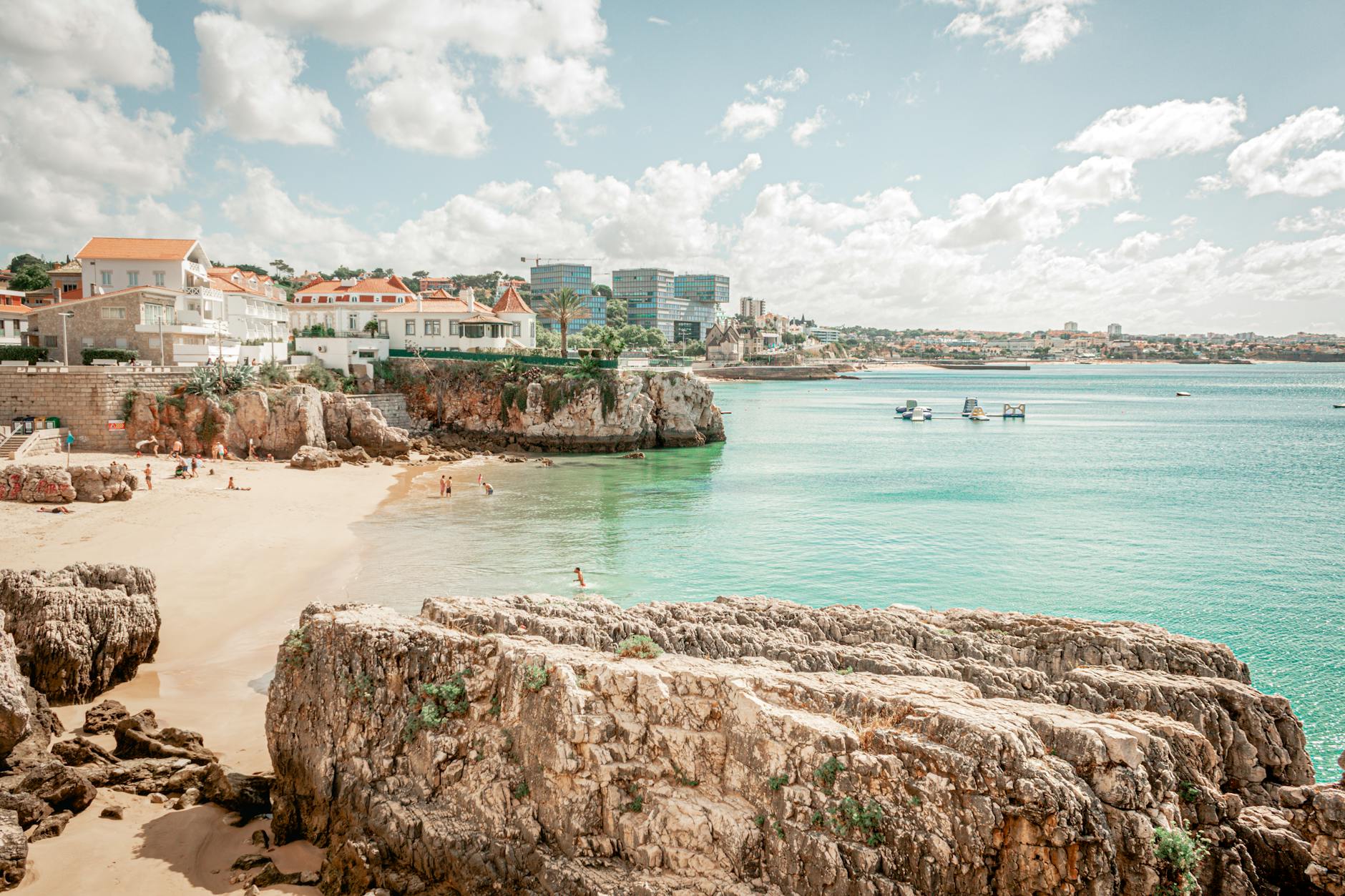
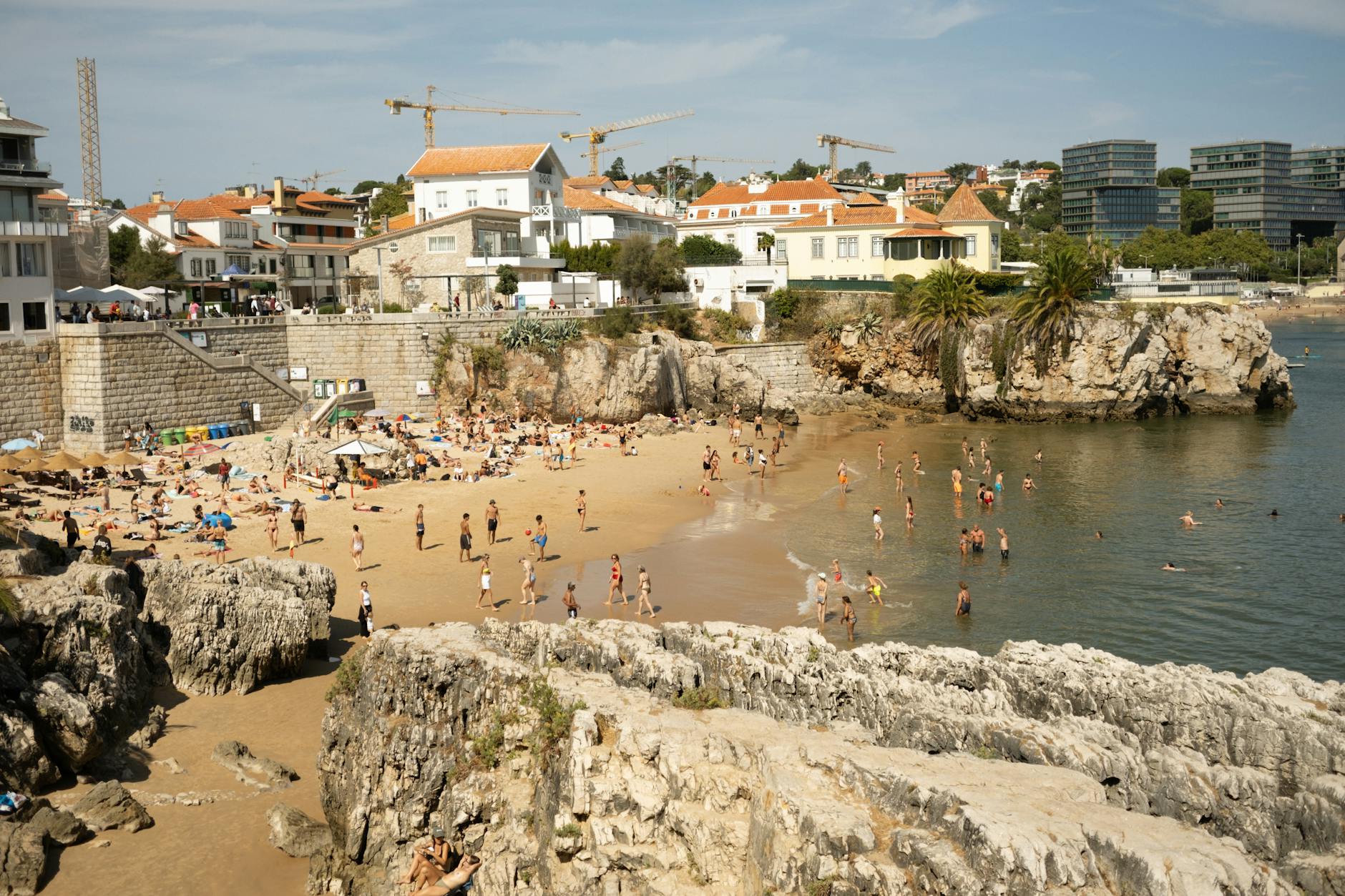
Tamariz at Estoril sits below the casino with a promenade, a tunnel under the railway and a slightly grand, faded atmosphere. The three little beaches in Cascais itself — Conceição, Duquesa and Rainha — are tiny, sheltered, very pretty and extremely full in summer, because they are ten metres from a town full of restaurants.
Our verdict: come to Cascais for the town and treat the beach as a bonus. If sand is the point of your day, get off at Carcavelos instead. Do not plan a beach day around Praia da Rainha, which is roughly the size of a tennis court.
The wild coast: Guincho and the Sintra beaches
Round the headland west of Cascais the coast turns to face the open Atlantic, and everything changes: bigger waves, colder water, dunes, cliffs and wind.
Praia do Guincho
Getting there: bus 405 or 415 from Cascais bus station — the same circular route run in opposite directions — €2.35 single, 20–25 minutes. Or by car. There is no train.
Guincho is the famous one — a wide dune-backed beach inside the Sintra-Cascais Natural Park, with the Serra de Sintra rising behind it and Cabo da Roca visible up the coast. It is spectacular, and it is almost always windy. That wind is exactly why it is one of Europe’s serious windsurfing and kitesurfing beaches, and exactly why an ordinary sunbathing afternoon here can be miserable.
Our verdict: go in the morning, or go for the surf, or go for lunch at one of the restaurants on the road behind and look at it. Do not go at three in the afternoon in August expecting to lie still.
More in our Praia do Guincho guide.
Praia Grande, Praia das Maçãs and Adraga
North of Cabo da Roca, on the Sintra side, is a run of big Atlantic beaches. Praia Grande is the largest and a well-known surf and bodyboard beach with a huge cliff at one end. Praia das Maçãs is the family option with a small town behind it and — in summer — a historic tram down from Sintra. Praia da Adraga is the beautiful one: a cove between rock stacks with a single celebrated fish restaurant above it.
Getting there is the catch: these are reached from Sintra by bus rather than from Lisbon directly, so a day here is really a Sintra day with a beach on the end of it.
More in our Sintra coast beaches guide.
Cabo da Roca
Not a beach — the westernmost point of mainland Europe, on cliffs a hundred metres above the water, and worth a stop on the same trip. See our guide.
Costa da Caparica: the south side
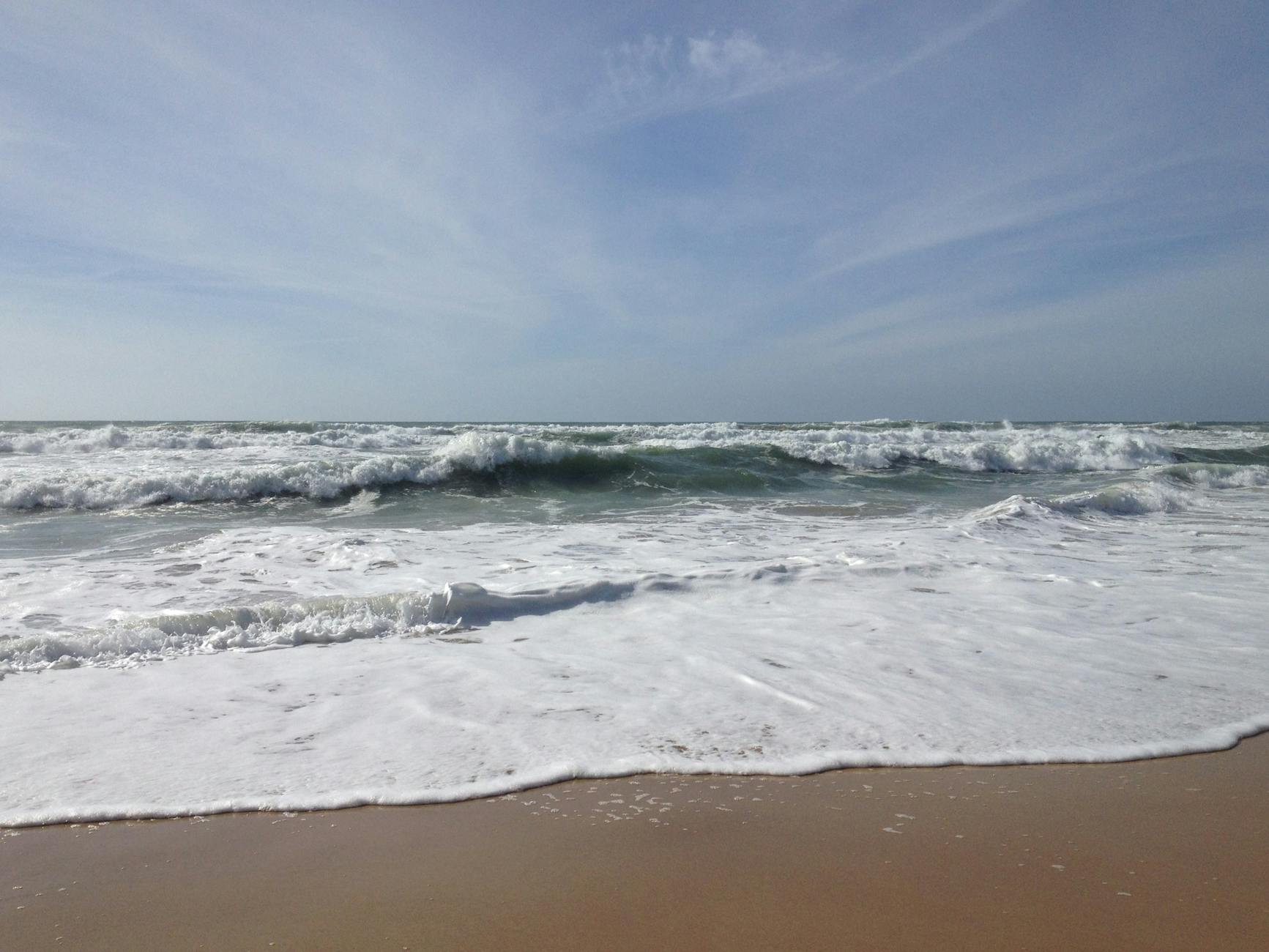
Cross the river and the coast changes character completely. The Costa da Caparica is about thirty kilometres of continuous sand divided into roughly two dozen named and numbered sections, backed by dunes and pine, and it is where Lisbon itself goes at the weekend.
Getting there: bus 3710 from Lisbon, or the ferry from Cais do Sodré to Cacilhas and a bus from there. Allow 45 minutes to an hour. In high summer a narrow-gauge beach train, the transpraia, runs south down the sand spit between the numbered beaches — it is the easiest way to reach the emptier stretches without a car.
The character changes as you go south:
- Costa da Caparica town beaches — busy, urban, plenty of cafés, easiest to reach, and the least attractive stretch.
- São João da Caparica, at the northern end near the fort, is a big open expanse that rarely feels crowded and is a good surf beach.
- The numbered beaches heading south get progressively quieter, younger and more alternative. Praia 19 is the long-established gay and naturist beach — see our gay Lisbon guide.
- Fonte da Telha, at the southern end, is the furthest and the wildest of the accessible stretches.
Our verdict: the best sand near Lisbon and the most Portuguese beach day available. The trade-off is a slower, less obvious journey and thinner infrastructure once you get past the town. Our Caparica guide has the mechanics.
Arrábida and Sesimbra: the beautiful water
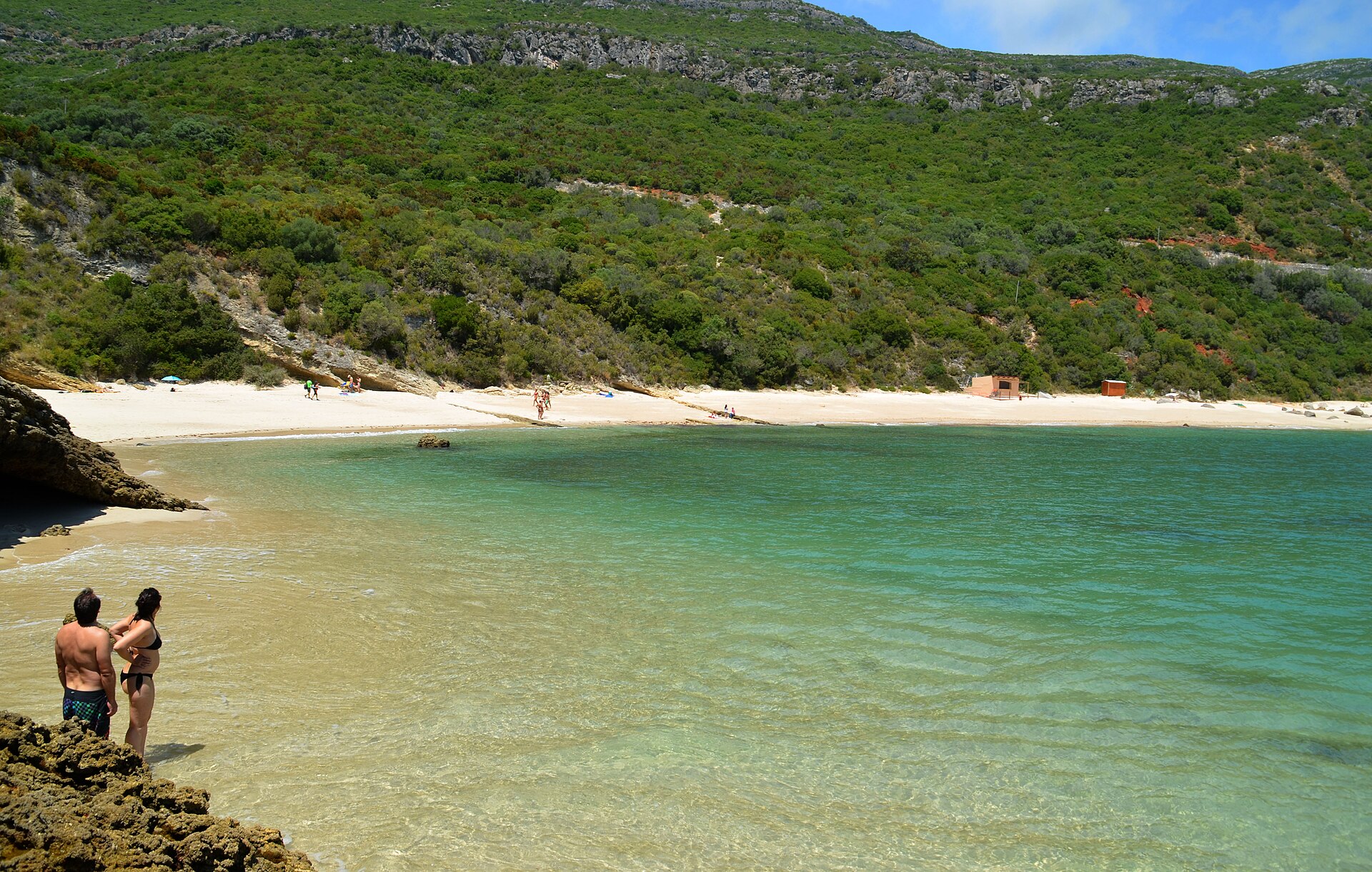
An hour south-east of Lisbon, the Serra da Arrábida drops into the sea and produces something that looks nothing like the rest of this coast: sheltered, pale-sand, turquoise-water coves facing south, protected inside the Arrábida Natural Park, with genuinely exceptional water quality.
- Portinho da Arrábida — the famous one, and the most photographed water near Lisbon. Small, gorgeous, and very difficult to reach in high summer, when access and parking are actively restricted to protect the park. Check the current arrangements before you set out; they change year to year.
- Praia dos Galapinhos and Praia da Figueirinha — the neighbouring coves, reached from Setúbal, with the same water and slightly easier access.
- Sesimbra — a proper fishing town with a sheltered town beach, excellent fish restaurants, and a castle above it. The easiest of this group to do without a car.
Our verdict: the best-looking beaches within reach of Lisbon, and the only ones where the water looks Mediterranean. But this is a full day out — an hour each way minimum, and much better with a car. Do not attempt it as a half-day. See our Arrábida guide and Sesimbra guide.
Which beach for which day
The short version, if you want to be told rather than to choose:
- You have one afternoon and no car: Carcavelos.
- You want a beach and a town in the same day: Cascais.
- You want the prettiest water: Arrábida — Galapinhos or Portinho — with a full day set aside.
- You want the biggest, emptiest sand: Costa da Caparica, heading south.
- You want to surf: Carcavelos to learn, Praia Grande or São João to progress, Guincho or Ericeira when you know what you are doing.
- You are with small children: Santo Amaro de Oeiras, Parede or São Pedro do Estoril — smaller, calmer, and the train stops at all of them.
- You want drama and photographs: Guincho or Adraga.
- You want to avoid everyone: the numbered Caparica beaches, or anywhere at all in May or late September.
Surfing
The coast around Lisbon is one of the best-served learning environments in Europe, mostly because there are beach breaks of every difficulty within an hour of the city and a school on almost all of them.
- Complete beginners: Carcavelos and Costa da Caparica. Sandy bottom, plenty of schools, easy logistics. A group lesson with board and wetsuit typically runs €35–€50 for two hours.
- Improvers: Praia Grande, São João da Caparica, Foz do Lizandro near Ericeira.
- Experienced: Ericeira, about an hour north, is a World Surfing Reserve — Ribeira d’Ilhas is the best-known wave — and Guincho when the wind cooperates.
The wetsuit is not optional at any time of year. Even in August, an hour in the water without one is unpleasant.
More in our surfing near Lisbon guide.
More in our Ericeira day trip guide.
Further afield: worth the extra hour
Three destinations sit beyond the standard day-trip radius and reward the extra travel if you have the time or a car.
Ericeira
About an hour north of Lisbon, Ericeira is a whitewashed fishing town that happens to be a World Surfing Reserve — one of a small handful worldwide. Ribeira d’Ilhas is the famous wave and hosts international competitions; Foz do Lizandro just south is the beginner-friendly beach with a river mouth and a wide, forgiving break. The town itself is genuinely pleasant, with good seafood and none of the polish of Cascais. Buses run from Campo Grande in Lisbon and take about an hour and a quarter.
Comporta and the Alentejo coast
South across the Sado estuary, past Setúbal, the coast opens into something completely different: enormous empty beaches backed by rice paddies, pine and cork oak, with almost no development and a reputation as the discreet-money end of the Portuguese coast. Comporta and its neighbours have some of the best sand in the country and effectively require a car — it is around ninety minutes from Lisbon and the last stretch has no useful public transport.
Troia
The peninsula opposite Setúbal, reached by a car and passenger ferry across the Sado, has long, calm, sheltered beaches on its estuary side and open Atlantic on the other. The estuary is also home to a resident population of bottlenose dolphins, which is unusual this close to a European capital and makes the ferry crossing worth doing on its own terms.
More in our Comporta from Lisbon guide.
Getting there: the practical mechanics
By train
The Cascais line from Cais do Sodré is the workhorse and covers everything from Belém to Cascais. Roughly every twenty minutes, more at peak. Fares are zonal: €2.20 to Carcavelos, €2.55 to Cascais (€1.30 child). Buy at the machine or load onto a Navegante card. The Lisboa Card includes these trains, which is one of the better arguments for it.
More in our guide to Lisbon beaches by train.
By ferry and bus
For Caparica: bus 3710 direct, or the ferry from Cais do Sodré across to Cacilhas and a connecting bus. The ferry costs a normal transport fare and is a lovely ten minutes on the water in its own right.
By car
A car genuinely helps for Guincho, the Sintra coast and Arrábida, and is unnecessary for everything on the train line. Be warned that beach parking in July and August is competitive to the point of futility — arrive before ten or do not bother. Our car rental guide covers whether it is worth it at all.
Season, weather and water
- June to September is the beach season proper: lifeguards on duty, beach bars open, everything running. It is also when the beaches are full and the afternoon wind is strongest.
- May and October are the sweet spot for a visitor — warm enough to sit out, the water no colder than it is in August, and a fraction of the crowds. Facilities are patchier and lifeguard cover may be limited.
- November to April the beaches are for walking, not swimming. They are magnificent for it: Guincho or Caparica on a bright January day, entirely empty, is one of the best things you can do near Lisbon.
Our weather by month and best time to visit pages have the temperature detail.
Beach safety
Take this seriously; the Atlantic here is not gentle.
- Swim between the flags where lifeguards are on duty. Portuguese beaches use a colour system: green means safe, yellow means wade but do not swim, red means stay out of the water. A chequered flag means the lifeguards are off duty.
- Rip currents are the main hazard on the open-coast beaches. If you are pulled out, swim parallel to the shore rather than against it.
- Shorebreak. Several of these beaches — Guincho and Praia Grande especially — have waves that break in very shallow water and can put an adult on the sand hard.
- The sun is stronger than it feels with a cool wind blowing. This is the single most common thing visitors get wrong.
What it costs
- Transport: €2.20–€2.55 each way by train; similar by bus or ferry to Caparica.
- Sunbed and parasol: where they exist, roughly €15–€25 for the pair for a day. Most people bring a towel and skip it.
- Beach bar lunch: €12–€20 a head for grilled fish, salad and a drink at a decent praia restaurant; less for a sandwich and a beer at a kiosk.
- Surf lesson: €35–€50 for a two-hour group lesson including board and wetsuit.
- Parking: free at most beaches, paid at Cascais and parts of Caparica, and impossible everywhere in August.
A beach day for two, travelling by train and eating a proper lunch, comes to around €50–€60 all in. It is the cheapest good day out in the region — see Lisbon on a budget.
What to bring
- A windbreak or a big towel, unless you enjoy sand at speed. Portuguese families bring proper shelters and there is a reason.
- A jumper or a fleece. Even in August the wind off the Atlantic makes late afternoon genuinely cool.
- Water and food. Fine on the developed beaches, essential on the numbered Caparica stretches and the Sintra coast, where there may be one kiosk or none.
- Cash. Beach kiosks are better than they were about cards, but not universally.
- Sandals you can walk in. The sand gets very hot and several of these beaches involve a long walk down and a longer walk up.
Our packing list covers the rest of the trip.
Portuguese beach culture, briefly
A few things that make more sense once somebody explains them:
- The shelters. Portuguese families arrive with proper windbreaks, sometimes with poles and guy ropes, and set up what looks like a small encampment. This is not overkill; it is a rational response to the nortada, and you will envy them by three o’clock.
- The bola de Berlim. A vendor will walk the sand calling out, selling doughnuts filled with custard from a cool box. Buying one is more or less obligatory and costs a couple of euros.
- Lunch is a real meal. The restaurante de praia is an institution — grilled fish, salad, a bottle of white, two hours. It is not a snack bar, and it is one of the best things about a beach day here.
- Nobody swims for long. Portuguese beach behaviour is largely about being on the sand rather than in the sea, for the obvious reason. Do not feel you are doing it wrong.
- Topless is normal, nudity is zoned. Topless sunbathing is unremarkable on any beach here. Full nudity is confined to the designated naturist beaches.
A beach day that works
If you want the whole thing planned:
- 09:30 — Cais do Sodré. Buy a return, get a seat on the right-hand side for the water.
- 10:00 — arrive Carcavelos, Oeiras or São Pedro do Estoril. The sand is uncrowded and the wind has not started.
- 10:15–13:00 — the good part of the day. Swim early, before the water gets churned up.
- 13:00–15:00 — lunch at a beach restaurant, out of the sun, while the wind builds.
- 15:00–17:00 — either back on the sand behind a windbreak, or on the train two stops to Cascais for a walk round the town and an ice cream.
- 18:00 — train back, into Lisbon for dinner at eight. If you have gone to Cascais, stay for sunset over the marina first.
That is a full, cheap, easy day and it is the one we would put in any Lisbon trip of four days or more — it is day four on our four-day itinerary for a reason.
Accessibility
Several beaches on this coast have seasonal accessible infrastructure — boardwalks over the sand, amphibious chairs available through the lifeguard station, and adapted showers and toilets. Carcavelos, Santo Amaro de Oeiras, Cascais and parts of Costa da Caparica are the most consistently equipped, and provision is generally summer-only, when lifeguards are on duty.
Provision varies year to year and by beach, so contact the municipality or the beach concession before relying on it. The wild-coast beaches — Guincho, Adraga, the Sintra coast — mostly involve steps, soft sand or a steep path and are difficult regardless. Our accessibility guide is honest about the wider picture.
Dogs
Rules differ by municipality and by season, and the general pattern is that dogs are not permitted on supervised bathing beaches during the summer season, while out of season the same beaches are relaxed to the point of being full of them. Some beaches designate a dog-friendly stretch. Check the signage at the entrance — it is posted, in Portuguese and usually English — and see our Lisbon with dogs guide.
What is not worth it
- Swimming in the Tagus. People ask. The answer is no — it is a working river with shipping and currents, and there are no bathing beaches within the city.
- Praia da Rainha in Cascais as a beach day. It is charming and roughly the size of a tennis court. Look at it, photograph it, and go to Carcavelos.
- Guincho on a windy afternoon with a picnic. Covered above, and the most common wasted beach day near Lisbon.
- A rushed half-day to Arrábida. It is an hour each way. Give it a full day or leave it for the next trip.
- Booked “beach transfer” tours. The train costs €2.20 and runs every twenty minutes. There is nothing to organise.
Beaches with something else attached
If a whole day of sand is not your idea of a holiday, several of these beaches come with a second reason to go.
- Cascais — a town with a fort, the Casa das Histórias Paula Rego, a marina, and the Boca do Inferno sea cave a short walk west. The beach is incidental and the day still works.
- Sesimbra — a working fishing harbour, a Moorish castle on the hill above, and some of the best fish restaurants in the region.
- Estoril — the casino, the gardens, and a promenade walk along the sea wall all the way to Cascais that takes about forty minutes and is one of the nicest flat walks near Lisbon.
- Guincho — pair it with Cabo da Roca, ten minutes up the coast, and you have the westernmost point of mainland Europe in the same afternoon.
- Praia das Maçãs — in summer, the historic tram from Sintra down to the coast, which is a genuinely lovely forty-minute ride and an attraction in its own right.
- Troia — the Sado ferry, the resident dolphins, and Roman ruins on the peninsula.
Pairing a beach with a town is also the safest hedge against the weather: if the wind is up or the cloud comes in, you have somewhere to go rather than a wasted journey.
Frequently asked questions
What is the closest beach to Lisbon?
Carcavelos, on the Cascais line — 19 to 26 minutes from Cais do Sodré for €2.20, then a ten-minute walk. It is also the closest Blue Flag beach with direct train access.
Can you swim in Lisbon itself?
No. Lisbon sits on the Tagus estuary and there are no bathing beaches in the city. Every beach in this guide requires a train, bus or ferry of at least 25 minutes.
How cold is the sea near Lisbon?
Cold. This is the open Atlantic with a cold current, and sea temperatures around Lisbon stay in the high teens Celsius even at the height of summer. It is swimmable, but a wetsuit is normal for anything longer than a dip.
Which beach near Lisbon is best for families?
The smaller Cascais-line beaches — Santo Amaro de Oeiras, Parede and São Pedro do Estoril — are sheltered, calmer and served by the same train. Carcavelos works too if you want facilities and space.
How do I get to Costa da Caparica?
Bus 3710 direct from Lisbon, or the ferry from Cais do Sodré to Cacilhas and a bus from there. Allow 45 minutes to an hour. In summer the transpraia beach train runs south along the sand to the quieter numbered beaches.
Is Guincho worth visiting?
Yes, in the morning, or for the surf, or for lunch with a view. It is one of the most dramatic beaches in the region and it is almost always windy, which makes an ordinary sunbathing afternoon there frustrating.
Which beach has the clearest water?
The Arrábida coves — Portinho da Arrábida, Galapinhos and Figueirinha — inside the Arrábida Natural Park, about an hour south-east. Access to Portinho is restricted in high summer, so check before you go.
When is the best month for a beach day near Lisbon?
June or September. Warm, long days, water no colder than August, and considerably fewer people. July and August are hot and full; May and October are quiet and pleasant with patchier facilities.
Do I need a car for the beaches near Lisbon?
Not for the Cascais line, which covers Carcavelos, Estoril and Cascais on a €2.20–€2.55 ticket. A car helps a lot for Guincho, the Sintra coast and Arrábida, though summer parking is difficult everywhere.
Are the beaches near Lisbon safe for swimming?
Where lifeguards are on duty and you swim between the flags, yes. Rip currents and shorebreak are real hazards on the open-coast beaches, and green, yellow and red flags mean safe, wade-only and stay out respectively.
Is there a nudist beach near Lisbon?
Praia 19 on the Costa da Caparica is the best-known, and is also the long-standing gay beach. Meco, further south near Sesimbra, is the other established naturist option.
Bottom Line
Lisbon has no beach and a hundred kilometres of them. For an easy day, take the Cascais line to Carcavelos for €2.20 and be on sand within half an hour; for a better day, get off a stop or two earlier at Oeiras or São Pedro do Estoril where the locals go. Cross the river to Caparica for the biggest, emptiest sand and the most Portuguese atmosphere, save Arrábida for a full day with a car because the water there is genuinely spectacular, and treat Guincho as a morning or a surf rather than an afternoon. Go early, bring a layer for the wind, respect the flags, and accept that the Atlantic is cold — everything else about a beach day here is close to perfect.
Photo Credits
Galapinhos beach: Galapinhos by Aabasch, CC BY-SA 4.0, via Wikimedia Commons.