Sintra
Cabo da Roca: Europe’s Westernmost Point
Free to visit, 40 minutes from Sintra, and best understood as a cliff walk rather than a photo stop. The 1624 bus, the wind, Praia da Ursa, and an honest verdict.
In this guide
Cabo da Roca is the westernmost point of mainland Europe: a granite headland a hundred and forty metres above the Atlantic, with a red-topped lighthouse, a stone marker carrying a line of sixteenth-century poetry, a car park, and a wind that will take your hat to Newfoundland. It is free, it is about forty minutes from Sintra, and it is one of the most over-photographed and under-explained places in Portugal. This guide tells you how to get there, what is actually there, how long to stay, and — honestly — whether it is worth the detour.
The stacks below the cape are the best-known beach on this coast, and the hardest to reach: our Sintra coast beaches guide is honest about the descent to Praia da Ursa.
Fifteen minutes south along the same coast is the beach that shares this headland’s weather — our Praia do Guincho guide pairs the two into one day.
The essentials
- Cost: free. There is no ticket, no gate and no opening time — the headland is open air, all day, every day.
- Getting there: Carris Metropolitana bus 1624, Cascais (Terminal) ↔ Portela de Sintra, via Azóia and Almoçageme.
- Time needed: 30–45 minutes for the monument and the viewpoint. Two to three hours if you walk the cliff paths, which you should.
- On site: a tourist office, a café, a gift shop, toilets, a large car park, and the lighthouse (not open to the public).
- Bring: a windproof layer, whatever the forecast says. This is not optional advice.
What is actually there
Let us be precise about this, because the photographs oversell it and the disappointment is avoidable.
Cabo da Roca is a headland in the Sintra-Cascais Natural Park where the Serra de Sintra runs out of land. On it you will find: a stone padrão — a cross-topped marker recording that this is continental Europe’s western extremity; the Farol do Cabo da Roca, a working lighthouse whose light has been on this headland since the eighteenth century and which is not generally open to visitors; a small tourist information office that sells a printed certificate confirming you stood here; a café and shop; and a viewing platform behind a low wall.
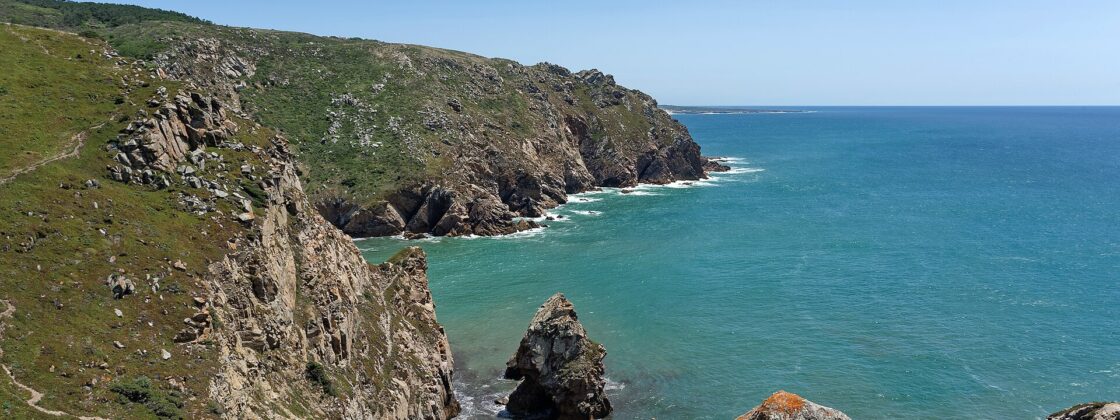
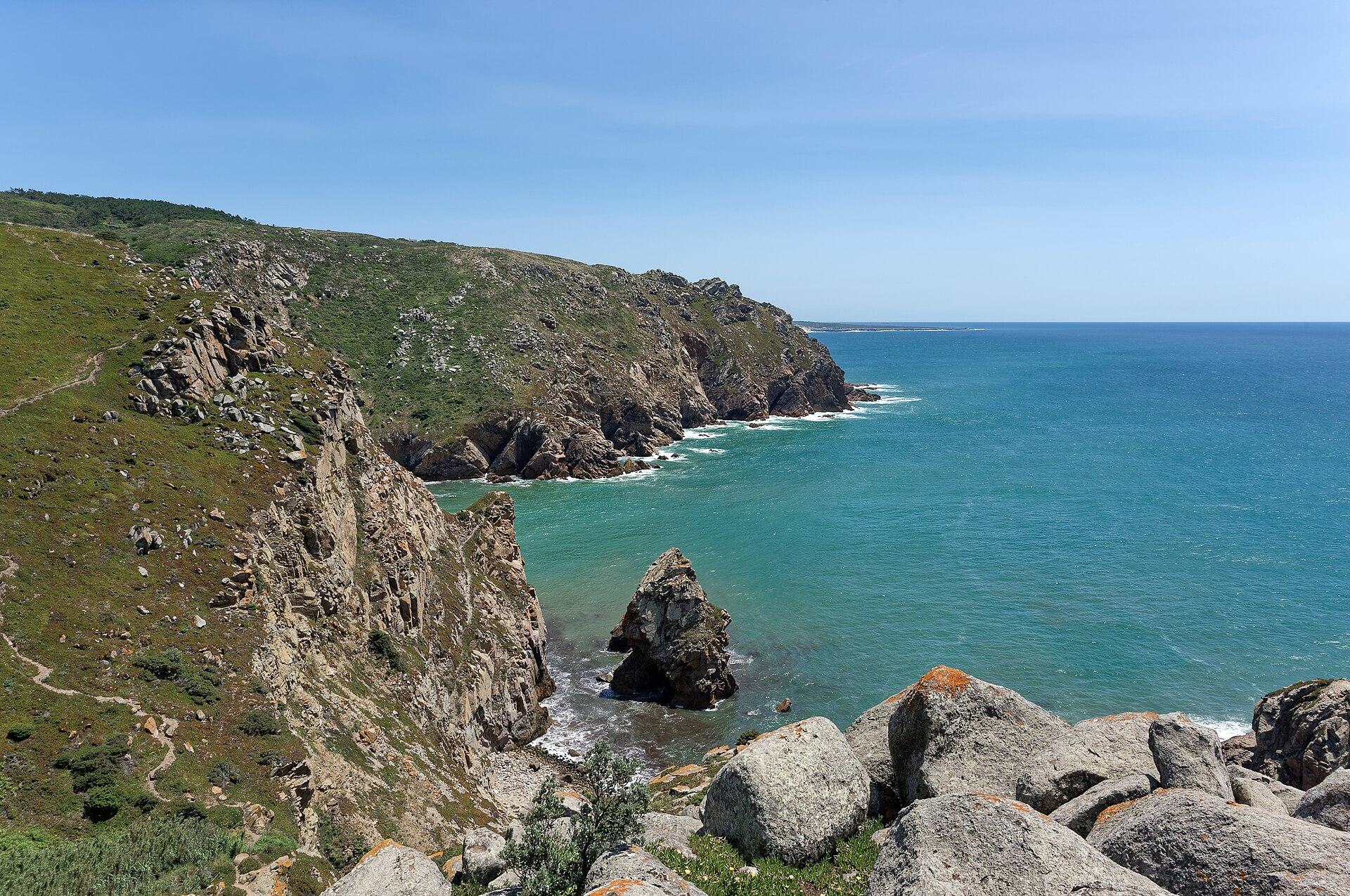
That is the whole of the built environment. It takes about twenty minutes to see, and coach tours allocate roughly that. What the coaches do not tell you is that the cape itself is the least interesting part of the site. The extraordinary thing here is the coastline running north and south of it — a serrated line of granite cliffs, coves and sea stacks with footpaths along the top and almost nobody on them.
The inscription
The marker carries the most quoted line in Portuguese literature: Luís de Camões’s description, from Os Lusíadas, of the place “where the land ends and the sea begins”. Camões wrote it about Portugal as a whole rather than about this specific rock, and the marker was put up in the twentieth century — but the line does exactly what it should, which is to remind you that for a very long time this cliff was, in European terms, the end of everything. Standing at it with the Atlantic doing what the Atlantic does is genuinely affecting for about ninety seconds, and there is no shame in that.
The certificate
The tourist office will sell you a diploma with your name on it certifying that you visited the westernmost point of continental Europe. It costs a few euros, it is entirely a souvenir, and whether it is charming or absurd depends on your temperament and the age of your children. We are not going to tell you not to buy one.
Getting to Cabo da Roca
By bus
The single most common error in older guides — and in a lot of currently published ones — is the bus number. Scotturb’s line 403 no longer exists. Carris Metropolitana took over the Lisbon region’s bus network in January 2023, and the route is now line 1624, running between Cascais (Terminal) and Portela de Sintra (Estação Norte) via Azóia and Almoçageme. Cabo da Roca is beside Azóia, and the stop is a short walk from the monument.
- From Cascais: around 33 minutes.
- From Sintra: around 40 minutes; the full Cascais–Sintra run takes about an hour.
- Frequency: roughly hourly, more often at peak times, and thinner on Sundays and holidays.
- Fare: about €2.60 a single at the time of writing. Confirm the current tariff on carrismetropolitana.pt before you travel — the zone fares change.
Check the timetable on the operator’s own site and note the last departure before you get comfortable on a cliff. The stop is remote, taxis do not cruise here, and missing the last bus is a genuine problem rather than an inconvenience.
By car
The easiest option by a distance, and the one we would choose. There is a large free car park at the cape, and the drive from Sintra takes about 25 minutes on the N247, from Cascais about 25 minutes along the coast road. In July and August the car park fills by late morning; go early or go late.
Driving also unlocks the point of the area, which is everything around Cabo da Roca — Praia do Guincho, Azenhas do Mar, Praia Grande, the Serra roads. See our car rental guide if you are considering it.
By organised tour
Most Sintra day tours from Lisbon bolt Cabo da Roca onto the end of the afternoon, typically for a twenty-minute photo stop before continuing to Cascais. If you were going on the tour anyway, that is fine and you lose nothing. Booking a tour specifically for Cabo da Roca is poor value; it is a free viewpoint. Our Sintra tours guide covers what the operators actually include.
Walking and cycling
There are cliff-top paths connecting Cabo da Roca north towards Praia da Ursa and Praia Grande, and south towards Guincho. They are magnificent, exposed, and unfenced in stretches. This is the best way to experience the cape, and it requires proper shoes and a sensible attitude to cliff edges.

Is Cabo da Roca worth it?
Here is the honest answer, in two parts.
As a twenty-minute coach stop: no, not really. If your entire experience is a car park, a queue for a photograph beside a stone marker, and a gift shop, you will wonder what the fuss was. It is a symbolic geographical point, not a spectacle, and the view — while good — is not meaningfully better than a dozen other places on this coast. The number of visitors who come away saying “it was just a rock” is high, and they are not wrong about what they saw.
As a half-day on the cliffs: yes, emphatically. Walk twenty minutes north from the car park and the crowd evaporates entirely. You get granite cliffs falling two hundred feet into water the colour of a swimming pool, coves you cannot reach, kestrels working the updraught, and the whole thing to yourself. This is one of the best coastal walks in Portugal and virtually nobody on the coaches ever sees it.
So the verdict is really about how you go. Do not make a special trip for the monument. Do make a special trip for the coastline. And if you are on a tour that stops here for twenty minutes, spend those twenty minutes walking away from the marker rather than queuing at it.
The two walks worth doing
If you take one thing from this page, take this: the walks are the reason to come, and both start from the same car park.
North, towards Praia da Ursa
Head north along the cliff top and within ten minutes the visitor centre is out of sight. Twenty-five minutes brings you to the viewpoint above Praia da Ursa, where the two great sea stacks stand offshore and the cliff drops away almost vertically. This is the photograph everyone has seen, and you can take it from the top without going anywhere near the descent. Allow an hour there and back at a gentle pace.
The path is clear, unfenced and undulating, on heath and rock. It is fine in trainers and unwise in sandals. There is no shade and no water.
South, towards Guincho
The southern path runs along the top of the Serra’s seaward face with a longer, wider view down the coast towards Cascais. It is less dramatic than the northern leg and considerably emptier, and it is the better choice on a busy afternoon or if you want an hour of not seeing anybody. You can walk as far as you like and turn around; there is no natural end point short of Guincho, several hours away.
What you will see on the way
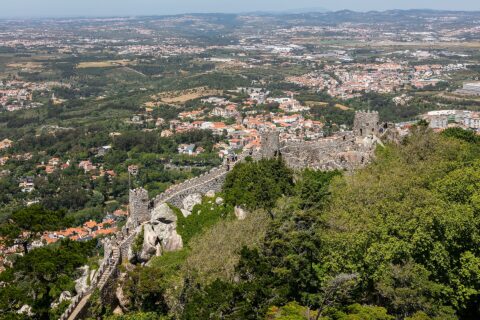
The headland is inside the Sintra-Cascais Natural Park, and the vegetation is a low, salt-burnt Atlantic heath — gorse, sea thrift, thyme and hottentot fig, with spring wildflowers from March. Kestrels and peregrines hunt the cliff face, and gulls nest on the stacks. The granite itself is the same body of rock that surfaces as the boulders at the Moorish Castle twelve miles inland; the Serra de Sintra is a single intrusion that ends here, in the sea, which is a satisfying thing to know while standing on the end of it.
Praia da Ursa — and a warning
The beach just north of Cabo da Roca, backed by two enormous sea stacks, is among the most photographed in Portugal and appears on every “hidden beaches” list. It should carry a warning, so here is ours.
The descent to Praia da Ursa is steep, unmaintained, partly on loose ground with a rope in places, and people are injured on it regularly. It is not a marked path in any meaningful sense. There is no lifeguard, no phone signal in the cove, and no easy way to get an injured person out. The Atlantic here has strong currents and cold water, and swimming is a bad idea in most conditions.
It is a spectacular place and plenty of people go down safely. But go with proper footwear, in dry conditions, not alone, not in flip-flops, and not at all if you are unsure. Photographs of it are free and involve no ambulance. The view down from the cliff path above is genuinely most of the experience.
The wind, and other practicalities
People underestimate this and then spend the visit miserable. Cabo da Roca is an exposed Atlantic headland facing the prevailing westerlies with nothing between it and North America. On an average summer afternoon it is windy; on a bad day it is difficult to stand up.
- Bring a windproof jacket in any month. A 28°C day in Lisbon can be 18°C and blowing hard at the cape.
- Hats and loose scarves will be lost. This is not a joke.
- Hold on to children near the wall. The drop is unfenced beyond the platform area.
- Drones are heavily restricted in the natural park and the wind makes them a liability regardless.
- Facilities are limited to the café, shop and toilets at the visitor building. There is nothing on the cliff paths.
- Sea fog is common in summer mornings and can reduce the view to nothing. It usually burns off by midday.
When to go
- Sunset is the obvious answer and it is correct — this is a west-facing cliff at the end of a continent, and the sun goes down into the ocean in front of you. It is also the busiest time, and you must have a car or a confirmed bus.
- Early morning is the quietest, though summer fog is a real risk before about ten.
- Spring and autumn give the best combination of clear air, wildflowers on the headland and manageable crowds. April to June is the sweet spot.
- Winter is dramatic — big Atlantic swell, empty paths — and frequently unpleasant. Go if the forecast is clear and you like weather.
- Avoid midday in July and August, when every coach on the Sintra circuit arrives within the same ninety minutes.
See the best time to visit Lisbon and weather by month for the seasonal picture, but remember that this coast has its own climate and is reliably cooler and windier than the city.
What to combine it with
Cabo da Roca on its own is not a day. Sensible pairings:
- Sintra in the morning, Cabo da Roca late afternoon. The classic, and it works if you have a car. On the 1624 bus it is tight but possible; check the last departure.
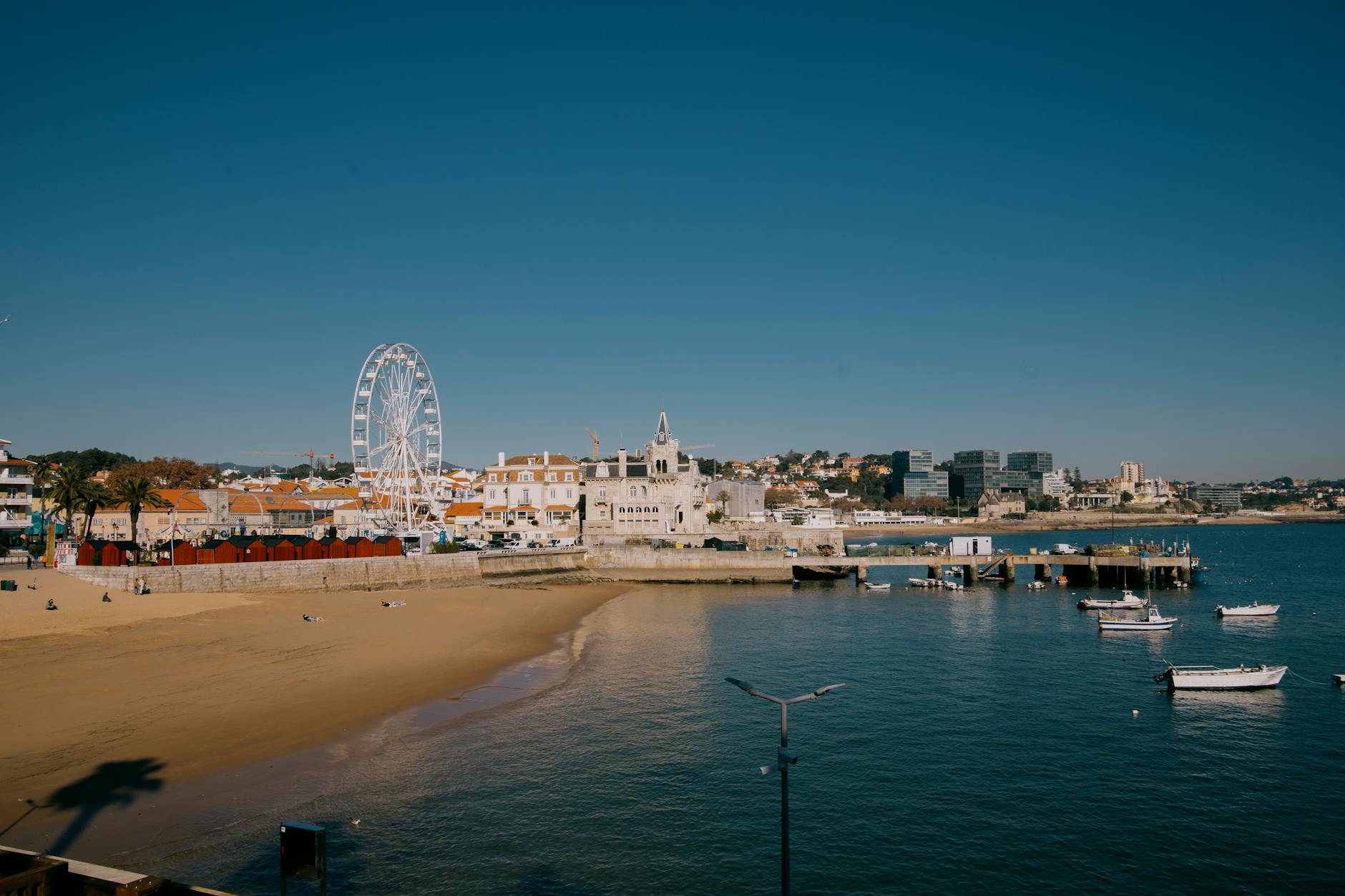
- Cabo da Roca and Cascais. The 1624 links them directly in about half an hour. Cape first, then a late lunch and a swim in Cascais — a very good day.
- Cabo da Roca, Praia Grande and Azenhas do Mar. The northern coast run, car only, and the best of the three for anyone who likes cliffs and empty beaches.
- Cabo da Roca and Praia do Guincho. Twenty minutes south, huge dunes, serious surf and the best seafood lunch on this coast.
What we would not do is try to fit Sintra’s monuments, Cabo da Roca and Cascais into a single day using public transport. That is three bus routes and a train, and it is the single most common way people ruin an otherwise excellent day out. Our Sintra day trip guide explains why, and day trips from Lisbon covers the alternatives.
A note on the geography
Cabo da Roca is the westernmost point of mainland Europe — the qualifier matters, and pedants will supply it. Further west lie the Azores, Iceland and various Atlantic islands that are European by politics if not by plate tectonics. On the continental landmass itself, this granite headland at roughly 38°47′N, 9°30′W is as far west as Europe goes, and it has been recognised as such since long before anyone could measure it properly.
The Romans called it Promontorium Magnum. Sailors called it the Rock of Lisbon and used it as the landfall mark for the Tagus, which is why the lighthouse matters and why there has been a light of some kind on this headland since the 1700s. If you want the wider story of Portugal’s relationship with this coastline, our history of Lisbon and the Monument to the Discoveries cover the era that this cliff opens onto.
Frequently asked questions
Is Cabo da Roca free?
Yes. There is no entrance fee, no ticket and no gate. Parking is free too. The only things you can pay for are the café, the gift shop and the souvenir certificate.
Which bus goes to Cabo da Roca?
Carris Metropolitana line 1624, running Cascais (Terminal) to Portela de Sintra via Azóia and Almoçageme. The old Scotturb 403 was absorbed into the Carris Metropolitana network in January 2023 and no longer exists under that number, which is worth knowing because a lot of guides still print it.
How long do you need at Cabo da Roca?
Thirty to forty-five minutes if you only want the monument, the viewpoint and a coffee. Two to three hours if you walk the cliff paths, which is what the place is actually for.
Can you visit the Cabo da Roca lighthouse?
Not usually. The Farol do Cabo da Roca is an operational lighthouse and is closed to general visitors, though Portuguese lighthouses occasionally open for heritage days. You can photograph it freely from the public area.
Is Cabo da Roca worth visiting?
For the cliff walk, yes — it is one of the finest stretches of coastline in Portugal. For the monument alone, it is a twenty-minute stop at a symbolic point, and a fair number of visitors find it underwhelming. Go with the walk in mind and you will not be one of them.
Can you swim at Cabo da Roca?
Not at the cape itself, which is cliff. Praia da Ursa below is reachable only by a steep, unmaintained scramble and has no lifeguard, strong currents and cold water — we would not recommend swimming there. For a proper swim, go to Praia Grande, Praia das Maçãs or Guincho, all of which have lifeguards in season.
Is Cabo da Roca good for sunset?
It is one of the best sunset spots in Portugal, facing due west over open ocean. Arrive at least half an hour early for parking, bring a warm layer, and make absolutely sure you have a way home — the last bus goes well before the light does in summer.
Bottom Line
Cabo da Roca is free, easy to reach and genuinely worth your time — provided you understand what you are going for. The monument is a photograph and a nice line of poetry, and twenty minutes is all it needs. The coastline either side of it is spectacular, empty and criminally overlooked, and it is why we would send anyone here.
So bring a windproof jacket, check the last bus before you settle in, walk north from the car park until the voices stop, and give the cape two hours instead of twenty minutes. Do that and it becomes one of the better afternoons of a Lisbon trip. Do the coach-stop version and it becomes a rock with a queue in front of it.