Sintra
Sintra National Palace: The Town’s Overlooked Best
Portugal's oldest surviving royal palace, in the middle of Sintra town: €13 tickets, the Sala dos Brasões, those chimneys, and why it beats Pena on a wet day.
In this guide
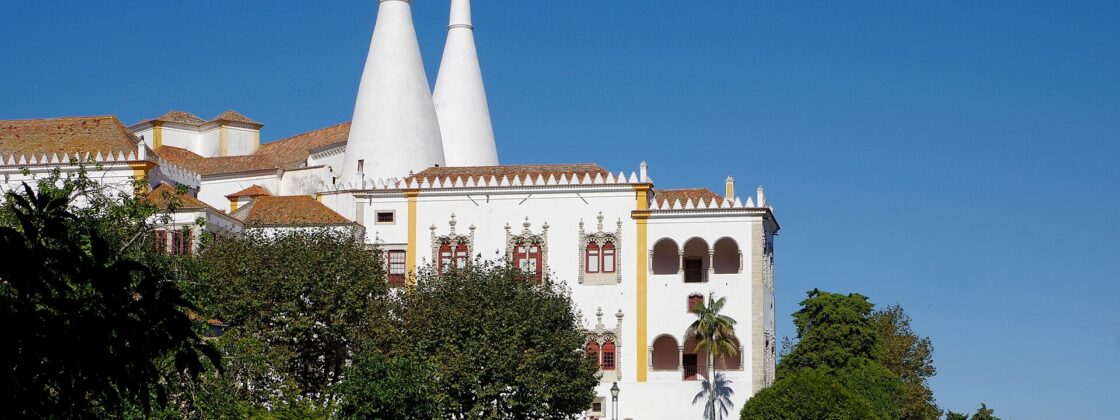
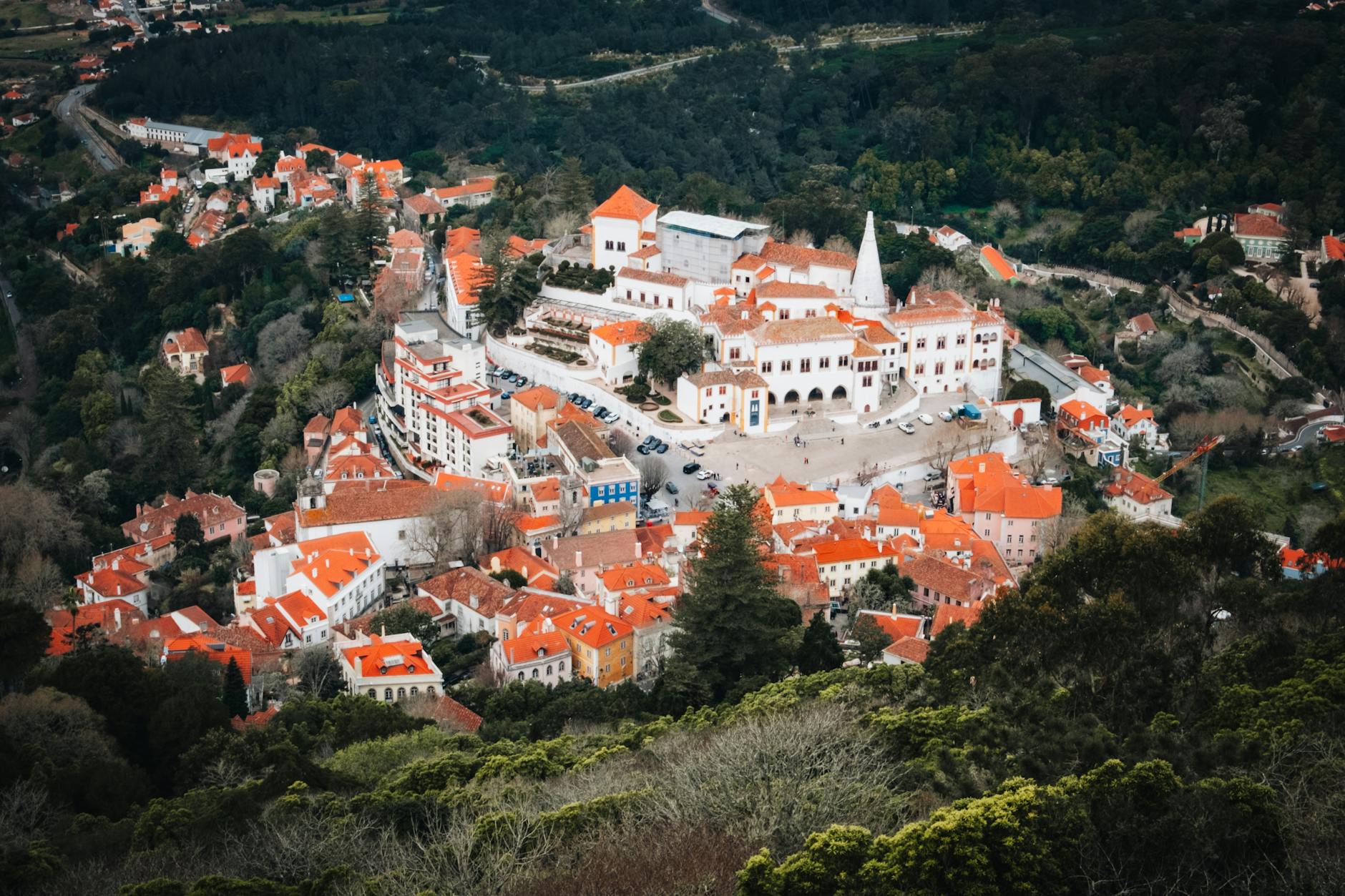
The Sintra National Palace — Palácio Nacional de Sintra — is the building with the two enormous white cones sticking out of it, standing in the middle of the old town where you cannot possibly miss it, and it is the Sintra monument that most visitors walk straight past on their way to the hill. That is a mistake, and this guide explains why. It is the oldest surviving royal palace in Portugal, it holds the country’s finest collection of medieval Mudéjar tiles, it needs no bus, and at €13 it is the cheapest serious ticket in town.

The essentials
- Adult ticket: €13. Youth (6–17) and seniors €10; family €35. Under-6s free.
- Hours: 09:30–18:30, last admission 17:30.
- Gardens: free to enter.
- Time needed: 60–90 minutes. It is a one-way route through about twenty rooms.
- Getting there: on foot. It is in the historic centre, roughly 20 minutes’ walk from Sintra station or two stops on the 434.
- Best for: bad weather, tired legs, anyone who likes tiles, and anyone who wants one Sintra monument that does not involve a hill.
Why this palace is the one people underrate
Sintra’s problem is that it has too much. Pena is on every poster; Regaleira has the initiation well that the internet loves; the Moorish Castle has the ridge walk. The National Palace, sitting flat in the middle of town looking like a large white building with a strange roof, does not photograph as an event. So people give it forty minutes at the end of the day, or skip it altogether.
What they miss is the only one of Sintra’s palaces that was actually lived in for six centuries. Portuguese kings and queens used this building continuously from the early 1400s to the 1880s. It was not a folly, a summer whim or a Romantic reconstruction — it is a real working royal residence that grew room by room across three architectural eras, and the joins are visible everywhere. Manueline windows open onto Mudéjar tilework; a Gothic hall gives onto a Renaissance chamber. It reads as a house that was added to by people who had strong opinions and no coherent plan, which is precisely what it was.
If you only have time for one indoor monument in Sintra, and you care more about history than spectacle, this is it.
A very short history
There was a Moorish residence on the site, taken along with the rest of Sintra by Afonso Henriques in 1147. The palace as you see it is essentially the work of two kings. João I, in the early fifteenth century, built the central core — the Swan Room, the Magpie Room, the kitchens and the chapel. A century later Manuel I, flush with money from the sea routes to India, added the eastern wing with its Coats of Arms Room and the elaborate window frames that give Manueline architecture its name.
After that the palace was mostly inherited rather than rebuilt, which is the reason it survives so intact. Its bleakest chapter belongs to Afonso VI, deposed by his brother and confined here from 1674 until his death in 1683 — nine years in a small room off the Chapel, where visitors are still shown the floor tiles said to be worn by his pacing. Treat that detail as tradition rather than documented fact, but the room itself is real enough and the atmosphere in it is genuinely unpleasant in a way no other Sintra interior manages.
The royal family used the palace until the fall of the monarchy in 1910, after which it became a national monument. It is run today by Parques de Sintra alongside Pena, Monserrate and the Moorish Castle.
What to see inside
The Swan Room (Sala dos Cisnes)
The largest hall in the palace and the first serious room on the route. Its ceiling is divided into octagonal panels, each holding a painted swan with a gold collar — twenty-seven of them, no two in quite the same posture. The traditional story links them to a daughter of João I sent to marry into Burgundy; whether or not that is true, the effect of standing under a ceiling of birds is the thing.
The Magpie Room (Sala das Pegas)
The best story in the building. The ceiling is covered in magpies, each holding a rose and a scroll reading por bem — “for the good”. The tale, told since at least the sixteenth century, is that João I was caught kissing a lady-in-waiting by his queen, Philippa of Lancaster, said “por bem” by way of explanation, and then had one magpie painted for every gossiping woman at court. It is almost certainly apocryphal and it is repeated on every tour, because it is a very good story about a king with a talent for making things worse.
The Coats of Arms Room (Sala dos Brasões)
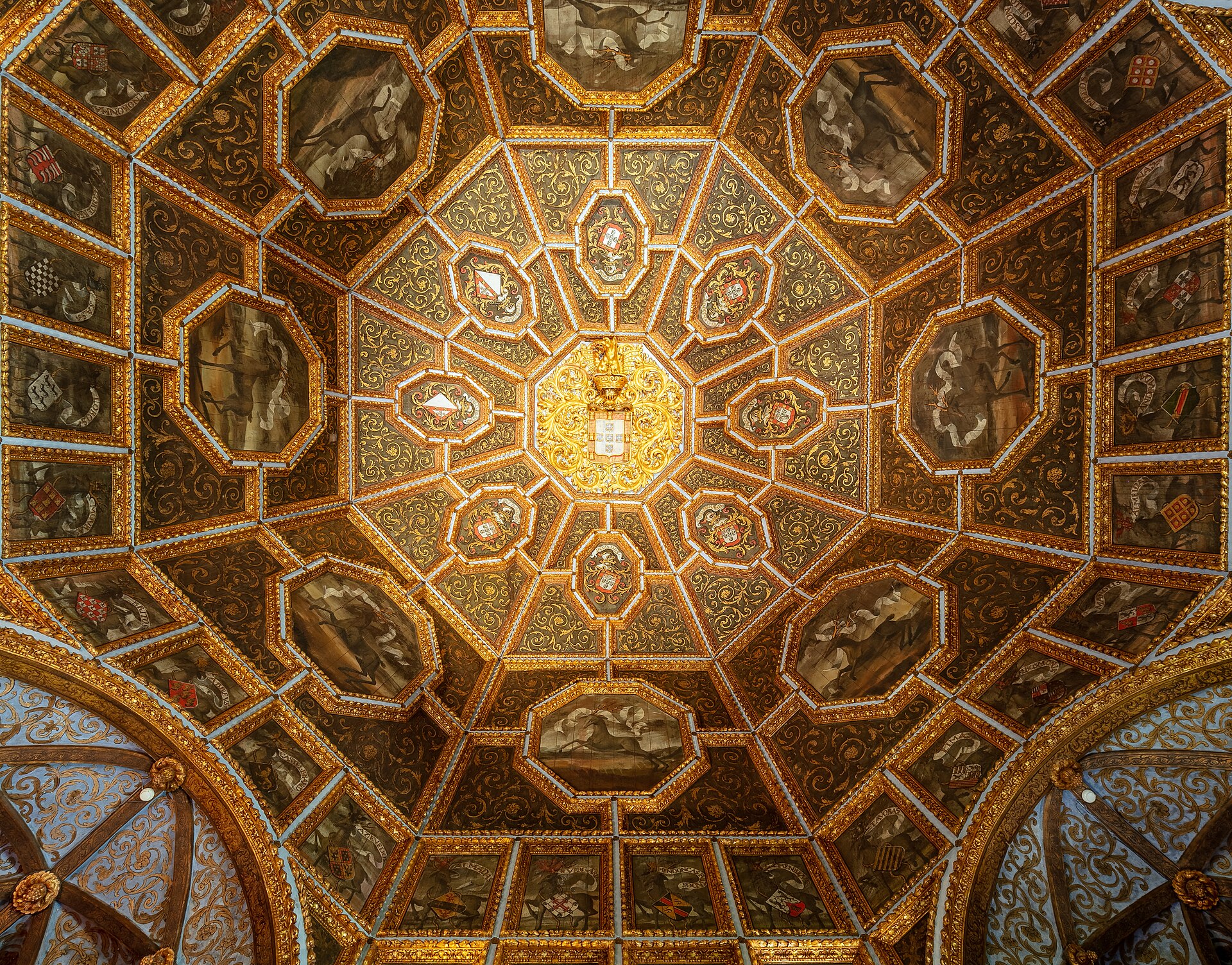
The set piece, and the room worth the ticket on its own. Manuel I’s heraldic hall has a gilded wooden dome of octagonal coffers carrying the arms of seventy-two Portuguese noble families, stags between them holding the shields, and the royal arms at the apex. Below, running right round the walls, is a band of eighteenth-century blue-and-white azulejos showing hunting scenes.
Look up for longer than feels natural. The room is a statement about a very specific moment — a king at the height of Portugal’s imperial wealth, arranging the entire nobility in a diagram with himself at the centre — and it is the single most impressive interior in Sintra, Pena included.
The kitchens and those chimneys
The two conical chimneys are not decorative and never were. They are the flues of the palace kitchen, and you walk into the base of them: a vast whitewashed cone rising above you into daylight, with the hearths and spits at floor level. Standing inside a chimney tall enough to lose your voice in is an oddly moving experience, and it is the bit children remember.
The Galley Room and the Manueline wing
Beyond the famous ceilings there is a run of quieter rooms that most visitors move through too quickly. The Sala das Galés takes its name from a painted ceiling shaped like an upturned hull, a reminder of where Manuel I’s money came from. The chambers of João III, the Golden Chamber and the small camarim beyond it are domestic in scale, and they are the rooms that make the building feel like a house rather than a museum — low doorways, awkward corners, windows cut where somebody once wanted light.
The Manueline window frames on the eastern facade are worth stepping outside for. Carved in the same twisted-rope, sea-knot vocabulary as the cloister at Jerónimos, they are among the earliest examples of the style anywhere, and they sit directly against fifteenth-century Gothic work that predates them by decades. That collision, repeated all over the building, is really what you have paid to see.
The Arab Room and the tiles
The palace holds what is generally reckoned the finest collection of Mudéjar azulejos in Portugal — the geometric, deeply glazed Hispano-Moresque tiles imported from Seville in the early sixteenth century, laid in dense repeating patterns quite unlike the blue-and-white narrative panels most visitors associate with Portuguese tilework. The Arab Room is the highlight, but the tiles are everywhere, and once you start noticing the different eras stacked on the same walls the whole route becomes more interesting.
If tiles are your thing, read our azulejo guide for how to tell the periods apart. Lisbon’s National Tile Museum is closed for works with no reopening date, so leave it out of your plans for now.
The Chapel and the Afonso VI chamber
The chapel is small, fourteenth-century in origin, with a painted wooden ceiling and a tiled floor of some age. The room beside it where Afonso VI was held is bare, low and grim, and the guides do not oversell it. It is a useful corrective in a town otherwise devoted to fantasy architecture.
Is the Sintra National Palace worth it?
Yes — and it is the Sintra ticket we would defend hardest. Here is the honest case, and the honest case against.
For: it is the cheapest of the major monuments at €13; it is in the town so it costs you no bus fare and no hill; it takes an hour rather than half a day; it is entirely indoors, which makes it the obvious choice when the Serra is in cloud; and the Sala dos Brasões is objectively finer than anything inside Pena.
Against: if what you want from Sintra is the sensation of walking through someone’s extravagant dream, this is not that building. It is a real house, and real houses are less theatrical than follies. Visitors expecting Pena’s colour or Regaleira’s strangeness sometimes find it sober. It is also a one-way route through a fixed sequence of rooms, so it does not reward wandering.
Where it fits against the others:
- Versus Pena (€20): Pena is the icon and the crowd. The National Palace is the better hour and half the effort. On a two-monument day, do Pena and this rather than Pena and something else on the hill.
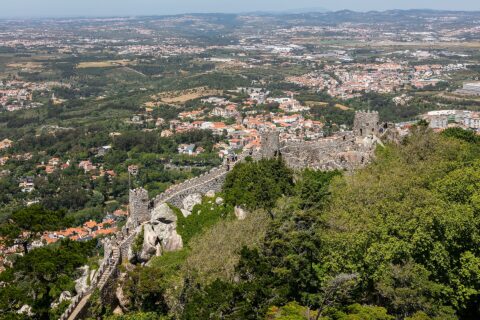
- Versus the Moorish Castle (€12): opposites. The castle is outdoors, physical, view-driven; the palace is indoors, decorative, weather-proof. Choose by forecast.
- Versus Quinta da Regaleira (€20): Regaleira is more fun and less historical. If you have children, Regaleira. If you have a rainy afternoon, the palace.
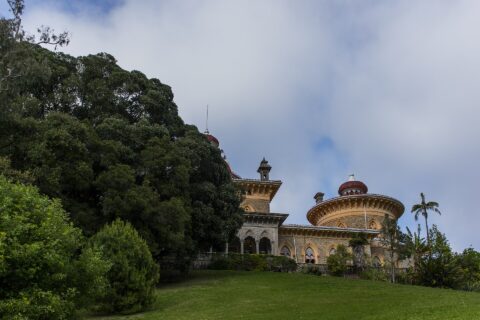
The fourth option most people never reach is covered in our Monserrate Palace guide.
Tickets and how to buy them
| Ticket | Price |
|---|---|
| Adult (18–64) | €13 |
| Youth (6–17) and senior (65+) | €10 |
| Family (2 adults + 2 youths) | €35 |
| Gardens only | Free |
Buy from Parques de Sintra online, where it is slightly cheaper, or at the door — queues here are far shorter than at Pena and there is no timed entry, so the palace is the piece of your day that can move. Combined tickets pairing it with Pena or the Moorish Castle exist and save a few euros. Quinta da Regaleira is privately run and is never included.
The Lisboa Card covers the train to Sintra but not the monuments, which is a distinction that catches people out at the door. Our tickets and tips page works through the combinations properly.
What the palace tells you about Sintra
There is a reason every subsequent owner of a Sintra hillside built something extravagant on it. The court came here in summer because the Serra is reliably five or six degrees cooler than Lisbon and holds moisture the coastal plain does not, and where the court went, the aristocracy followed, and where the aristocracy went, the English money of the nineteenth century followed after that. Pena, Regaleira, Monserrate and Seteais all exist downstream of a decision made in the fourteenth century about where the king would spend August.
Visiting the National Palace first, rather than last, reframes the rest of the town. The follies on the hill stop being a random collection of eccentricities and start reading as four hundred years of people competing with a building they could all see from their windows. It is a small shift, and it makes the day better.
When to go
The palace absorbs visitors better than Pena because it is a walking route rather than a set of bottlenecks, but the middle of the day in high season is still slow going, with tour groups stacking up in the Swan Room.
- Best: first thing at 09:30, or after about 16:30 once the coach parties have gone back down the hill.
- Ideal use: as your rainy-day monument, or as the last stop of a Sintra day when your legs have given up. It closes at 18:30 with last admission at 17:30, later than the Moorish Castle, which makes it the natural closer.
- Avoid: 11:00–14:00 from June to September if you can help it.
Sintra’s own weather is worth checking separately from Lisbon’s — the Serra makes its own cloud, and the day that ruins the ridge view is the day this palace is the right answer. See the best time to visit.
Practical notes
- Accessibility: better than any other Sintra monument, but not step-free. There are stairs between levels and worn floors throughout; ask at the ticket desk about the accessible route. Our accessibility guide has more.
- Photography is permitted without flash. The ceilings are the point, so a wide lens or a phone’s ultra-wide earns its keep here.
- Bags: large rucksacks are not welcome in the narrower rooms; there is limited storage at the entrance.
- Route: one-way, roughly twenty rooms, no shortcuts back. Use the loo before you start.
- The gardens are free and are a decent shady sit if you are waiting for someone.
- Eating: you are in the town centre, so you have the whole of Sintra’s old quarter within three minutes’ walk — which is more than can be said for anywhere on the hill.
Our guide to eating in Sintra covers what is worth it around the palace.
Fitting it into a Sintra day
The shape that works, and the one we recommend in our Sintra day trip guide: early train from Rossio, bus 434 straight to the top for a booked Pena slot, walk down to the Moorish Castle, walk down into town, and finish at the National Palace in the late afternoon before it closes at 18:30. That is three monuments, one bus fare, and gravity doing most of the work.
If you have a half-day rather than a full one, the palace alone is the best use of it — you can be off the train, through the palace, fed, and back on a train in about three hours, which is not true of anything on the hill.
Frequently asked questions
How long do you need at the National Palace of Sintra?
An hour if you move; ninety minutes if you read the panels and look properly at the ceilings. It is a fixed one-way route of about twenty rooms, so the range is narrow.
Is the Sintra National Palace worth it compared to Pena?
Different things. Pena is the more astonishing object from outside and the more crowded experience inside; the National Palace has better interiors, more history and no hill. Most people should do both. If forced to choose one on a wet day, choose this.
Do you need to book the Sintra National Palace in advance?
No. There is no timed entry and the queue is rarely serious. Booking online saves a little and is worth doing if you already have a Parques de Sintra basket open for Pena.
What are the chimneys at Sintra Palace for?
They are the kitchen chimneys, and they are entirely functional — two conical flues drawing smoke from the palace hearths. You can walk into the base of them, which is the single most memorable thing in the building for most visitors under twelve.
Is the palace suitable for children?
Reasonably. It is short, indoors, and the chimneys, the swans and the magpies all land well with younger children. It has less running-around room than Regaleira, so if you are picking one child-friendly monument, Regaleira wins. See Lisbon with kids for the wider picture.
Can you visit the gardens without a ticket?
Yes — the palace gardens are free. The interiors, which are the reason to come, are not.
Bottom Line
The Sintra National Palace is the town’s best-value monument and its most consistently underrated one. It is cheaper than Pena, takes a third of the time, needs no bus, works in any weather, and contains in the Sala dos Brasões an interior that nothing else in Sintra can match.
Give it an hour on the way in or the way out, rather than treating it as the thing you do if there is time left. If the Serra is under cloud and the ridge is a white blur, cancel the hill entirely and spend the money here instead — you will get a better day out of it, and you will finally learn what those chimneys are for.