Sintra
Quinta da Regaleira: Tickets, Initiation Well and Tunnels
The 2026 ticket, the timed-entry system, how to reach the Initiation Well without a 45-minute queue, and what else on the estate is worth your time.
In this guide
Quinta da Regaleira is the strangest thing in Sintra and, for a lot of visitors, the best. It is not a royal palace and not a national monument — it is a private estate built at the turn of the twentieth century by a rich Brazilian-Portuguese collector with an interest in alchemy, the Knights Templar and freemasonry, who filled four hectares of hillside with grottoes, towers, chapels and a spiral well cut 27 metres down into the rock. There is nothing else quite like it in Europe.
Ten minutes further west on the same 435 bus is Monserrate, the other great garden on this hill — less theatrical than Regaleira, considerably quieter, and the two pair into the best low-effort day in Sintra.
This guide covers the 2026 ticket, the timed-entry system that catches most people out, how to reach the Initiation Well without queueing for an hour, and what to actually do with your time once you are inside. It also says plainly which parts of the estate are worth your legs and which are not.

The essentials
- Price: €20 adult in 2026. Youth and senior €15, family €60. Under-5s free but they still need a ticket.
- Hours: gardens 09:00–19:30 and the palace, chapel and exhibition rooms 10:00–19:00 on the summer schedule, with last admission at 17:30. Hours change by season — check regaleira.pt before you travel.
- Timed entry: slots every 30 minutes from 09:00 to 16:30. You get a one-hour grace period after your slot, which is more forgiving than the Parques de Sintra sites.
- Closed: 1 January and 24, 25 and 31 December.
- Buy from: regaleira.byblueticket.pt, the only authorised online seller. Ignore anyone else.
- Time needed: two hours minimum, three if you want the whole estate. Most people underestimate this.
- Audio guide: €5 at the ticket office, with 30 listening points. Worth it — the estate is dense with symbolism that is invisible without explanation.
One point that trips up a great many visitors: Quinta da Regaleira is privately run and is not included in any Parques de Sintra combination ticket. If you have bought a Pena and Moorish Castle bundle, it does not cover this. Nor does the Lisboa Card.
What the place actually is
The estate was bought in 1892 by António Augusto Carvalho Monteiro, an entomologist and book collector who had made a fortune in Brazilian coffee and precious stones and was known in Sintra as Monteiro dos Milhões — Monteiro of the Millions. Between 1898 and 1912 he worked with the Italian architect and opera set designer Luigi Manini to build what he wanted: not a house to live in, but a landscape encoded with the symbolism of the orders that interested him.
That origin explains everything odd about the place. The Gothic Revival palace has pinnacles and gargoyles but only a handful of usable rooms. The chapel has a Templar cross in the floor and an inverted image of the Holy Trinity. The gardens have two initiation wells that were never wells, connected by tunnels to grottoes with names like the Portal of the Guardians. Sintra’s other estates were built to impress or to live in; this one was built to be read.
UNESCO listed the whole Sintra cultural landscape in 1995, and the municipality bought Regaleira in 1997, opening it to the public a year later. It is now the second most visited site in Sintra after Pena.
The Initiation Well
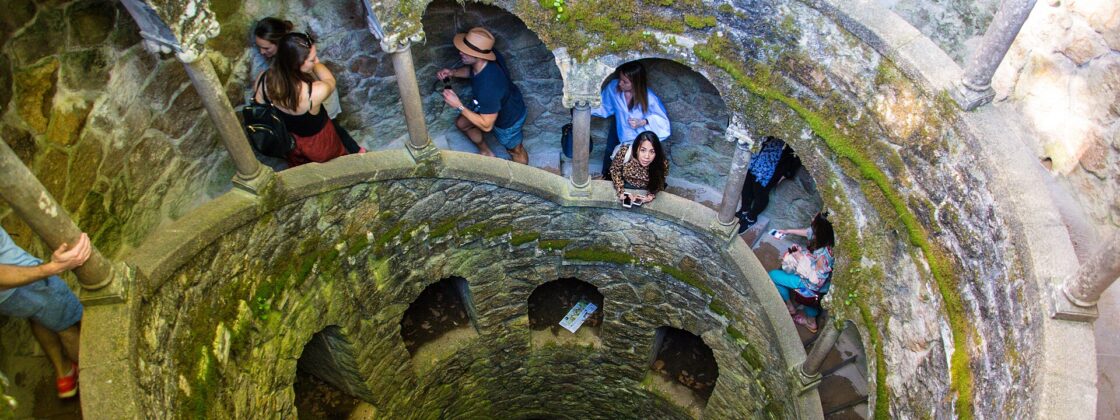
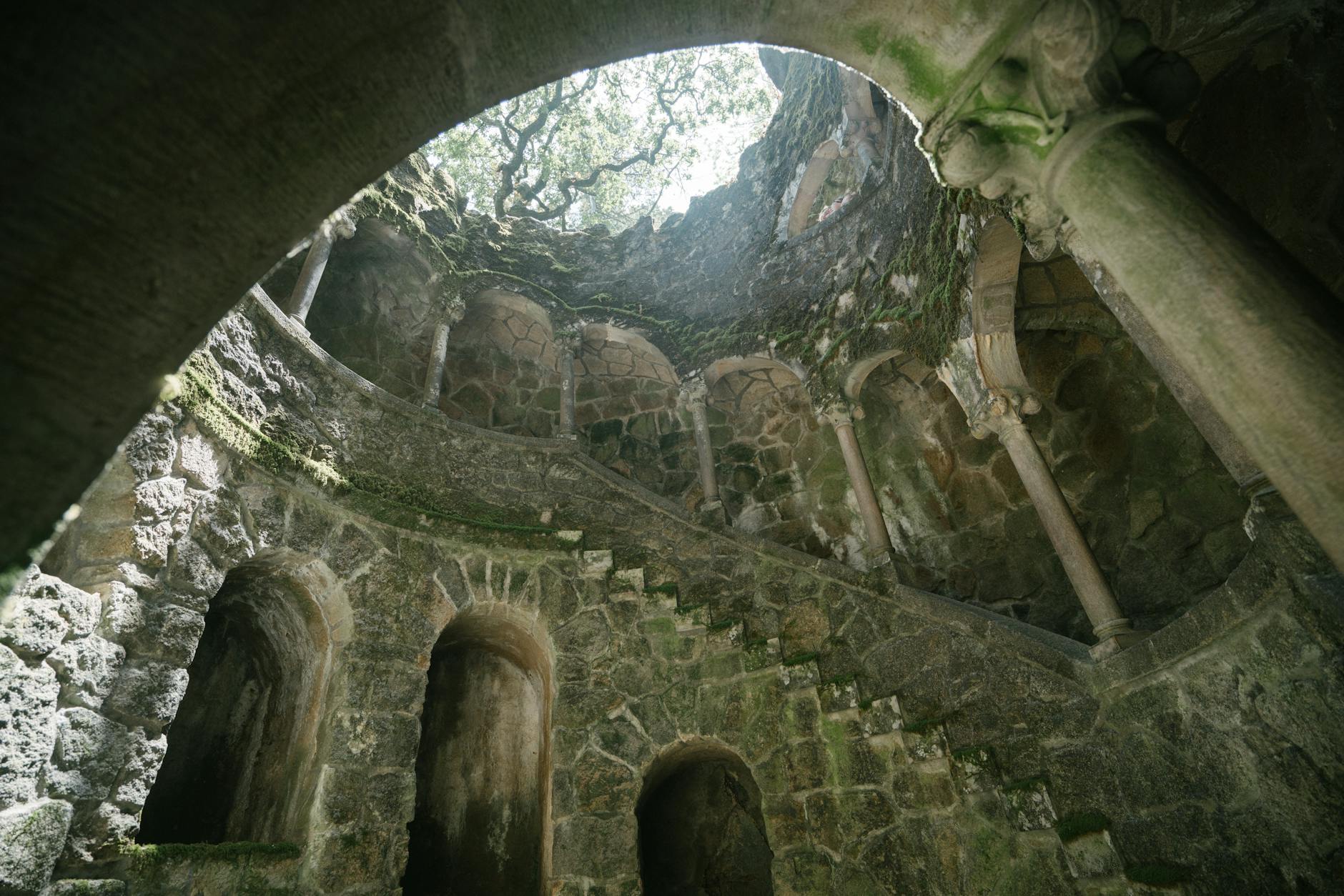
This is what people come for and it deserves the attention. The Poço Iniciático is an inverted tower: a shaft 27 metres deep with a spiral staircase of nine landings winding down its inner wall, lit from a single opening at the top. It was never a well. It was built for ceremonies — the nine landings are usually read as the nine circles of Dante’s Inferno, or the nine levels of a Templar or masonic initiation, depending which interpretation you prefer.
You descend from ground level and come out at the bottom into a tunnel system that runs under the garden and emerges, after a few dark and slightly damp minutes, either at the Waterfall Lake — where you cross the water on stepping stones — or at the Portal of the Guardians. Doing it in that direction, down and then out, is the intended sequence and much the better experience.
How to avoid the queue
Here is the practical advice this page exists for. The well is the bottleneck of the entire estate. The staircase is narrow, one-way, and by midday the line to enter the top can run 30 to 45 minutes, with people funnelled through in slow batches.
Two things fix that. First, book the earliest slot you can, get through the gate and walk straight to the well before doing anything else — most visitors turn left towards the palace first, which buys you twenty minutes of clear ground. Second, if you have arrived late and the queue is long, walk down to the Waterfall Lake and enter the tunnel from the bottom instead. You will climb rather than descend, which loses some of the drama, but you will skip the entire line.
A note on photographs
The overhead shot everybody has seen — the perfect green spiral — is taken looking straight down from the top opening, and the top opening is behind a railing that a queue is moving through. You will get roughly fifteen seconds. Have the camera ready. The better photograph, and the one fewer people take, is from the third or fourth landing looking up, where the moss and the stonework read properly.
The rest of the estate
Regaleira is often reduced to the well, which is a shame — the well takes ten minutes and the ticket covers four hectares.
The palace
Five floors of Gothic Revival with Manueline and Renaissance details piled on. The interior is sparsely furnished, because it never held Monteiro’s collection in the way a house museum would, and some visitors find it underwhelming after the gardens. What is worth the climb is the roof terrace, reached by a narrow spiral stair, which gives you the whole estate laid out below and the Moorish Castle on the ridge opposite. Thirty minutes.
The chapel
Small, and the most concentrated piece of symbolism on the site. Above the door, the Annunciation; inside, a Templar cross set into the floor, an inverted pentagram, and stained glass with the arms of the Carvalho Monteiro family. There is a crypt beneath it connected — of course — to the tunnel system. Ten minutes, and much better with the audio guide running.
The second well
The Unfinished Well, or Poço Imperfeito, is smaller, straight-sided rather than spiral, and almost always empty of people. It is a two-minute detour from the main path and worth it purely for the contrast.
The grottoes and the tunnels
A network of passages links the wells, the Waterfall Lake, the Grotto of the East and the Portal of the Guardians. Some sections are unlit, low and genuinely dark; there are handrails but the floor is uneven and wet in winter. This is the most enjoyable part of the estate for children and the least enjoyable for anyone claustrophobic. Allow forty minutes to do the whole network properly.
The upper gardens
Terraces, a Portuguese-tiled bench, the Fonte da Abundância, and a viewpoint over the valley. The paths climb steadily and the gravel is loose in places. This is the part to cut if you are short of time or energy — it is pleasant rather than remarkable.

The symbolism, briefly decoded
Almost every guide to Regaleira gestures vaguely at “Templar and masonic symbolism” and leaves it there. It is worth a little more than that, because knowing what you are looking at changes the visit from a pretty garden into a legible one.
Carvalho Monteiro was interested in the Order of Christ — the Portuguese successor to the Knights Templar — in alchemy, and in Dante. Manini, his architect, had spent a career designing opera sets, and the estate is laid out like one: a sequence of scenes you move through in order, each with its own iconography.
- The nine landings of the Initiation Well map onto Dante’s nine circles of Hell, and equally onto nine degrees of masonic initiation. The descent is symbolic death; the emergence from the tunnel into daylight at the Waterfall Lake is rebirth. That is why the intended direction is down and out, not up and back.
- The compass rose set into the floor at the bottom of the well carries a Templar cross over the Carvalho Monteiro arms.
- The chapel floor repeats the Templar cross, and the ceiling shows an inverted representation of the Trinity — a deliberate reversal that would have been read as heterodox at the time.
- The Portal of the Guardians, where two stone figures flank the tunnel exit, marks the boundary between the ordered garden above and the underground world below.
- The Fonte da Abundância and the terraces above it use classical and Renaissance figures for the outward, public face of the estate — the material world, as against the mysteries underneath it.
None of this is settled scholarship; Monteiro left no explanatory key, and much of the interpretation is later reconstruction. But the estate was unquestionably designed to be decoded, and reading it that way is far more rewarding than treating it as landscaping.
Getting there
Regaleira sits about ten minutes on foot from Sintra’s historic centre, uphill along Rua Barbosa du Bocage. It is one of the few Sintra sites you can genuinely reach without transport — Pena and the Moorish Castle both need bus 434 or a long climb, but Regaleira does not.
From Sintra station the walk is roughly 25 minutes, mostly gentle, through the town centre past the National Palace. Bus 435 (the “Villa Express” circuit) stops outside and continues to Seteais and Monserrate, which is the useful route if you are combining them. Bus 434, the Pena circuit, does not stop at Regaleira — a very common mix-up.
From Lisbon, the train from Rossio takes about 40 minutes; our Lisbon to Sintra train guide covers tickets and timings, and the Sintra day trip guide sets out how to sequence a whole day.
For the bus passes, the queue-beating order and which combination tickets are actually worth buying: our Sintra tickets and transport guide.
How to fit it into a Sintra day
The scheduling problem in Sintra is that Pena Palace is timed-entry on a fixed slot and everything else has to flex around it. Regaleira, with its half-hourly slots and one-hour grace period, is the most forgiving site in town, which makes it the right thing to build around Pena rather than against it.
If you are building Sintra into a longer Lisbon trip rather than treating it as a standalone day, our combined Lisbon and Sintra itinerary sequences the whole thing.
If you have one day and want two sites
Pena on the first slot of the morning — see our Pena Palace guide — then bus 434 back down, lunch in the historic centre, and Regaleira on a mid-afternoon slot. You will get the well after the coach groups have thinned and before the last admission at 17:30. This is the best pairing in Sintra and it works.
If you have one day and want to skip Pena
An unpopular opinion that a lot of people come round to: Regaleira plus the Moorish Castle is a better day than Pena plus anything. Regaleira on the 09:00 or 09:30 slot with the estate almost empty, three hours there, lunch, then the castle walls in the afternoon light. Cheaper, quieter, more interesting.
If you have half a day
Regaleira alone, on an early slot, and then the town. Two and a half hours in the estate, an hour wandering Sintra’s centre and a queijada from Piriquita. Back in Lisbon by mid-afternoon. Our Sintra guide covers the town itself.
What is next door
Regaleira sits on the road west out of Sintra town, and three more sites lie along the same stretch. If you have a full day and any energy left, this is the direction to walk in — it is downhill on the way out and much quieter than the Pena road.
Palácio de Seteais
Five minutes further on, an eighteenth-century neoclassical palace now run as a hotel. You cannot tour the interior, but the gardens and the triumphal arch between the two wings are open to walk through and the view south across the valley is one of the best in Sintra. It costs nothing and takes fifteen minutes.
Monserrate
About twenty-five minutes on foot beyond Seteais, or a short hop on bus 435. A Moorish-influenced Victorian palace built for an English merchant, surrounded by a botanical park that collects species from Mexico, Australia and Japan. It is the least crowded major site in Sintra by a wide margin. The palace roof is under restoration into early 2027, though the gardens are unaffected — worth knowing before you make the trip.
Sintra town
Ten minutes back the other way. The National Palace with its two conical kitchen chimneys, the cluster of pastry shops around Piriquita, and the tourist office. This is where to eat: the restaurants immediately around Regaleira are aimed squarely at people who have just come out of Regaleira, and priced accordingly.
Trying to do Regaleira, Monserrate and Pena in one day is possible on paper and miserable in practice. Pick two. Our Sintra tours guide covers the organised alternatives if you would rather not manage the logistics yourself.
Practical notes
What to wear
Proper shoes, not sandals. The tunnels are wet, the well steps are worn granite and slippery in any weather, and the garden paths are gravel and steep in places. Sintra also sits several degrees cooler than Lisbon and holds Atlantic mist on the hill — take a layer even in August.
Accessibility
Be realistic: this is a difficult site. The Initiation Well is a narrow spiral staircase with no lift and no alternative route from the top. The tunnels are uneven, low in sections and unlit in others. Much of the garden is on steep gravel paths. The palace has a stair-only upper floor. The ground-level terraces near the entrance and the chapel are manageable, but a full visit is not realistically possible with a wheelchair or significant mobility limits.
With children
Regaleira is the best site in Sintra for children by a distance — tunnels, caves, stepping stones, a spiral staircase and a tower. Under-5s are free (still ticketed). The one caution is the well itself: nine flights with an open drop on one side and no barrier at some landings. Hold on to small children the whole way down.
Food
There is a café by the entrance with reasonable coffee and unreasonable sandwiches. Eat in Sintra town before or after instead; it is ten minutes away and vastly better. Take water with you — there is a lot of climbing and few places to buy anything inside the estate.
Crowds by time of day
The quietest window is the first hour after opening. The busiest is 11:30 to 14:30, when the Lisbon coach tours and the mid-morning trains converge. From about 16:00 it empties again, and the last two hours before closing are genuinely pleasant, though the light in the well is best in the middle of the day when the sun is overhead.
Is it worth €20?
Yes — with a caveat. If you go, walk the well, photograph it and leave after fifty minutes, you have paid €20 for a staircase and you will feel it. Regaleira only justifies the price if you give it two to three hours and use the audio guide, because the whole point of the estate is that it is a designed sequence rather than a single attraction.
Compared with the rest of Sintra: it is €20 against €20 for Pena, €13 for the National Palace and €12 for the Moorish Castle. Pena has the better exterior and the worse crowds. The Moorish Castle has the better view and costs less. Regaleira has the most to actually do, and it is the one people talk about afterwards.
The honest verdict: if you are visiting Sintra once in your life, do Pena and Regaleira. If you are coming back, or if Pena’s queues put you off, Regaleira is the one to keep.
Frequently asked questions
Do you need to book Quinta da Regaleira in advance?
In high season, yes — slots do sell out, particularly the early morning ones that are worth having. Book at regaleira.byblueticket.pt, which is the only authorised online seller. Out of season you can usually walk up and buy at the gate.
Is Quinta da Regaleira included in the Sintra combined tickets?
No. It is privately managed by a foundation and sits outside the Parques de Sintra system entirely, so no Pena, Moorish Castle or Monserrate bundle includes it. The Lisboa Card does not cover it either.
How long does a visit take?
Two hours as an absolute minimum, three to see the estate properly. The well itself takes ten minutes; everything else is the reason the ticket costs what it does.
Can you go down the Initiation Well, or only look at it?
You walk all the way down the spiral staircase and out through the tunnels at the bottom. It is one-way and the descent is the intended direction, although you can also enter from the bottom near the Waterfall Lake if the top queue is long.
What is the difference between Quinta da Regaleira and Pena Palace?
Pena is a nineteenth-century royal palace on a mountain top — bright colours, a spectacular exterior, furnished rooms and the heaviest crowds in Sintra. Regaleira is a private estate in the valley below, built around symbolism, tunnels and gardens rather than rooms. Pena photographs better from outside; Regaleira is more interesting to be inside.
Is it too dark or too tight for claustrophobic visitors?
Parts of it, yes. The tunnels between the well and the Waterfall Lake are low, unlit in stretches, and there is no way to turn back once a group is behind you. The gardens, palace and chapel are all fine — you can enjoy most of the estate without going underground at all.
Which is the best time of day for photographs?
Late morning, when the sun is high enough to reach down into the well shaft and light the moss. For the estate generally, the last two hours before closing give softer light and far fewer people in frame.
Bottom Line
Quinta da Regaleira is the most original thing in Sintra, and at €20 it is fair value provided you give it the time it needs. Book the earliest slot you can, walk straight to the Initiation Well before anyone else does, take the tunnels down to the Waterfall Lake, and then work back up through the chapel, the palace roof and the grottoes with the audio guide running.
Do not treat it as a photo stop between Pena and the train. And do not assume your Sintra combination ticket covers it — it does not, and that surprise at the gate is the most common complaint visitors have about the place.