Sintra
Castelo dos Mouros: Sintra’s Moorish Castle Guide
Sintra's tenth-century ridge fortress: 2026 prices, the 434 bus, what survives inside the walls, and an honest verdict on whether it beats Pena for your afternoon.
In this guide
- The essentials
- What the Moorish Castle actually is
- Prices and tickets in 2026
- Getting up the hill
- What to see inside
- What Ferdinand II actually did, and why it matters
- Photographing the castle
- Is the Moorish Castle worth it?
- When to go
- Practical advice
- Where it fits in a Lisbon trip
- Frequently asked questions
- Bottom Line
The Moorish Castle Sintra — Castelo dos Mouros — is the ruined tenth-century fortress whose battlements crawl along the ridge above the town, and it is the one Sintra monument that rewards effort rather than ticketing. There are no rooms, no furniture and no gilt: just a kilometre of granite wall, a very long view, and an hour of climbing. This guide covers what it costs, when to go, how to get up there, what you are actually looking at, and — honestly — whether it deserves a slot on a day when Pena and Regaleira are competing for the same hours.

The essentials
- Adult ticket: €12. Youth (6–17) and seniors €10; family ticket €33.
- Hours: 09:30–18:00, last admission 17:30. The ticket office closes 12:00–13:00 — a genuinely awkward detail that catches people arriving at lunchtime.
- Time needed: 1 to 1.5 hours inside, plus 25–40 minutes each way if you walk up from town.
- Getting there: Scotturb bus 434 from Sintra station, or a steep walk from the historic centre. Private cars are not permitted at the monument.
- Not suitable for: wheelchairs, prams, anyone with a serious fear of heights, or anyone unwilling to climb several hundred uneven steps.
What the Moorish Castle actually is
Parques de Sintra dates the fortification to the tenth century, built under Muslim rule to watch the coastal approach and the road inland — though the hilltop had been occupied long before, with archaeology on the site turning up ceramics from the Neolithic, the Bronze Age and the Iron Age. It was never a palace and never a residence in the way Sintra’s other monuments were. It was a garrison and a lookout, and that is still exactly what it feels like.
It surrendered to Afonso Henriques in 1147, in the weeks after the fall of Lisbon, and then did what redundant hilltop castles do: it emptied out, lost its strategic point, and slowly fell down. A small Christian community persisted on the hill for a while — excavations have found both Muslim houses and a Christian cemetery here — but by the late medieval period the place was essentially abandoned.
What saved it was Romanticism. In the nineteenth century King Ferdinand II, the same restless German prince who built Pena out of a wrecked monastery next door, had the ruin consolidated and partly rebuilt as a picturesque object in his landscape. This matters more than most visitors realise: a good deal of the crenellation you walk along is his, not the Moors’. The castle you visit is a genuine tenth-century site wearing a nineteenth-century costume, and it is more interesting once you know that rather than less.
Prices and tickets in 2026
| Ticket | Price |
|---|---|
| Adult (18–64) | €12 |
| Youth (6–17) and senior (65+) | €10 |
| Family (2 adults + 2 youths) | €33 |
| Children under 6 | Free |
Buy online from Parques de Sintra before you travel. It is marginally cheaper, and more importantly it means you are not standing at a closed ticket window between noon and one o’clock. Unlike Pena, the Moorish Castle is not timed entry — your ticket is valid for the day — which makes it the flexible piece in a Sintra schedule rather than the fixed one.
Parques de Sintra sells combined tickets pairing the castle with Pena or the National Palace, and the saving is real but small. Note that Quinta da Regaleira is privately owned and is not in any Parques combination. Our Sintra tickets and tips page works through which combination makes sense for which kind of day.
Getting up the hill
By bus 434
The Scotturb 434 circuit runs from Sintra station through the historic centre, up to the Moorish Castle and then on to Pena, before looping back down. The day pass is €13.50 — about 8% cheaper booked online — and covers the 434 and the 435 for 24 hours from first validation. In high season the queue at the station can be twenty minutes, and the bus is standing-room only on the climb.
The single most useful piece of scheduling advice for Sintra: ride the 434 to the top first and work downwards. Get off at Pena if that is your timed slot, walk down to the castle afterwards, and finish in town. Going up-and-down repeatedly is what turns a Sintra day into a bus-queue day.
On foot
There is a marked path up from the historic centre, starting near the church of Santa Maria, that takes most people 25–40 minutes. It is shaded, cobbled in places, and consistently steep. In April or October it is one of the nicest half-hours in Portugal. In July at two in the afternoon it is a mistake, and we would not pretend otherwise.
Walking down is easier and genuinely recommended — you drop out of the woods directly into the old town, which is a far better arrival than a bus stop.
By car, tuk-tuk and taxi
Private vehicles cannot access the monument. Parking in Sintra’s centre is close to impossible in season, and the road up the hill is narrow, one-way in stretches and heavily policed. Tuk-tuks will take you up for roughly €10–€15 a head and are a reasonable option for anyone who cannot manage the climb but wants to avoid the bus queue. Our Sintra day trip guide has the full transport picture, and the train guide covers getting to Sintra in the first place.
What to see inside
The parapet walk
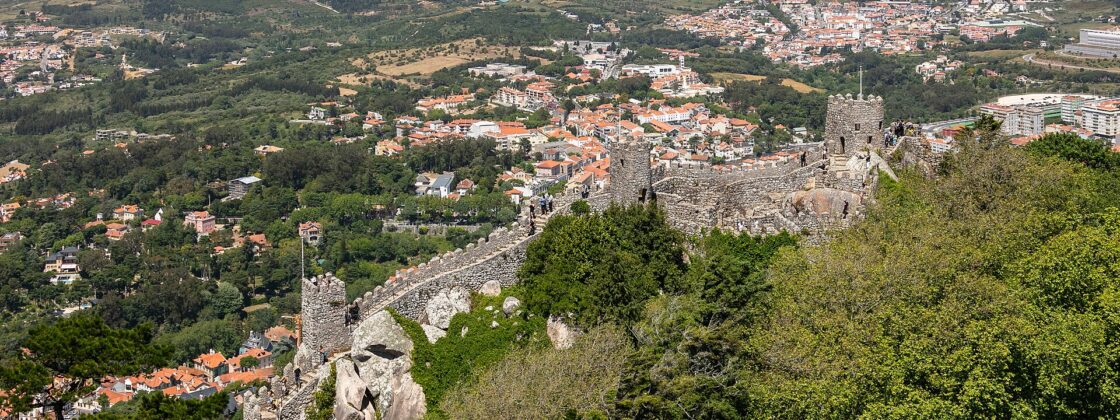
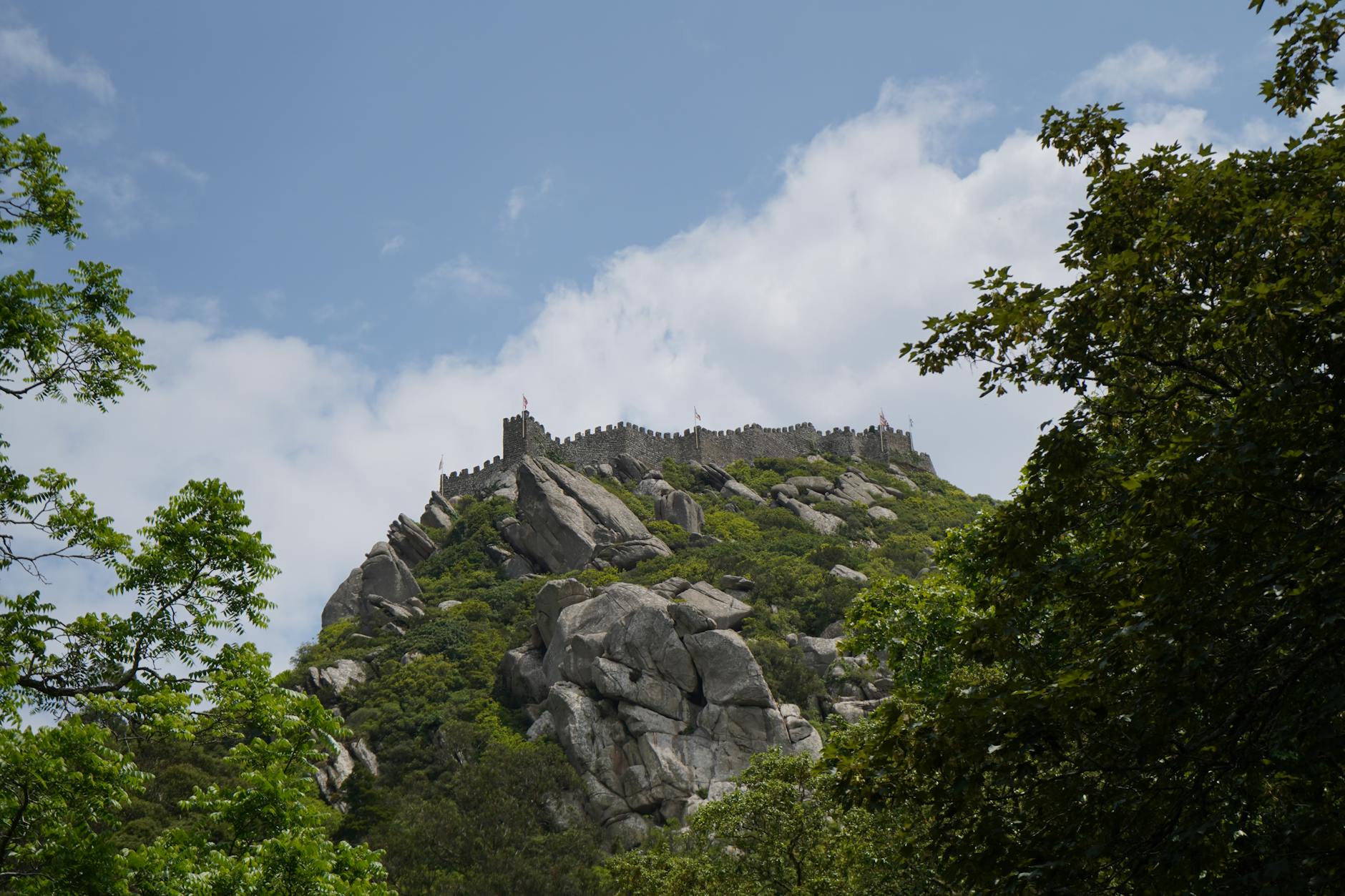
This is the monument. A circuit of granite wall runs along the ridge, dipping and climbing with the rock, interlocking with natural boulders where the builders could not be bothered to improve on geology. You walk it. There are steps — hundreds of them, of wildly inconsistent height — and stretches where the drop on one side is considerable and the handrail is a rope. It is exhilarating and it is not for everyone.
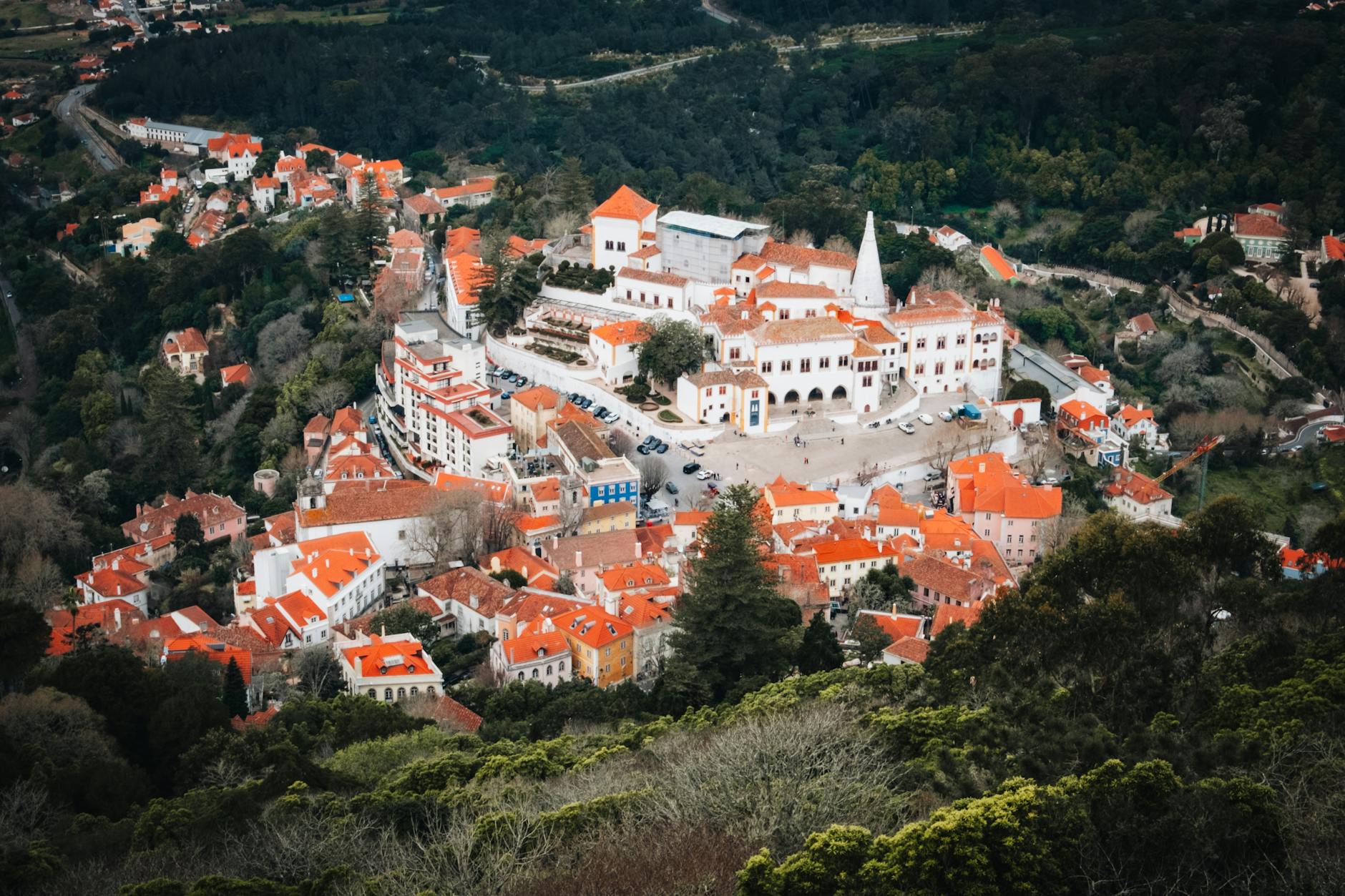
The high point is the Royal Tower at the western end, from which you get the view that sells the place: Sintra’s rooftops and the twin white chimneys of the National Palace directly below, Pena’s yellow and red domes on the neighbouring crag, the green of the Serra falling away west, and on a clear day the Atlantic and Cabo da Roca beyond.
The archaeological remains
Between the walls, on the plateau, are the traces of what the hill actually held: the footprints of Muslim houses, a medieval Christian necropolis with rock-cut graves beside the ruined church of São Pedro de Canaferrim, and the storage silos that fed a garrison under siege. There is a small interpretation centre in the church ruin.
Be realistic about this: the archaeology is genuinely important and visually modest. If you come expecting excavated streets you will be disappointed. If you come understanding that you are looking at a thousand years of continuous, awkward, overlapping occupation on one hilltop, it is quietly remarkable.
The cistern
The vaulted cistern that supplied the garrison survives, and it is the one piece of the site where the Moorish engineering is unambiguous and undiluted by Ferdinand’s restorers. Small, cool, and worth the two minutes.
What Ferdinand II actually did, and why it matters
It is worth spending a paragraph on this, because it changes how the site reads. When Ferdinand bought the neighbouring monastery ruin in 1838 and began turning it into Pena, he also acquired the collapsed castle on the next crag and treated it as part of the same composition. He was not restoring it in any archaeological sense — the discipline barely existed — he was making a ruin look the way a nineteenth-century Romantic thought a ruin ought to look.
So he had walls rebuilt, crenellations added where none had survived, and paths cut so that visitors could walk the circuit rather than scramble it. He also planted much of the surrounding woodland. The result is a hybrid: authentically tenth-century in its footprint, siting and lower masonry, and thoroughly Victorian in its silhouette. Parques de Sintra is refreshingly upfront about this, and its guided visits deal with the romantic reconstruction as a subject in its own right rather than an embarrassment.
None of which makes the castle less worth seeing. It makes it a better story — a Muslim watchpost, a Christian garrison, an abandoned hill, and then a German prince’s idea of the Middle Ages, all stacked on the same rock.
Photographing the castle
Two things are worth knowing. First, the best photograph of the Moorish Castle is not taken from inside it — the wall snaking along the ridge is the shot, and you need distance for that. Pena’s grounds, the road between the two monuments, and several points on the walk up all give you it. Second, the best photograph from the castle is west and late: the Royal Tower looking out over the Serra towards the Atlantic, with the light behind the hills rather than in your lens.
Mid-morning is the worst of both, with the town in haze and the sun straight down the ridge. If photography is a priority, go either at opening or after about four in the afternoon, and accept that you will be sharing the tower either way.
Is the Moorish Castle worth it?
Here is the honest verdict, because this is the question people actually arrive with.
Yes, if you like walking and views, and no, if you are collecting palaces. The Moorish Castle offers no interiors, no decorative arts, no furniture and no grand rooms. What it offers is the best view in Sintra, an hour of physical, slightly vertiginous walking on old stone, and the only site on the hill that predates the eighteenth century by any meaningful margin.
Some specific comparisons, since your day almost certainly cannot hold everything:
- Versus Pena Palace (€20): Pena is the more extraordinary object and the more crowded experience. If you can only do one, do Pena — but the castle’s view of Pena is better than Pena’s view of itself.
- Versus Quinta da Regaleira (€20): Regaleira is the better afternoon if you have children, or if you want atmosphere and invention rather than history. The castle is the better morning.
- Versus the National Palace (€13): The National Palace is indoors, in town, needs no bus, and is the one to choose in bad weather. In good weather the castle wins comfortably.
- Versus Monserrate (€12): A genuinely close call, and they are opposites — Monserrate is a garden and a cool interior with almost no crowds; the castle is exposed rock and a view.
If you have a full Sintra day, the strongest pairing we know is Pena in a booked morning slot, then walk down to the Moorish Castle for the early afternoon, then walk down into town. That is roughly €32 in tickets plus the €13.50 bus pass, it uses gravity rather than fighting it, and it ends with you in the old town at the right time for a travesseiro and a beer.
When to go
Sintra’s weather is its own thing. The Serra generates cloud that the coast and Lisbon do not have, and the castle sits high enough to be inside it. A morning that is bright in Lisbon can be a wall of white fog on this ridge, and if the view is the point, fog removes the point entirely.
- Best months: late April to early June, and mid-September to late October. Clear, warm enough, and the crowds are survivable.
- Best time of day: at opening, 09:30, before the 434 has delivered its first full loads. The light is also better looking west later in the day, so a mid-afternoon visit is the alternative.
- Worst: July and August between 11:00 and 16:00. Full sun on bare granite, no shade on the wall, and the bus queues at their longest.
- In winter: genuinely excellent when it is clear, and the castle is one of the few Sintra sights that is arguably better empty. Check the forecast for Sintra specifically, not Lisbon.
The 09:30–18:00 hours shorten out of season on the Parques de Sintra calendar, so confirm the closing time for your date before you build the afternoon around it.
Practical advice
- Wear proper shoes. The steps are worn granite and are slick after rain. Sandals and smooth soles are how people end up sitting down suddenly.
- Take water. Provision on the hill is thin and there is no café worth the name inside.
- Take a layer. It is reliably several degrees colder and considerably windier on the ridge than in the town.
- Do not bring a pram. There is no route around the walls that a wheeled thing can take. A carrier works; a buggy does not.
- Watch the noon ticket-office closure if you are buying on the day.
- Allow more time than the map suggests. The circuit is short in distance and slow in practice, because everyone stops on the wall.
Where it fits in a Lisbon trip
Sintra is a full day from Lisbon and the Moorish Castle is one third of it at most. The train from Rossio takes about 40 minutes, runs frequently, and is covered by the Lisboa Card. Trying to add Cascais or Cabo da Roca to the same day is the classic Sintra mistake — the transport eats it.
If you are building the wider trip, how many days you need in Lisbon makes the case for a dedicated fourth day here, and the Sintra guide covers the town as a whole.
If the ridge view leaves you wanting the actual edge of the continent, see our Cabo da Roca guide.
Frequently asked questions
How long do you need at the Moorish Castle?
Between an hour and ninety minutes inside the walls, depending on how often you stop for the view — and everyone stops more than they planned. Add 25–40 minutes each way if you are walking up from town rather than taking the 434.
Is the Moorish Castle worth visiting if I’ve already booked Pena?
Yes, and the two work well together because the castle is not timed. Do Pena at your slot, then walk across and down to the castle. They are about fifteen minutes apart on foot and the walk itself is pleasant.
Is it hard to walk around the Moorish Castle?
Moderately. The circuit is not long but it is entirely stairs and uneven stone, with steep drops and rope handrails in places. Reasonably fit visitors find it fine; anyone with knee trouble, balance issues or a real fear of heights should think carefully. It is not wheelchair or pram accessible in any part.
Can you visit the Moorish Castle for free?
No — the walled monument is ticketed at €12. The wooded park approach on the walk up is free, and you can see the walls from below and from Pena’s grounds without paying, but the parapet walk and the archaeological area are inside the paid perimeter.
Is there anywhere to eat at the Moorish Castle?
Effectively no. There is a small kiosk near the entrance selling drinks and packaged snacks, and that is the extent of it. Eat in Sintra town before you go up, or plan to come down hungry — the old town has far better options and you will want the excuse to stop. Our Sintra guide points at the reliable ones.
Can you do the Moorish Castle and Pena on the same ticket?
Parques de Sintra sells a combined ticket covering both, at a modest saving over buying separately. It is worth it if you are certain of doing both on the same day; it is not worth buying speculatively, because Pena’s timed entry means a combined ticket still commits you to a slot.
Which is better, the Moorish Castle or Pena Palace?
Pena is the more spectacular building; the castle is the better hour. If you want one photograph to take home, Pena. If you want to feel like you have actually been somewhere, the castle. Most people who do both say the castle surprised them more.
Do I need to book the Moorish Castle in advance?
Not for a time slot, because there isn’t one, but buying online saves a little money and avoids the noon-to-one ticket office closure. In August it also avoids a queue.
Bottom Line
The Moorish Castle is the least polished and most honest thing on the Sintra hill. It has no interiors to hurry you through and no gift shop worth the name — just a thousand-year-old wall running along a ridge, a scatter of graves and grain silos, and a view that takes in the palace, the town, the Serra and the Atlantic in one turn of the head.
At €12 it is the best-value ticket in Sintra, and at an hour and a half it is the easiest to fit into a crowded day. Skip it only if you cannot manage the stairs, or if the forecast says the ridge will be in cloud — in which case put the money towards the National Palace instead and come back for the view another time.