Landmarks & Monuments
Ponte 25 de Abril and Pilar 7: Inside the Bridge
Pilar 7 lets you stand inside the leg of Lisbon's red suspension bridge for under four euros. What it costs, what you see, the 372-step catch, and where the free views are better.
In this guide
Pilar 7 Lisbon is the one attraction in the city where you buy a ticket to stand inside a bridge — not beside it, not under it, but in the hollow concrete leg that holds up the western half of the Ponte 25 de Abril. It costs less than a beer, it is almost never busy, and it gives you a view along the Tagus that no miradouro in the old city can match. It also has a catch that most guides do not mention, and we will get to that early rather than burying it.
This guide covers the bridge itself, what the Pilar 7 Experience actually gives you for your money, whether it beats the free viewpoints a few minutes away, how to get there without a car, and what it is like to cross the thing on foot, by train or behind the wheel. It is written for people who have half a day in Alcântara and want to know whether this is worth an hour of it.
What the Ponte 25 de Abril is, and why it looks so familiar
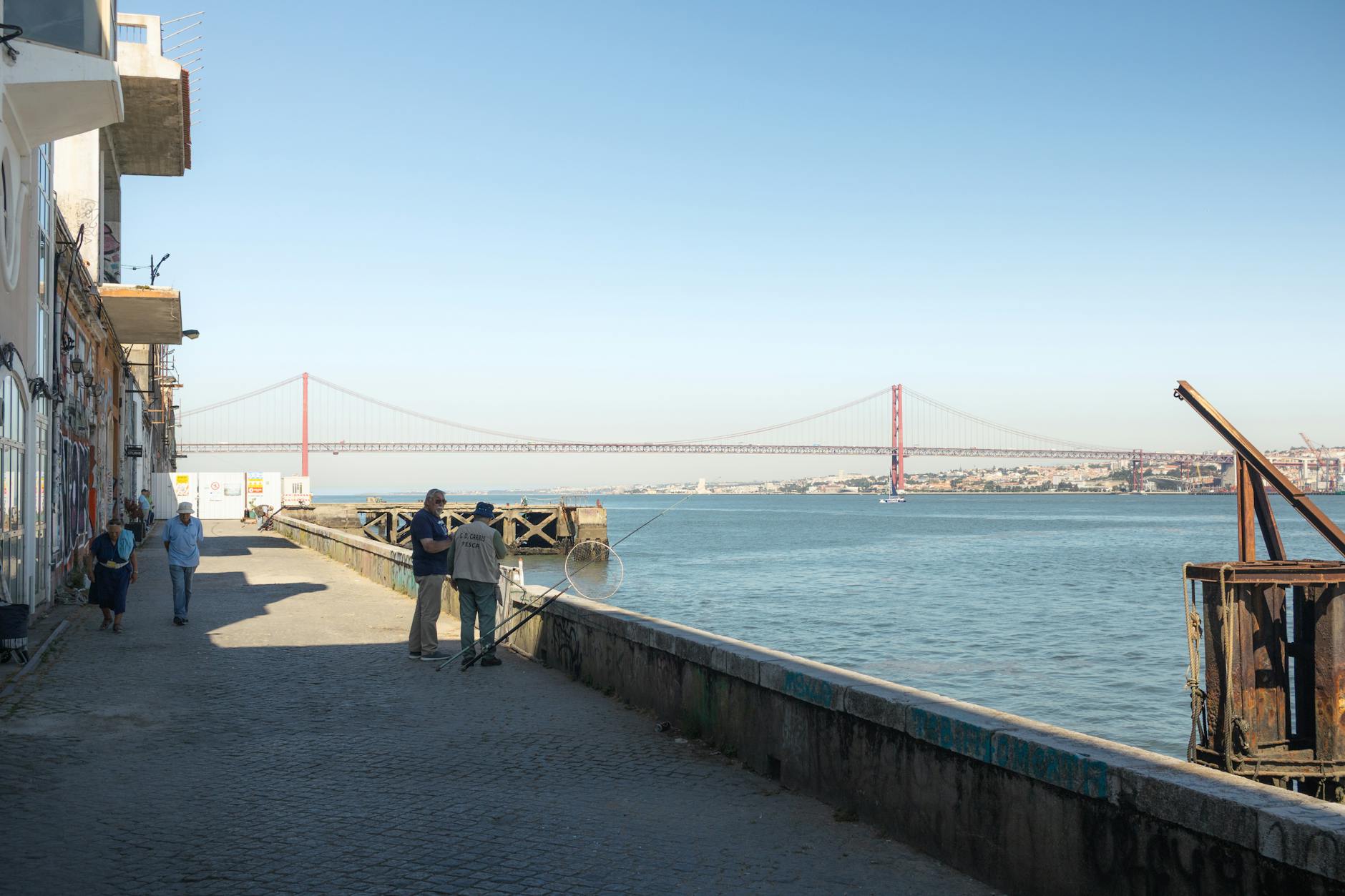
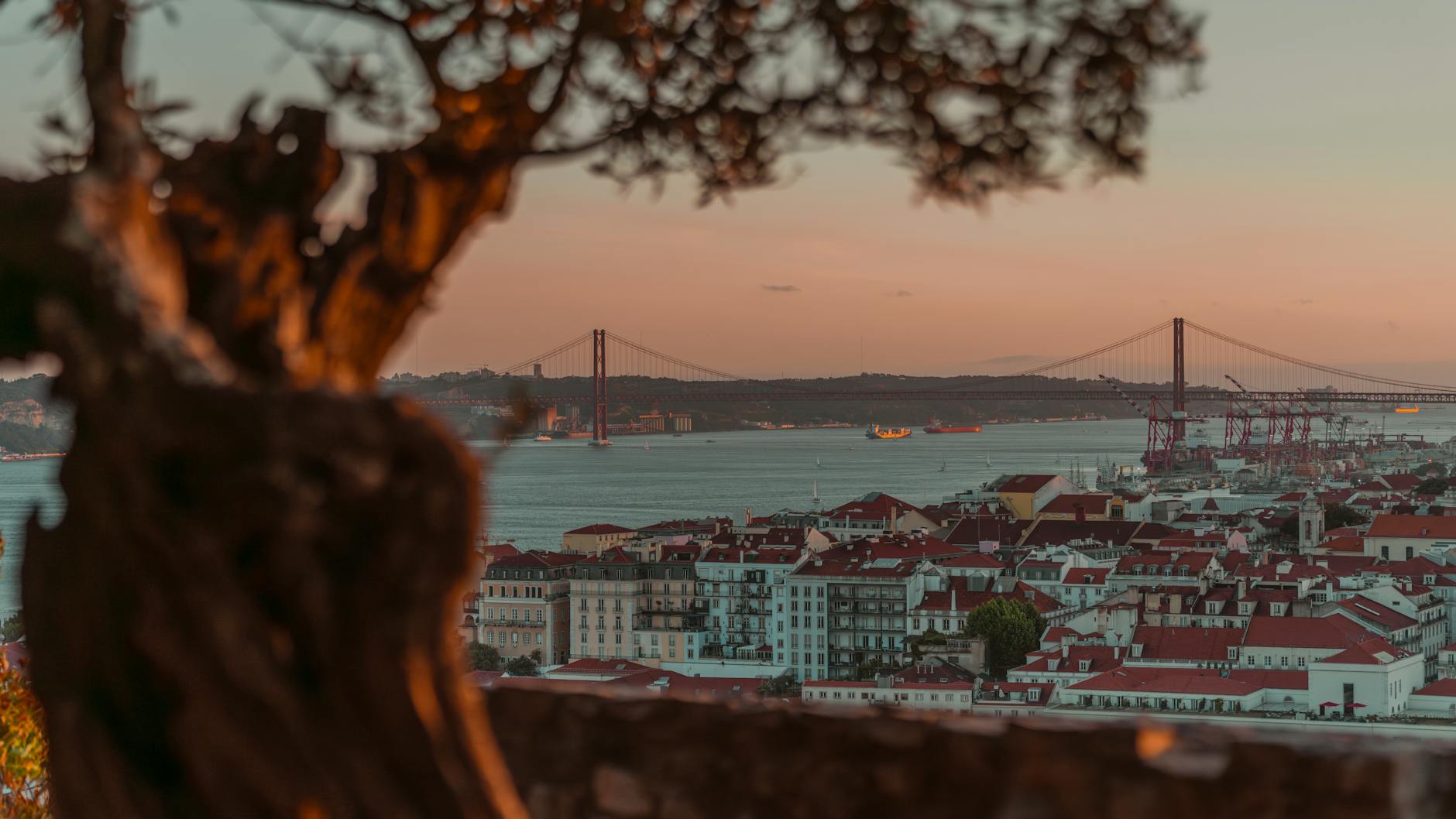
Almost every first-time visitor says the same thing within about four seconds of seeing it: that’s the Golden Gate. It isn’t, but the instinct is sound. The bridge was built by an American firm, painted in the same International Orange, and slung across a wide tidal estuary in a way that makes the comparison irresistible. The engineering lineage actually runs to the San Francisco–Oakland Bay Bridge rather than the Golden Gate, but nobody in Lisbon is going to correct you.
It opened in August 1966 under a different name — the Ponte Salazar, after the dictator whose regime built it. On 25 April 1974 the Carnation Revolution ended that regime, and within days somebody had climbed up and taken the letters down. The bridge has carried the date of the revolution as its name ever since, which makes it one of the few pieces of national infrastructure anywhere that is named after the day the government fell.
The numbers are still impressive sixty years on. The main suspended span runs a little over a kilometre between the two towers, and the whole crossing is well over two kilometres end to end. When it opened it was the longest suspension bridge in Europe. In the 1990s the deck was strengthened and a second, lower level was added underneath for trains, which is why the roadway hums and shudders in a way that unnerves some drivers — that is a commuter train passing beneath you.
Two bridges, and how to tell them apart
Lisbon has two crossings of the Tagus and visitors mix them up constantly. The 25 de Abril is the red suspension bridge in the west, close to Belém and Alcântara, landing on the south bank at the foot of the Cristo Rei statue. The Vasco da Gama is the 17-kilometre concrete ribbon out east past Parque das Nações, built for Expo 98, and it is enormous but not remotely photogenic. If somebody sends you a picture of “the Lisbon bridge”, it is the red one.
Pilar 7: what you are actually paying for
Pilar 7 is the seventh support pillar counting from the south, and the last one on the Lisbon bank before the deck leaps out over the water. It is a hollow concrete box roughly eighty metres tall, and in 2017 the bridge operator opened it to the public as an “experience” — which in practice means three things stacked on top of each other.
- Ground floor. A room of scale models and construction photographs explaining how the thing was assembled, plus a small shop and a virtual-reality station. The VR puts you on the maintenance walkways up in the cables, which is genuinely unpleasant if you have any fear of heights, and that is a compliment.
- Fourth floor. The mirror room and the cable room — the latter is the good bit. You stand a metre from one of the main suspension cables where it passes through the pillar, close enough to see the individual strands and the grease. There is a real sense of scale here that a photograph cannot carry.
- The top. A glass-floored viewing platform at the level of the pillar’s 26th floor, out on the flank of the bridge, with the roadway directly overhead and the river a long way down.
The whole visit takes forty minutes to an hour if you read the panels, twenty if you go straight up for the view. It is not a big attraction and it does not pretend to be.
Prices and hours
Standard adult admission is €3.70, with reduced rates for children aged 6 to 15, students and over-65s. Under-5s go free, and so do Lisboa Card holders — the card also gets you 10% off in the shop, for whatever that is worth. It opens daily from 10:00 to 18:00, with last entry at 17:00, closes on 25 December, and runs a shortened 10:00–17:00 day on 24 and 31 December and 1 January. Prices and hours checked September 2026; confirm on the operator’s own site before you go.
The catch: the lift
As of September 2026 the lift is out of service and the viewing platform is reachable only by stairs — 372 of them. The operator has dropped the adult ticket to €3.00 to compensate, which is fair of them, but €0.70 does not change the fact that you are climbing the equivalent of a twenty-storey building in a warm concrete shaft.
Be honest with yourself about this before you buy. If you are travelling with small children, with anyone who has a heart or knee problem, or in the August heat, this is not a small ask, and there is no way to see the top without doing it. Anyone using our Lisbon accessibility guide should treat Pilar 7 as effectively closed until the lift is fixed. Check the status on the day — this is exactly the kind of thing that gets repaired without any announcement.
Is Pilar 7 worth it?
Yes, with conditions — and the conditions matter more here than at most Lisbon sights.
It is worth it if you are interested in how things are built, if you are already in Alcântara for LX Factory or the docks, or if you want a view of the city from an angle almost nobody photographs. At three or four euros it is one of the cheapest ticketed things to do in Lisbon, and the cable room is a genuinely memorable ten minutes. The crowd levels are the real luxury: you can have the platform to yourself on a weekday morning while a queue three hundred metres long shuffles into Belém Tower twenty minutes’ walk away.
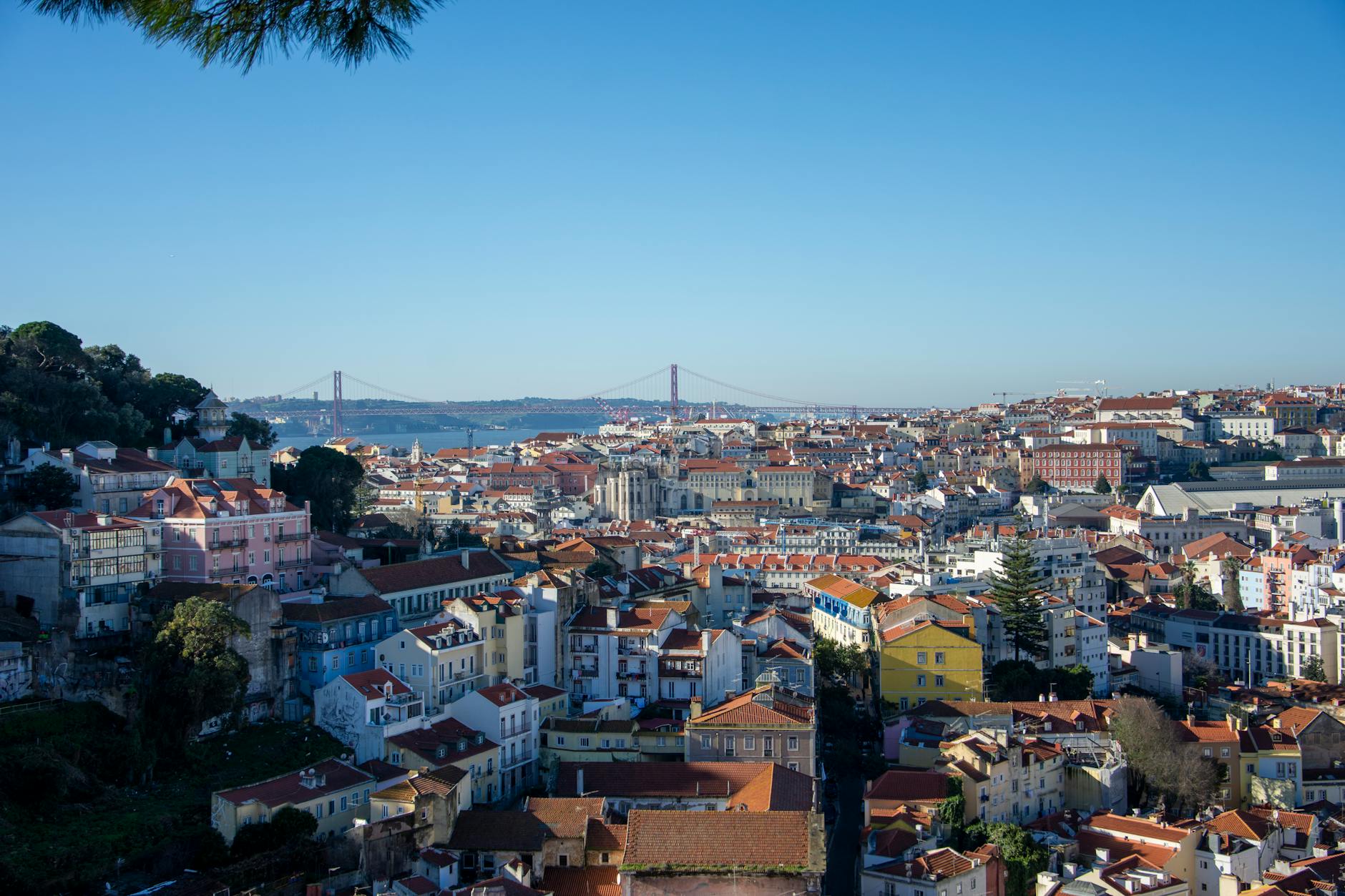
It is not worth it if what you actually want is a great view of Lisbon. This is the thing people get wrong. From Pilar 7 you are looking along and under the bridge, with the deck cutting across the sky above you and the docks and container terminal in the foreground. It is dramatic and industrial and it is not the postcard. For the postcard — red bridge, blue river, terracotta city — you want to be somewhere else looking at the bridge, not standing inside it. And if the stairs are still the only way up, the honest calculation for a lot of visitors is that the same hour spent at a miradouro with a glass of wine costs nothing and delivers more.
Where to see the bridge properly, for free
- Miradouro do Cristo Rei, on the south bank at Almada. The single best view of the bridge in existence, with the whole of Lisbon behind it. Ferry from Cais do Sodré to Cacilhas, then bus 3001.
- Jardim 9 de Abril and the Santo Amaro docks, directly beneath the Lisbon-side span. You get the underside of the bridge framing the river, and a row of restaurants to sit at while you look.
- Miradouro do Bairro do Alvito and Parque Florestal de Monsanto, up behind Alcântara — quiet, green, and level with the top of the towers.
- The 25 de Abril at sunset from the Belém riverfront, with the sun going down behind the western towers. See our Lisbon sunset guide for the timings.
Getting to Pilar 7
The entrance is on Avenida da Índia in Alcântara, at the foot of the pillar, and it is easy to walk past — the door is small and set into the base of the structure.
- Tram 15E runs along the riverfront between Praça da Figueira, Cais do Sodré and Belém, and passes through Alcântara. It is the simplest option from the centre and takes roughly twenty minutes from Cais do Sodré. See the Lisbon trams guide for how the modern 15E differs from the vintage lines.
- Train to Alcântara-Mar on the Cascais line from Cais do Sodré — three or four minutes, and the station is a short walk from the pillar. The same line continues to Cascais if you want to make a day of it.
- Bus — several Carris routes serve Alcântara from Cais do Sodré and Belém; check the live board rather than trusting a printed schedule.
- Walking from LX Factory takes about ten minutes, mostly flat, which is why the two pair so naturally.
Fares are the standard city rates: a single on a Navegante ocasional card is €1.90 and covers an hour across Carris and the Metro, the card itself costs €0.50 once, and a 24-hour Carris and Metro ticket is €7.25. Full detail in our Lisbon transport guide.
Crossing the bridge yourself
You cannot walk or cycle across the Ponte 25 de Abril — there is no pedestrian deck, and this catches people out every year. Your options are:
By train
The lower deck carries Fertagus commuter trains from Lisbon to the south bank, and this is the cheap thrill. You cross inside the bridge, with the girders flickering past the windows and the river below. Trains from Roma-Areeiro, Entrecampos, Sete Rios and Campolide run to Pragal — the stop for Cristo Rei and Almada — and onward to Setúbal. Journey time to Pragal is about ten minutes. Fertagus sets its own fares separately from Carris and the Metro, so buy at the machine and check the current price rather than assuming your city ticket covers it.
By car
The bridge is tolled northbound only — you pay coming into Lisbon and cross free going south. Traffic is genuinely bad at rush hour in both directions and the bridge is a bottleneck for the entire southern commuter belt. If you have rented a car in Lisbon, avoid crossing between roughly 07:30 and 09:30 northbound or 17:30 and 19:30 southbound. Rates change; confirm the current toll with your rental company or on the operator’s site before you drive it.
By bus
Long-distance coaches to the Setúbal peninsula and the Alentejo cross the bridge from Sete Rios, which gives you the view from a high seat for the price of a bus ticket — the cheapest way to experience the crossing if you are heading south anyway, for instance to Sesimbra or Setúbal and Arrábida.
Making a half-day of it in Alcântara
Pilar 7 on its own is a forty-minute stop and not worth a dedicated trip across the city. Built into an afternoon in Alcântara it works well:
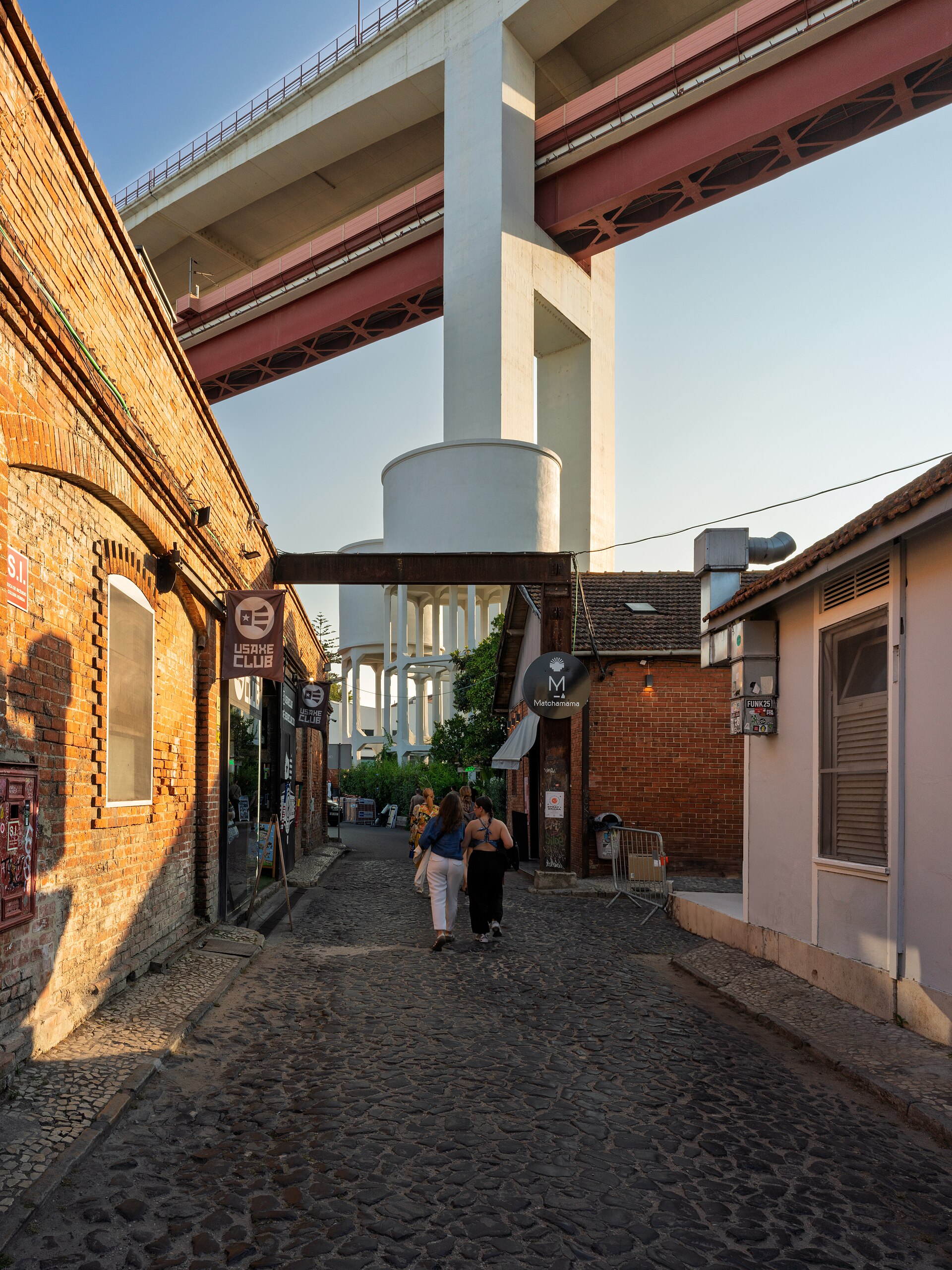
- LX Factory — a former industrial complex of print works and warehouses now full of bookshops, design studios and restaurants, ten minutes’ walk away and easily the neighbourhood’s main draw.
- The Santo Amaro docks — a strip of converted warehouses under the bridge, better for a late lunch by the water than for nightlife these days.
- Museu do Oriente — a serious, quiet museum of Portugal’s presence in Asia, in a converted cod warehouse, and one of the city’s most underrated. Covered in our museums guide.
- Street art — the alleys around LX Factory and up towards Alcântara carry some of the best murals in the city; see the Lisbon street art guide.
- Belém is one stop further west on the 15E, so you can finish at Jerónimos or a pastel de nata.
Practical tips
- Check the lift status the morning you go. It changes the visit completely, and neither aggregator sites nor guidebooks keep up.
- Go in the morning if you want photographs — afternoon sun sits behind the bridge and you will be shooting into it.
- Wind. The platform is exposed and the Tagus estuary funnels a stiff breeze most afternoons. Bring a layer even in summer, and hold on to hats and phones.
- The glass floor is the bit children remember and the bit vertigo sufferers do not enjoy. There is plenty of solid floor to stand on if you would rather not.
- Buy at the door. There is rarely a queue and the resellers charge more than the operator does for exactly the same ticket.
- Bags. There are no lockers; if you are moving between accommodation, use the luggage storage options in the centre first.
Frequently asked questions
How much does Pilar 7 cost?
€3.70 for a standard adult ticket, reduced to €3.00 while the lift is out of service, with lower rates for children aged 6 to 15, students and over-65s. Under-5s and Lisboa Card holders enter free. Checked September 2026.
Can you walk across the Ponte 25 de Abril?
No. There is no pedestrian or cycle path. The only ways across are by car, by bus, or on a Fertagus train on the lower deck.
How many steps are there at Pilar 7?
372 to the viewing platform when the lift is out of service. When the lift is running you can ride the whole way up.
Is Pilar 7 included in the Lisboa Card?
Yes — entry is free with a valid Lisboa Card, plus 10% off in the shop. Whether the card as a whole pays for your trip depends on what else you do; we run the numbers in our Lisboa Card guide.
How long does a visit take?
Forty minutes to an hour at a normal pace, including the exhibition rooms. Twenty minutes if you only want the view.
Is it suitable for young children?
The glass floor and the VR are a hit with school-age children, but the stairs rule it out for toddlers and pushchairs while the lift is down. Our Lisbon with kids itinerary has alternatives in the same part of the city.
Which is the better view — Pilar 7 or Cristo Rei?
Cristo Rei, without much argument, if you want to see the bridge and the city together. Pilar 7 is the better experience if you want to understand the bridge as a structure. They are on opposite banks and a ferry apart, so doing both in a day is easy.
Bottom Line
Pilar 7 is a small, cheap, unusually thoughtful attraction that gives you something no viewpoint can — the sensation of standing inside a piece of working infrastructure with a suspension cable an arm’s length away and traffic thundering overhead. For three or four euros it is one of the best-value tickets in Lisbon, and on a weekday you will barely share it with anyone.
But it is not the view you came for, and while the lift is out those 372 steps are a real barrier rather than a footnote. Treat it as a twenty-minute detour on an Alcântara afternoon that already includes LX Factory and the docks, not as a destination in itself. Then cross to the south bank at some point in your trip and look back at the bridge from Almada, where it is at its most spectacular and costs nothing at all.
Photo Credits
LX Factory beneath the bridge approach: Cobblestone Lane and Water Tower View at LX Factory, Lisbon (54712988968) by Dale Cruse, CC BY 4.0, via Wikimedia Commons.