Museums & Culture
Street Art in Lisbon: A Self-Guided Tour of the City’s Murals 2026
Explore Lisbon's vibrant street art scene—the best murals, neighborhoods to explore, guided tours, and the artists behind the works.
In this guide
- The Two Stars: Vhils and Bordalo II
- Best Neighborhoods for Street Art
- Top 10 Murals to Photograph
- Self-Guided Walking Tours
- Guided Street Art Tours
- Where to See and Buy Street Art Indoors
- Notable Lisbon Street Artists Beyond the Big Two
- Street Art and Gentrification
- Best Time and Light for Street Art Photos
- Photography Tips
- Practical Tips
- FAQ: Lisbon Street Art
- Bottom Line
Lisbon street art didn’t emerge from a scene — it emerged from a crisis. After 2008, Portugal’s economic collapse left entire blocks abandoned, façades crumbling, landlords absent. Artists moved in. What followed over the next fifteen years is one of Europe’s most significant experiments in public art: two Lisbon-born artists reached international fame, the city commissioned murals on social housing blocks, and tourists started booking flights specifically to see walls.
This guide is a self-guided walking tour of Lisbon’s best street art — the artists, the neighborhoods, standout murals, and everything you need to find them. Updated for 2026.
Quick Answer: Start at LX Factory for the densest concentration of work (Bordalo II, AKACorleone, Pedro Zamith all in one site). For walking routes: Calçada da Glória → Bairro Alto takes 90 minutes and hits Vhils. For serious enthusiasts, half a day in Estrada de Chelas (outer Lisbon by Uber) is unmatched. The Underdogs gallery (Rua da Boavista 78) sells prints and runs curated tours.
The Two Stars: Vhils and Bordalo II
Lisbon produced two artists who changed how the world thinks about street art. They’re not just local heroes — both are represented by major international galleries and have permanent works in cities from Shanghai to New York. That said, Lisbon remains their biggest gallery, and both still work here.
Vhils (Alexandre Farto)
Born in Seixal, just south of Lisbon, Alexandre Farto developed a technique nobody else was doing: instead of painting walls, he carves them with a pneumatic drill, etching through layers of plaster, brick, and decades of accumulated material to reveal portraits. The faces that emerge look like they were always there, waiting to be uncovered rather than created.
His breakthrough came in 2008 — the same year Banksy included his work in a Cans Festival in London. Since then, Vhils has worked internationally (São Paulo, Hong Kong, New York, Dublin), but his Lisbon works remain his most concentrated. Find him on Calçada da Glória, in Graça, at LX Factory, and on walls in Bairro Alto and Braço de Prata.
The work is deliberately impermanent. Old buildings get demolished. New owners paint over. Part of the point is that cities change — and Vhils records the layers before they disappear.
Bordalo II (Artur Bordalo)
Where Vhils subtracts, Bordalo II accumulates. His massive animal sculptures are built from recycled trash — old tires, car bumpers, computer parts, plastic crates, household debris. The results are paradoxical: beautiful creatures assembled from waste, placed on the walls of cities that produced that waste.
His series “Big Trash Animals” runs across Lisbon and dozens of international cities. Look for owls, lizards, elephants, raccoons, and foxes made entirely from discarded plastic and metal. The raccoon at LX Factory — one of his most photographed pieces worldwide — is roughly four metres wide and assembled from car parts and domestic junk.
Bordalo II has also curated street art projects in outer Lisbon (Estrada de Chelas being the most significant), inviting international artists and turning peripheral neighborhoods into destination points for art tourists.
Best Neighborhoods for Street Art
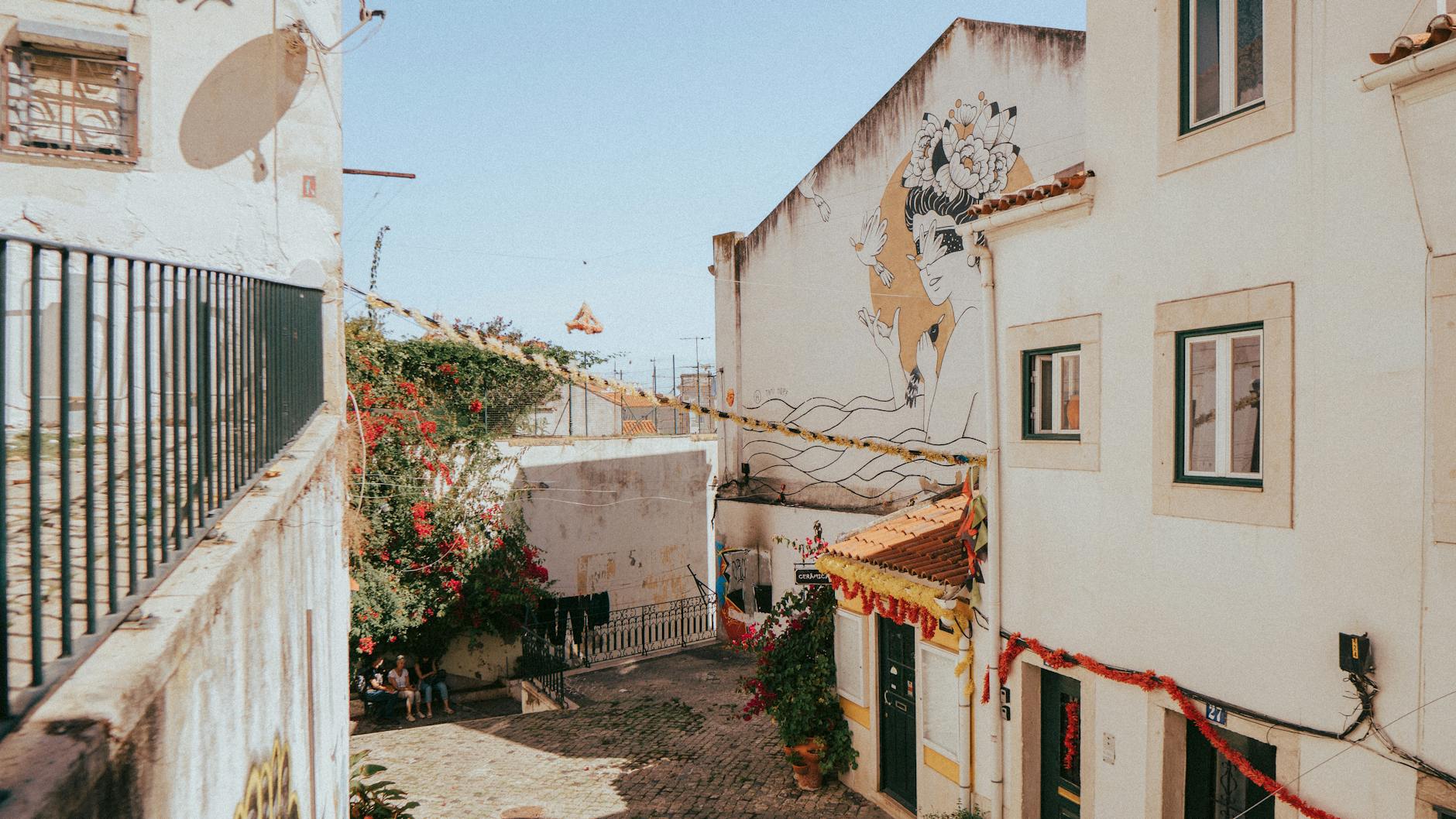
LX Factory (Alcântara)
The single best concentration of street art in central Lisbon. This converted 19th-century industrial complex now houses restaurants, studios, and shops — and every surface is fair game for murals. Bordalo II’s raccoon anchors the site, but there are works by AKACorleone, The Caver, Pedro Zamith, and rotating visiting artists throughout.
Plan an hour minimum just for the art. The Sunday market adds another reason to come. See our LX Factory guide for the full picture.
Graça
Hilltop neighborhood with three iconic pieces in close proximity: a Shepard Fairey (the American Obey artist) wall, Vhils chiseled portraits, and Bordalo II animals. The Tram 28 route passes through — ride up and walk down through the streets on foot.
Estrada de Chelas (Outer Lisbon)
Bordalo II curated a major street art project here, inviting artists from around the world for what became one of Europe’s most impressive outdoor galleries. Works by Vhils, Okuda, Daniela Guerreiro, Ricardo Romero, Kampus, and Bordalo II himself cover entire building facades. This is a residential area — Uber there and walk the stretch, about 45 minutes at a steady pace. Best for serious street art fans.
Mouraria
Working-class, multicultural neighborhood where murals reflect community identity rather than gallery ambition. Add Fuel’s tile-pattern murals blend seamlessly with the actual azulejo tiles on buildings. ±MaisMenos±’s text-based political pieces appear on alley walls. The mix of fado heritage, immigrant culture, and art makes Mouraria one of Lisbon’s most textured walks.
Anjos / Intendente
Gentrifying fast. Street art in this area tells a specific story: community displacement and resistance. Some of the most politically charged pieces in Lisbon appear here — read them against the backdrop of the real estate pressure on the neighborhood, and they land differently.
Marvila / Beato
Eastern industrial district undergoing rapid transformation into craft breweries, studios, and event spaces. The street art concentration is growing with the creative class moving in. Worth a dedicated afternoon trip for current work.
Galeria de Arte Urbana (Picoas Underground)
The city’s official urban art project transformed an underground pedestrian passage near Picoas metro into a permanent gallery. Free entry, year-round. This is institutionalized street art — commissioned, curated, and protected. Not the rawness of Mouraria, but excellent quality in a compact space.
Bairro Padre Cruz
Outer Lisbon. The “Crono Project” turned this social housing block into a five-storey open-air gallery — Portuguese artists commissioned to work at scale. One of the earliest examples of state-sponsored monumental street art in Portugal.
Top 10 Murals to Photograph
- Bordalo II’s Raccoon — LX Factory wall, assembled from car parts and trash
- Vhils’s “The Boy” — Calçada da Glória, chiseled portrait
- Shepard Fairey wall — Graça
- Bordalo II’s Half-Lion — Galeria de Arte Urbana
- “Fado” by Add Fuel — tile-style mural in Mouraria
- Vhils + Os Gemeos collaboration — Bairro Alto
- The “Crono” tower in Bairro Padre Cruz
- Pedro Zamith’s surrealism — LX Factory
- Various murals on Calçada da Glória funicular route
- Bordalo II’s Owl — Calçada de Carriche
Self-Guided Walking Tours
Tour 1: Central Lisbon Stroll (1.5 hours)
Start at Calçada da Glória — take the funicular up or walk. The street has Vhils work on the way down. Continue through Bairro Alto (murals scattered on side streets). Hit Praça Luís de Camões, then walk to Cais do Sodré. End at the Pink Street / Time Out Market area. You’ll spot painted cobblestones, Vhils carved walls, and the general visual chaos of Bairro Alto at night. Morning works better for photos.
Tour 2: LX Factory Deep Dive (1–2 hours)
Single site, dense art. The Bordalo II raccoon is the centrepiece, but the inner alleyways have smaller works constantly refreshing. Café and lunch options on site mean you can make a half-day of it. Sunday mornings when the market opens add the best energy.
Tour 3: Graça to Mouraria (2 hours)
Tram 28 to Graça. Walk downhill through Mouraria’s narrow streets — murals appear on corners, doorways, entire building sides. The scale shifts constantly: postage-stamp stencils next to four-storey pieces. End at Martim Moniz square and have a beer.
Tour 4: Outer Lisbon Major Works (Half Day)
Uber to Estrada de Chelas (about €8–12 from central Lisbon). Walk the full street of Bordalo II–curated works. Continue to Picoas’s Galeria de Arte Urbana underground passage. Serious investment of time, significant payoff if monumental street art is your thing.
Guided Street Art Tours
Context helps. The best murals have stories behind them — why that wall, who commissioned it, what got demolished. Guided tours supply what a map can’t.
| Tour | Format | Price | Duration |
|---|---|---|---|
| Underdogs Tours | Curated by leading street art gallery | €25–35 | 2–3 hrs |
| Lisbon Walker Street Art | Walking tour with guide | €25–35 | 3 hrs |
| Street Art Game | Treasure hunt / game-based | €20–25 | 2 hrs |
| Take Free Tours Lisbon | Tip-based walking tour | Free + tip | 2 hrs |
| VoiceMap Audio Tour | Self-guided with phone audio | €5–10 | Flexible |
Underdogs Tours are the standout option if you want genuine depth — the gallery represents Vhils and Bordalo II, so the guides know both artists personally.
Where to See and Buy Street Art Indoors
Underdogs Public Art Store
The gallery and shop that anchors Lisbon’s street art scene. Sells limited-edition prints, books, and merchandise from Vhils, Bordalo II, Add Fuel, AKACorleone, and others. If you want to take Lisbon street art home in a form you can actually hang, this is the place. Prices start around €50 for prints, rising to several hundred for signed limited editions.
Address: Rua da Boavista 78 (near LX Factory)
Galeria de Arte Urbana
Permanent street-art exhibition in the Picoas underground passage. Free entry, managed by the Lisbon City Council. Rotating works alongside permanent pieces. Good introduction to the scene without any walking commitment.
MAAT Museum
The Museum of Art, Architecture and Technology in Belém includes street art and urban art in its programming. Not strictly street art, but the conceptual overlap with Bordalo II’s work (which addresses consumption and waste) means MAAT shows artists from the same ecosystem. See our MAAT visitor guide.
National Tile Museum Connection
Add Fuel’s tile-pattern murals are the bridge between classical Portuguese azulejo tradition and contemporary street art. To understand where he’s coming from, visiting the National Tile Museum beforehand makes his Mouraria work hit differently. The Gulbenkian’s contemporary wing also shows artists from Lisbon’s art ecosystem — see our Gulbenkian guide.
For the broader culture context, our Museums & Culture pillar covers all of Lisbon’s major cultural institutions.
Notable Lisbon Street Artists Beyond the Big Two
- Add Fuel — Modernises the classic azulejo tile aesthetic into monumental murals. His work is unmistakable: geometric, intricate, and deeply Portuguese.
- AKACorleone — Colourful figurative work, often characters with expressive faces. Heavy LX Factory presence.
- ±MaisMenos± — Text-based political street art, anti-austerity, pro-community. Found in Mouraria and Anjos.
- Tamara Alves — Lisbon-based portraitist whose female figures appear on buildings across the city.
- Pedro Zamith — Surrealist scenes, often at LX Factory. Dreamlike compositions in bold colours.
- Pantónio — Large-scale figurative works. Known for swirling organic forms, often marine-themed.
- Daniela Guerreiro — Emerging female muralist with strong work in Chelas project.
Street Art and Gentrification
This is the uncomfortable subtext of Lisbon’s open-air gallery. Murals tend to appear in neighborhoods under pressure — Mouraria, Anjos, Marvila — and often arrive ahead of the cafés and boutiques that follow. The art celebrates a community’s identity at the precise moment that community is being priced out.
±MaisMenos±’s text pieces address this explicitly. Works reading “THIS IS NOT A SAFE INVESTMENT” appeared on buildings in areas experiencing rapid rent increases. Add Fuel’s tile murals preserve something of old Lisbon’s aesthetic while the buildings themselves get renovated and flipped.
Whether street art accelerates gentrification or documents it is a genuine debate in Lisbon. Walking Mouraria with that in mind changes what you see.
Best Time and Light for Street Art Photos
- Mornings (7–10 AM) — Empty streets, clean compositions, soft directional light. Best for narrow alley shots in Mouraria.
- Late afternoons (3–6 PM) — Warm raking light on south-facing walls. Good for LX Factory and any large west-facing pieces.
- Overcast days — Actually ideal. Diffused light eliminates harsh shadows on multi-coloured murals. What looks like bad weather for sightseeing is good weather for street art photography.
- Avoid harsh midday summer sun — Colours wash out, shadows are unworkable on vertical surfaces.
Photography Tips
- Include scale — a person, a bicycle, a parked car. Murals lose their impact without context for size.
- Wide angle captures the whole piece; a telephoto compresses Vhils’s carved texture better.
- Shoot details — Bordalo II’s work rewards close examination of individual components (the tire that became a wing, the bumper that became an ear).
- Environmental framing — balconies, telephone wires, laundry in the foreground. These confirm this is a real city, not a gallery.
- Phone works fine — modern phones handle the contrast. Nothing precious required.
Practical Tips
- Comfortable shoes — the walking routes involve cobblestones, hills, and long stretches
- The landscape changes — works get demolished, painted over, or refreshed. Check Instagram (@underdogs_store) for current pieces before visiting
- Respect residential areas — murals are on people’s homes. Don’t block doorways, keep noise down in side streets
- Free — all outdoor street art is free to see. The only costs are tours (optional) and prints (optional)
- Best combined with: LX Factory visit, Mouraria neighbourhood lunch, or a Bairro Alto evening
FAQ: Lisbon Street Art
Who are the most famous Lisbon street artists?
Vhils (Alexandre Farto) and Bordalo II (Artur Bordalo) are the international names. Vhils carves portraits into walls using a pneumatic drill. Bordalo II builds large animal sculptures from recycled trash. Both are represented internationally and have work across Lisbon.
Where’s the best concentration of street art in Lisbon?
LX Factory in Alcântara for a single site. Estrada de Chelas in outer Lisbon for the most ambitious curated outdoor gallery. Mouraria for murals integrated into residential neighbourhood fabric.
Can I take a guided street art tour?
Yes. Underdogs Tours are the best for depth — they represent the key artists. Free walking tours with tip-based payment run daily. Expect to pay €20–35 for a quality guided experience.
Is street art legal in Lisbon?
All the major murals are commissioned and legal. Lisbon City Council has actively supported public art programmes (including the Galeria de Arte Urbana and Crono Project). Smaller tags exist but the serious work is above board.
How do I find Vhils murals?
Calçada da Glória, Graça, LX Factory, Bairro Alto, and Braço de Prata all have his work. Locations shift as buildings change, so the Underdogs website has the most current map.
Where can I buy Lisbon street art?
Underdogs Public Art Store at Rua da Boavista 78 sells prints and books by Vhils, Bordalo II, Add Fuel, and others. Limited editions sell out — if you see something you want, buy it.
Bottom Line
Lisbon’s street art scene is one of Europe’s most serious — not just decorative, but politically charged, technically ambitious, and deeply connected to the city’s economic and social history. Vhils and Bordalo II made Lisbon an international destination for muralists, and artists from across the world have since left work here. Start at LX Factory for the most accessible concentration, walk Calçada da Glória and Bairro Alto for central pieces, and commit a half-day to Estrada de Chelas if you want the full picture.
Street art and azulejos are the same instinct four centuries apart — decorating the outside of buildings because the inside was somebody else’s business. The Tile Museum makes that lineage obvious, the Museums & Culture pillar covers the indoor half of the city’s art, and the Gulbenkian and MAAT are where contemporary work goes when it comes off the walls.