Where to Stay in Lisbon
Where to Stay in Sintra: Best Areas and Hotels
Should you stay in Sintra at all? The areas compared — historic centre, São Pedro, Colares, the coast — plus the named hotels, the €2 tourist tax and six things nobody tells you.
In this guide
- Should you stay in Sintra or day-trip from Lisbon?
- The areas, and what each one actually means
- Hotels worth knowing about
- What it costs
- When to book, and what the seasons do to prices
- Six practical things nobody tells you
- Quick matcher
- Getting around once you are here
- Frequently asked questions
- Bottom Line
- Photo Credits
Deciding where to stay in Sintra starts with a question most guides skip: should you stay here at all? The overwhelming majority of visitors come out from Lisbon for the day and go back at six, and for a lot of people that is the right call. But Sintra after the coaches leave is a genuinely different place — quiet, cool, faintly gothic — and if you want that, this page tells you which part of the municipality to book, what each area actually costs you in walking and bus fares, and where the real trade-offs are.
Should you stay in Sintra or day-trip from Lisbon?
The honest position: stay one or two nights if you want Sintra itself; day-trip if you want the monuments.
Sintra’s monuments are all daytime operations, and every one of them shuts by 18:30 at the latest. If your plan is Pena, the Moorish Castle and a palace, you can do that comfortably from Lisbon on the 40-minute train and sleep somewhere with more restaurants, more nightlife and cheaper beds. Our Sintra day trip guide sets that version out.
What staying buys you is the two hours at either end. From about 18:00 the coaches go, the day-trippers head for the station, and the old town becomes a small Portuguese hill town again — mist coming off the Serra, half the shops shut, three or four restaurants with locals in them. Mornings are better still: you can be at the gates of Pena at opening while everyone else is still on the train. If you have four days or more in the region, one night in Sintra is a genuinely good use of it.
Do not stay in Sintra if: you are on a short trip and want Lisbon’s food and nightlife; you are travelling on a tight budget (beds here cost more than the equivalent in Lisbon); or you have no car and want to see the coast, which is awkward without one.
The areas, and what each one actually means
The historic centre (Vila Velha)
Best for: first-time visitors, romance, anyone without a car.
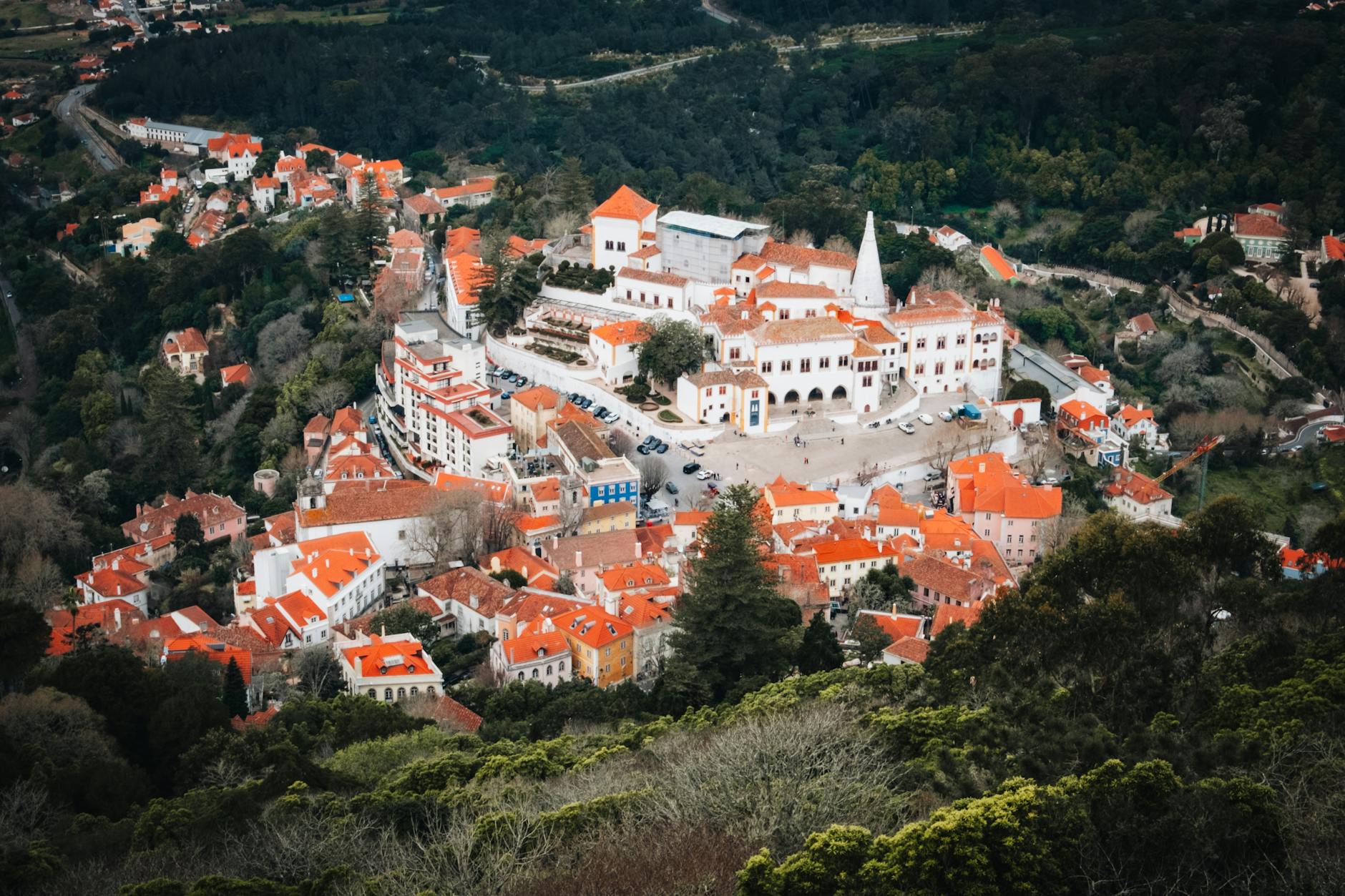
The old town clustered around the National Palace is what everyone pictures, and it is the obvious choice. You are a few minutes’ walk from the palace, the 434 and 435 bus stops, the best restaurants and the travesseiro shops, and you can walk up to the Moorish Castle from your front door. Evenings here are the whole reason to stay in Sintra.
The trade-offs are real, though. It is expensive by Sintra standards; rooms are often small and in old buildings with steep stairs and no lift; parking is close to impossible and usually costs extra at a lot outside the centre; and between about 10:00 and 18:00 you will be sharing your street with several thousand people. Delivery vans and tour coaches make the mornings noisy.
São Pedro de Penaferrim
Best for: a quieter base, drivers, second visits.
About twenty minutes’ walk uphill and east from the old town — or two stops on the bus — São Pedro is the neighbouring village, with its own square, its famous second-and-fourth-Sunday market, a handful of good restaurants and noticeably calmer streets. Rooms are cheaper than the centre and parking is possible.
The catch is the walk. It is uphill on the way back, and it is dark and pavement-free in stretches. Perfectly fine if you are content with a taxi after dinner; irritating if you were expecting to stroll.
Estefânia and around Portela de Sintra station
Best for: value, and anyone train-hopping to Lisbon.
The modern part of town, between the two stations, is where most of Sintra’s everyday life happens — supermarkets, a proper high street, ordinary restaurants at ordinary prices. Beds are the cheapest in the municipality and the trains to Lisbon are on your doorstep.
It is also, frankly, not very charming. You are staying in a normal Portuguese suburb about 25 minutes’ walk from the pretty bit. If your budget is the binding constraint and you would rather spend the money on tickets and dinner, it is a rational choice, and we would not pretend otherwise — but nobody has ever come home enthusing about Estefânia.
Colares and the wine country
Best for: drivers, couples, people who want a rural stay.
West of Sintra, between the Serra and the sea, Colares is a small wine region — one of Portugal’s oldest demarcated DOCs, growing on sand dunes — with quintas, guesthouses and converted farm buildings scattered through it. It is beautiful, it is quiet, and it is about ten minutes’ drive from both the monuments and the coast.
You need a car. Bus service exists but is thin, and you will spend the trip watching timetables. With a car, this is arguably the best base in the whole municipality. See our Portuguese wine guide for what Colares actually produces, which is unlike anything else in the country.
The coast: Praia das Maçãs, Azenhas do Mar, Praia Grande
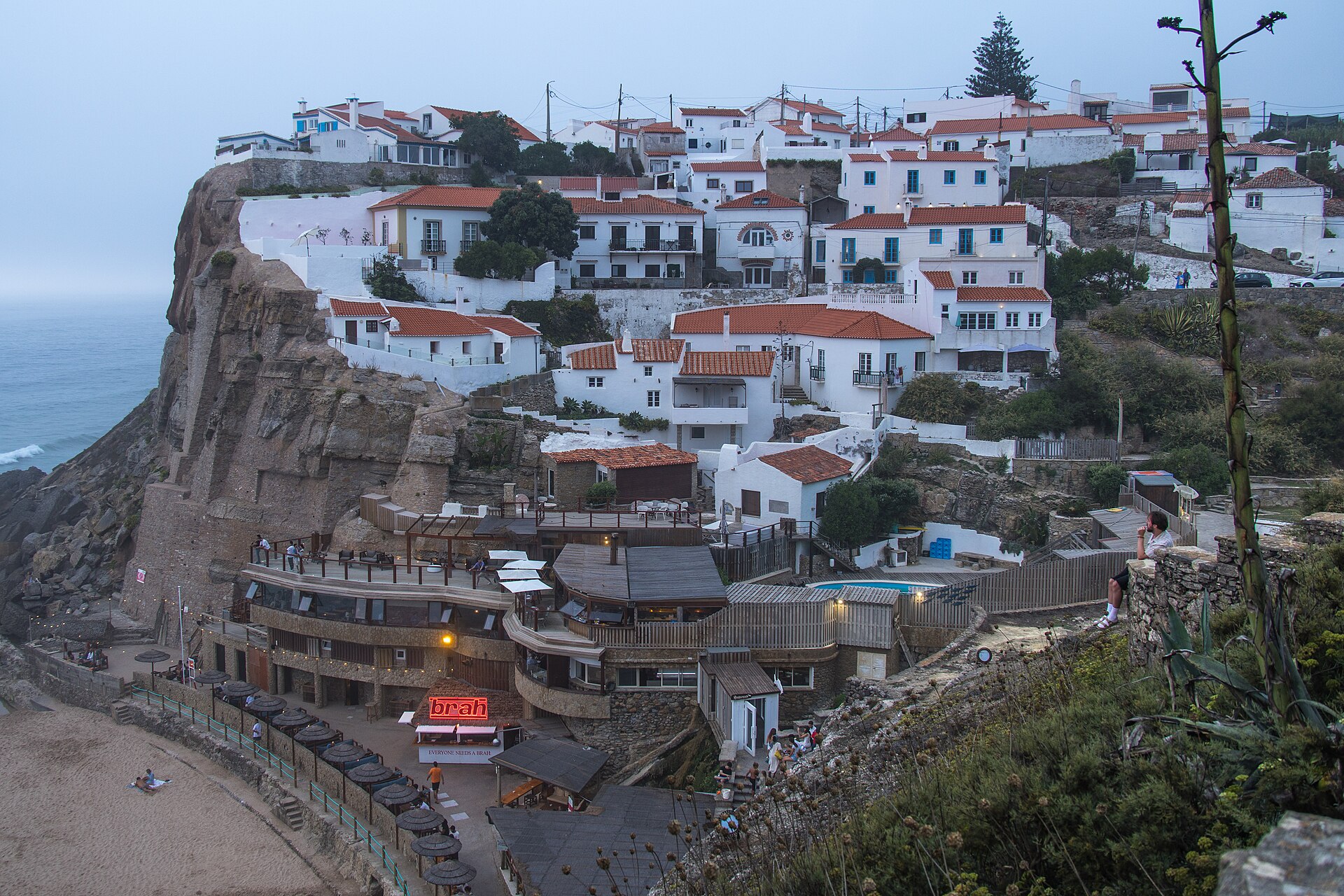
Best for: summer, families, anyone combining Sintra with beach days.
Twenty minutes west, the municipality meets the Atlantic at a run of cliff-backed beaches. Praia das Maçãs is the liveliest and has the historic tram link to Sintra in summer; Azenhas do Mar is the postcard village built into the cliff; Praia Grande has the biggest sand and the surf schools.
Staying here means a beach holiday with monuments attached rather than the other way round, and in July and August that is a very good trade. Be clear-eyed about the water, though: this is the open Atlantic, it is cold, and the surf is serious. It is not a Mediterranean beach holiday.
Linhó and the resorts
Best for: golf, spas, and travellers who want a resort rather than a town.
The area between Sintra and Cascais holds the large resort properties — golf courses, spas, full-service restaurants, shuttle buses. They are comfortable and expensive and they have almost nothing to do with Sintra as a place. If that is what you want, it is here; if you came for the town, you will spend the stay in a taxi.
Cascais, as the alternative base
Best for: people who want both, and cannot decide.
This deserves a mention because it is often the right answer. Cascais is a proper seaside town with far more hotels, far more restaurants, a beach, a train line straight into Lisbon, and the 1624 bus running up to Sintra via Cabo da Roca in about an hour. Beds are competitive and the evenings are livelier than anything Sintra offers.
The cost is that you do not get the empty Sintra morning, which is the single best thing about sleeping in Sintra. If that does not matter to you, Cascais is the more practical base by some distance.
Hotels worth knowing about
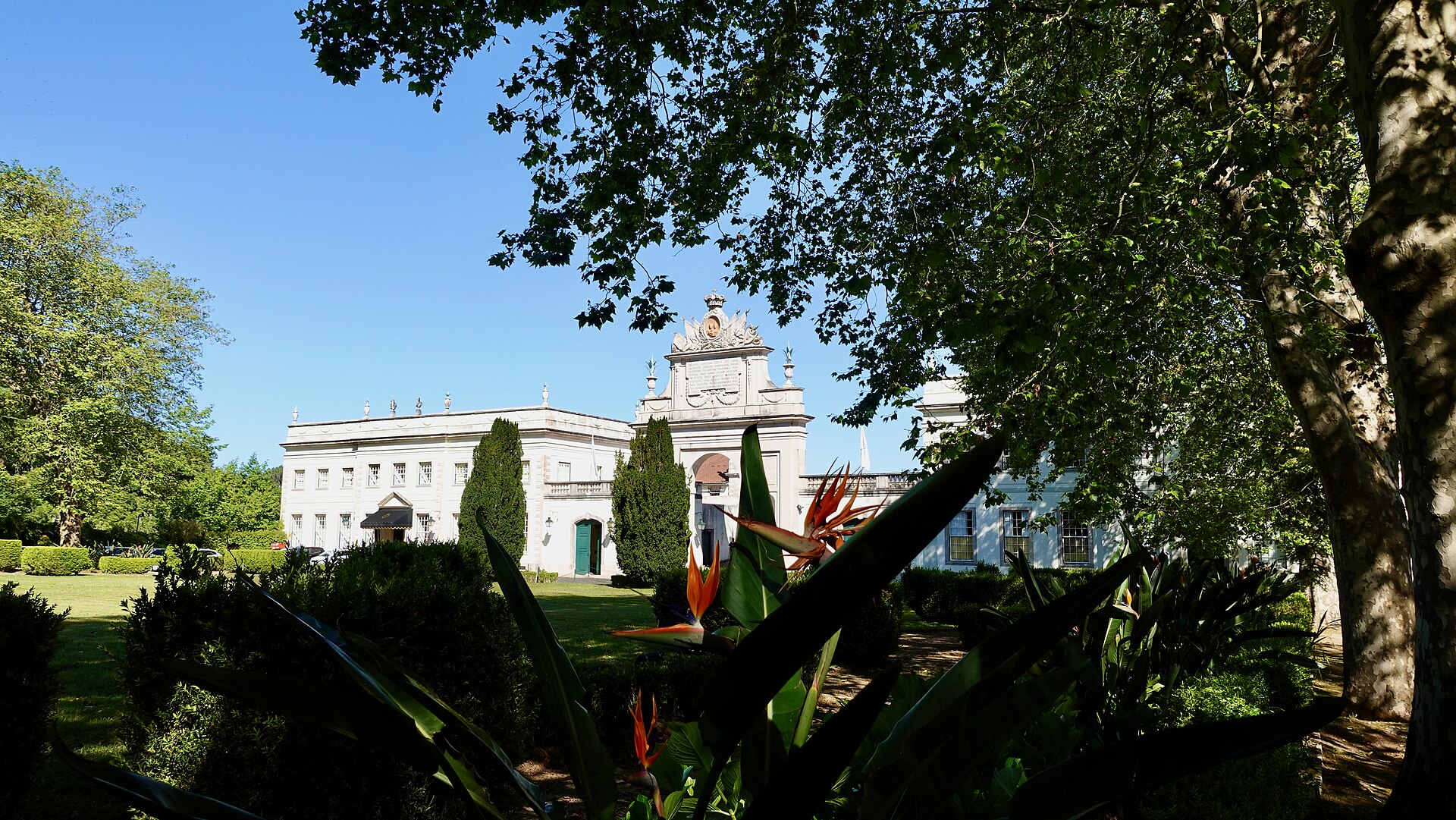
Sintra has fewer than twenty hotels in total, which makes the named properties worth knowing. These are the ones that shape the market:
- Palácio de Seteais — an eighteenth-century neoclassical palace on the road out to Monserrate, a hotel since the 1950s, with around thirty rooms and views straight up to Pena and the Moorish Castle. It is the grandest place to sleep in Sintra and priced accordingly. Ownership and branding here have changed in recent years, so check who is actually operating it when you book.
- Lawrence’s Hotel — opened in 1764 and reputedly the oldest still-operating hotel on the Iberian Peninsula, on Rua Consiglieri Pedroso about 300 metres from the National Palace. Sixteen rooms, low ceilings, period furniture, some with four-posters and fireplaces. Byron stayed here in 1809 and wrote part of Childe Harold’s Pilgrimage during the visit; Beckford was a guest before him. Small, atmospheric, and not for anyone who wants a modern bathroom.
- Sintra Boutique Hotel — in the historic centre, modern rooms, views over the old town and the natural park, and a restaurant that takes itself seriously. The reliable middle option, and consistently well rated.
- Guesthouses and quintas — this is where most of Sintra’s beds actually are, and where the value is. A converted quinta in Colares or a family-run guesthouse in São Pedro will typically cost less than a centre hotel and give you more space.
Book early. Sintra’s stock is genuinely small, and in July, August and the weeks either side of Easter the good places go months ahead. Our where to stay in Lisbon guide covers the alternative if you decide to base yourself in the city instead.
What it costs
Sintra is not cheap, and specifically it is not cheaper than Lisbon — a common assumption that catches people out. Small supply, high demand and a heavily seasonal market push prices up, and the historic centre in August is the most expensive accommodation in the district outside central Lisbon and Cascais.
The one bit of good news is the tax. Sintra’s municipal tourist tax is €2 per guest per night, capped at three consecutive nights, with guests under 13 exempt. That is half Lisbon’s €4, and capped at three nights rather than seven — so a couple staying two nights pays €8 rather than the €16 the same stay would attract in the city. It has been €2 since March 2023, having started at €1 under the original 2019 regulation, and it is collected by the property at check-in or check-out. Our tourist tax page explains how the Lisbon version differs.
For the wider budget picture, see is Lisbon expensive — the food and transport numbers there hold in Sintra too, though restaurant prices in the old town run 20–30% above Lisbon equivalents.
When to book, and what the seasons do to prices
Sintra’s accommodation market is unusually spiky, because there is so little of it. A hundred extra visitors wanting beds on a given night moves prices here in a way it never would in Lisbon.
- July and August are the peak by a wide margin, and the historic centre sells out weeks ahead. Book by spring if you want a specific property.
- Easter week and the weeks either side behave like high summer on price without the weather.
- May, June, September and early October are the sweet spot: good weather, real availability, and rates perhaps a fifth below peak.
- November to February is genuinely cheap, and Sintra in winter mist is atmospheric in a way that suits the place. Some smaller guesthouses close entirely, and restaurant choice narrows.
- Weekends cost more than weekdays year-round, because Lisbon empties into Sintra on Saturdays.
One scheduling note that saves money and queues: if you can stay midweek and visit the monuments on a Tuesday or Wednesday, you get both cheaper rooms and noticeably thinner crowds at Pena. Weekend visits to Sintra in summer are the single most crowded experience in the Lisbon region.
Six practical things nobody tells you
- Parking in the historic centre is effectively impossible. If you are driving, confirm with your property exactly where you will leave the car before you book, and expect to pay for a lot outside the centre and walk in.
- The hills are real. Sintra is built on a slope and the pretty streets are cobbled and steep. Check where your guesthouse actually sits relative to the town, not just how many metres away it is.
- Restaurants close early. Many kitchens in the old town stop serving by 21:30 and a good number shut entirely on Sunday or Monday. This is not Lisbon; do not assume you can decide at ten.
- The buses stop. The 434 and 435 finish in the early evening, and the 1624 to the coast and Cascais thins out badly after dark. Plan the last leg of any evening.
- It is colder and wetter than Lisbon. The Serra makes its own weather and holds cloud when the city is clear. Pack a layer even in July.
- Two nights is usually the right number. One night means you arrive tired and leave early; three means you run out of Sintra. Two gives you a full day of monuments plus one empty morning.
Quick matcher
- First visit, no car, want the atmosphere: historic centre.
- Driving, want space and quiet: Colares or São Pedro.
- Travelling in summer with children: Praia das Maçãs or Praia Grande.
- On a budget: Estefânia, or day-trip from Lisbon and skip the question.
- Want restaurants and a beach and Sintra: Cascais.
- One splurge night: Seteais, and eat elsewhere.
Getting around once you are here
The Scotturb 434 loops from the station through the centre to the Moorish Castle and Pena; the 435 runs west past Regaleira and Seteais to Monserrate; the Carris Metropolitana 1624 connects Sintra with Cabo da Roca and Cascais. The €13.50 Scotturb day pass covers the 434 and 435 for 24 hours from first validation and is about 8% cheaper online.
Staying in the centre means you catch these at the start of their loops rather than after they have filled up at the station, which in high season is a genuine advantage — often the difference between a seat and forty minutes standing. See the Moorish Castle, National Palace and Monserrate guides for what each route is for, and the train guide for getting here.
Frequently asked questions
Is it worth staying overnight in Sintra?
For one or two nights, yes — if what you want is the town after the day-trippers leave and the monuments before they arrive. If you only want to see Pena and a palace, day-trip from Lisbon and spend the money on dinner.
Where is the best area to stay in Sintra?
The historic centre for a first visit without a car; Colares or São Pedro with a car; the coast in summer. The centre costs more and is busier by day, but it puts you at the bus stops and the restaurants and it is the only area where the evenings are the reason you came.
How much is the tourist tax in Sintra?
€2 per guest per night, capped at three consecutive nights, with under-13s exempt. It is collected by the property at check-in or check-out, and it is half what Lisbon charges.
Is Sintra cheaper than Lisbon to stay in?
No, generally the opposite. Sintra has very little accommodation stock and strong seasonal demand, and the historic centre in high summer is among the more expensive places to sleep in the Lisbon district. The tourist tax is lower, which offsets a small part of it.
Can you stay in Sintra without a car?
Yes, easily, provided you stay in the historic centre or near a station. Colares, the coast and the resorts all effectively require one. The 434, 435 and 1624 buses cover the monuments and the coast, but they stop early and thin out on Sundays.
How many nights should you spend in Sintra?
Two. One night leaves you rushing, three usually runs out of things to do unless you are using Sintra as a base for the coast and Cascais as well. See how many days you need in Lisbon for how it fits into a longer trip.
Bottom Line
Most people should day-trip Sintra from Lisbon, and there is no shame in that — the monuments are all daytime, the train is quick, and Lisbon has more of everything in the evening. But if you have the days to spare, one or two nights in the historic centre gives you the two things a day-tripper can never have: an empty Pena at opening, and a Sintra evening with the mist coming down and the coaches gone.
Book the centre if you have no car and want the atmosphere, Colares or São Pedro if you are driving, the coast if it is August and you have children, and Cascais if you want the practical compromise. Whatever you choose, book early — there are fewer than twenty hotels in the whole town, and the good ones know it.
Photo Credits
The Seteais palace hotel: Sintra, Portugal (52197302350) by Rick McCharles from Calgary, Canada, CC BY 2.0, via Wikimedia Commons.
Azenhas do Mar on the Sintra coast: 2026-09-05 Azenhas do Mar 3 by Alexkom000, CC BY 4.0, via Wikimedia Commons.