
Getting around Lisbon is genuinely part of the trip. The city runs on vintage wooden trams that screech through medieval lanes, 19th-century funiculars that haul you up absurdly steep hills, and a metro system tiled with azulejo murals that most cities would put in a gallery. Knowing how it fits together saves you time, money, and a lot of sweating on cobblestones. This Lisbon transportation guide covers every mode — airport to city center, around the historic neighborhoods, and out to day trips like Sintra and Cascais.
All fares, timetables, and travel card details are updated for 2026, including the Navegante card system that replaced the old Viva Viagem cards.
Lisbon Airport to City Center
Humberto Delgado Airport sits 7 km north of the city center — close enough that the airport transfer is rarely a hassle. Your options, ranked by value:

Metro (Best Value)
The Red (Vermelha) line runs from the airport to the city center in 25–30 minutes. You’ll transfer at Alameda or São Sebastião to reach central stations like Baixa-Chiado or Marquês de Pombal. Cost: €1.90 per journey plus a one-time €0.50 Navegante card fee. Trains run 6:30 a.m. to 1:00 a.m., every 6–9 minutes. It avoids traffic entirely — which matters when half the city is gridlocked. The station is well-signed from arrivals.
Taxi and Ride-Hailing Apps
Taxis from the airport to central Lisbon run approximately €15–€25 depending on destination and traffic, plus a small luggage surcharge. Journey time: 15–25 minutes. Uber and Bolt are both widely available and typically 10–20 percent cheaper than taxis. Use the dedicated ride-hailing pickup area outside arrivals. Taxis and rideshares make sense if you arrive after the metro closes or have heavy luggage.
Airport Bus
Bus 744 and 783 from Carris serve the airport at regular transit fares (€1.72 with Navegante Zapping). Journey time: 30–40 minutes depending on traffic. Good if your hotel sits directly on the route.
The Lisbon Metro
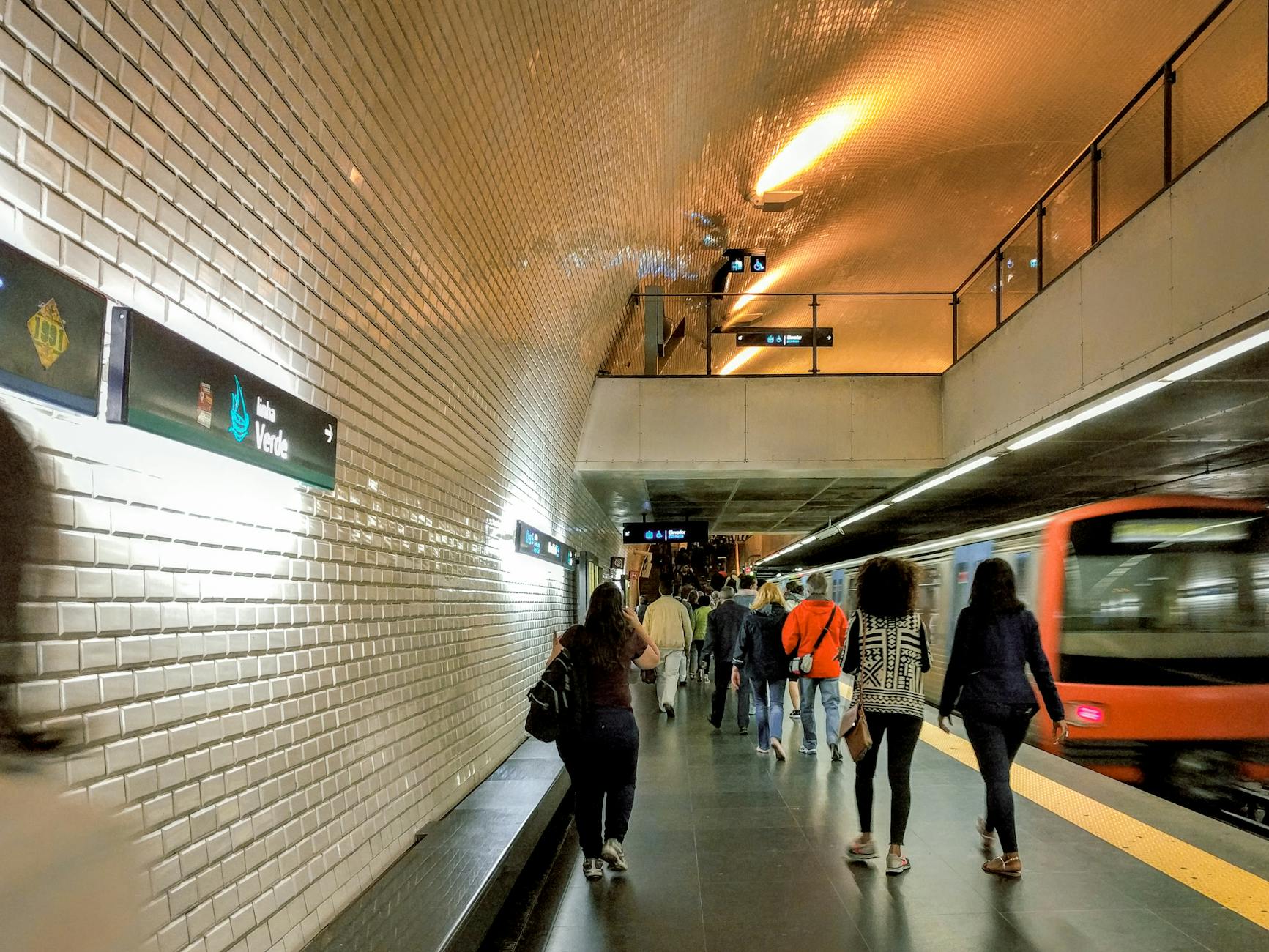
The Lisbon metro is the backbone of public transport here — modern, clean, frequent, and cheap. Four color-coded lines, 55 stations, service from 6:30 a.m. to 1:00 a.m. It’s the fastest way to cover longer distances without fighting traffic.
Metro Lines and Key Stations
The four lines: Blue (Azul/Gaivota) from Reboleira to Santa Apolónia; Yellow (Amarela/Girassol) from Odivelas to Rato; Green (Verde/Caravela) from Telheiras to Cais do Sodré; Red (Vermelha/Oriente) from the airport to São Sebastião. Key interchanges: Marquês de Pombal (Blue and Yellow), Alameda (Green and Red), Baixa-Chiado (Blue and Green — the most useful station for first-time visitors). All tourist areas of central Lisbon are within easy reach of at least one metro station, with the notable exception of Alfama, which is better served by trams and buses.
Metro Stations as Art Galleries
Many stations carry extraordinary azulejo installations, murals, and sculptures by major Portuguese artists. Highlights: Oriente (panels by artists from five continents), Olaias (geometric designs by Tomás Taveira), Parque (marine-themed tiles), Cais do Sodré (the “rabbits” installation by Inez Teixeira and Patrícia Figueiredo). Worth slowing down for.
Trams in Lisbon
Lisbon’s trams (eléctricos) are working transport and a slice of city history at the same time. The vintage wooden cars date from the early 20th century and navigate streets so narrow you could almost touch the buildings from the window.

Tram 28: The Iconic Route
Tram 28 winds from Martim Moniz through Graça, past the cathedral and São Jorge Castle, through Alfama, down to Baixa, up to Chiado and Bairro Alto, and on to Campo de Ourique. The full route takes 40–50 minutes one way. A single ticket bought on board costs €3.30; a Navegante card with Zapping credit cuts that to €1.72. It’s extremely popular — queues at the Martim Moniz terminus can hit an hour in peak season. Board before 9 a.m. or after 5 p.m. for the best experience, and keep valuables secured.
Other Useful Tram Routes
Tram 12 runs a shorter circular route through Alfama — same vintage carriages as Tram 28, far fewer crowds. Tram 15E is a modern, air-conditioned tram from Praça da Figueira to Belém: the most comfortable and direct way to reach the Jerónimos Monastery, Belém Tower, and MAAT. Tram 25E connects Campo de Ourique to Praça da Figueira through scenic residential streets. All trams accept Navegante cards.
Funiculars and Elevators
Lisbon’s three historic funiculars and the Santa Justa Elevator were built in the late 1800s and early 1900s specifically because the hills were otherwise impassable.

The Elevador da Glória connects Restauradores Square to the São Pedro de Alcântara viewpoint and Bairro Alto. The Elevador da Bica descends from Bairro Alto toward the river — the framed view of the Tagus at the bottom is one of the best in the city. The Elevador do Lavra, the oldest (1884) and least visited, climbs from near Avenida da Liberdade to the Torel Garden. All three funiculars are covered by the 24-hour transport pass and the Lisboa Card. Without a pass: around €3.80 per ride, or €1.72 with Navegante Zapping.
The Santa Justa Elevator (Elevador de Santa Justa) is a neo-Gothic iron lift connecting Baixa to the Carmo Convent in Chiado. Designed by Raul Mesnier du Ponsard, operating since 1902. A return trip costs €5.30 (free with Lisboa Card). Queues get long — the local move is to access the upper platform from the Largo do Carmo side and pay only the small terrace fee.
Buses in Lisbon
Lisbon’s bus network, operated by Carris, runs over 100 routes covering virtually every corner of the city. Buses reach parts of Alfama and Belém faster than trams during rush hour, and serve the airport. Most routes operate around 6:00 a.m. to 11:00 p.m.; night buses (N-prefix) run key routes midnight to 5:00 a.m. on weekends. A single fare: €2.30 paid on board, or €1.72 with Navegante Zapping. Google Maps and the Carris app both show real-time arrivals.
Tickets, Travel Cards, and Fares
The Lisbon ticketing system is simple once you understand the three main options for 2026.
Navegante Card (Zapping)
The Navegante card is a reusable smart card costing €0.50, loaded with credit (“Zapping”). Each journey deducts €1.72 for metro, bus, or tram — compared to €2.30–€3.30 paying on board. Tap on yellow validators at boarding. Load credit at metro station machines, Payshop locations, and some newsagents. The card stays valid indefinitely and can be shared between travelers (one tap per person). Best option for most visitors making a moderate number of trips.
Contactless Payment
Since 2023, Lisbon’s metro accepts contactless bank cards and mobile wallets (Apple Pay, Google Pay). Tap the card or phone on the validator. The fare is €1.92 per metro journey — slightly more than Zapping but no separate card needed. Contactless isn’t accepted on all bus and tram routes yet, so a Navegante card remains more versatile.
24-Hour Transport Pass
A 24-hour pass costs €7.25 and covers unlimited travel on metro, buses, trams, and funiculars for 24 hours from first validation. Breaks even at around four or five trips. A more comprehensive 24-hour pass including Fertagus and CP urban trains costs €11.40. Both are loaded onto a Navegante card at metro station machines.
Lisboa Card
The Lisboa Card combines unlimited public transport (metro, buses, trams, funiculars, and trains to Sintra and Cascais) with free or discounted entry to over 30 museums and attractions. Available for 24 hours (€31), 48 hours (€51), or 72 hours (€62). The 72-hour card typically earns its cost within two days if you visit the Jerónimos Monastery, São Jorge Castle, and the National Tile Museum. Buy online for a discount; collect at the airport or downtown pickup points.
Ferries Across the Tagus
The Tagus River ferries are one of Lisbon’s most underrated transport experiences. The most useful crossing: Cais do Sodré to Cacilhas on the south bank — a 10-minute ride costing about €1.50 with Navegante Zapping. From Cacilhas, the view back across the river to the Lisbon skyline, the 25 de Abril Bridge, and Cristo Rei is worth the trip alone. The Cacilhas waterfront has excellent and affordable seafood restaurants, especially Ponto Final. Other routes connect Terreiro do Paço to Barreiro and Montijo.

Taxis, Uber, and Bolt
Ride-hailing apps Uber and Bolt are widely used in Lisbon and usually cheaper than traditional taxis. A typical ride within the city center: €5–€10. Both work well for late-night travel after the metro closes, reaching hilly neighborhoods with luggage, or splitting a fare in a group. Traditional taxis (cream-colored cars with green roofs) are metered and available at ranks throughout the city. Make sure the meter is running, and note the surcharges for luggage and rides outside city limits.
Day Trip Transport from Lisbon
Several of Portugal’s best day-trip destinations are a short train or bus ride away.
Train to Sintra
CP trains to Sintra depart every 20–30 minutes from Rossio station. The 40-minute journey costs about €2.40 each way with a Navegante card, and is free with the Lisboa Card. From Sintra station, bus 434 loops to the main palaces (Pena Palace, Moorish Castle, National Palace). Go on a weekday to avoid weekend queues.
Train to Cascais
The train to Cascais departs from Cais do Sodré and follows the Estoril coastline for 35 minutes. At about €2.40 each way, it’s one of the most scenic and affordable train rides in Portugal. Stops include Estoril (casino and beach), Cascais (old town, Boca do Inferno), and several beach stations en route. Trains run every 20 minutes.
Bus to Costa da Caparica
For the popular Costa da Caparica beaches south of Lisbon, take a bus from Praça de Espanha (TST line 153 or Carris Metropolitana). The journey takes 30–40 minutes. In summer, a mini-train runs along the coast from the main beach, dropping passengers at different sections along a 10-kilometer stretch.
Walking and Cycling in Lisbon
Despite the hills, walking is often the best way to see the historic center. Distances between major attractions are short, and the best discoveries — hidden viewpoints, tiled façades, hole-in-the-wall tascas — only happen on foot. Wear shoes with grip; the calcada (cobblestone pavement) gets slippery when wet.
For cycling, the GIRA bike-share system offers electric bikes that make the hills manageable. A daily pass costs about €2.10, with each trip up to 45 minutes included. E-scooters also operate across the city. The riverside cycling path from Cais do Sodré to Belém is flat, scenic, and popular with both commuters and visitors. If you want to cover the steep historic neighborhoods without the legwork, tuk-tuk tours are the practical alternative — small three-wheelers that reach lanes no taxi can.
Practical Transport Tips for Lisbon
Get a Navegante card immediately: Buy one at the airport metro station as soon as you land. The €0.50 investment pays for itself on your first journey through lower fares.
Avoid rush hours: Metro and buses are most crowded 8:00–9:30 a.m. and 5:30–7:30 p.m. on weekdays. Tram 28 runs packed with tourists from about 10:00 a.m. to 5:00 p.m. daily.
Download useful apps: Google Maps handles Lisbon transit well. The official Carris and Metro apps show live departure times. Moovit is another solid option for multi-modal journey planning.
Beware of pickpockets on Tram 28: Keep bags in front of you, phones in zipped pockets. It’s Lisbon’s highest-risk route for petty theft.
Renting a car: Only worth it for day trips to the Alentejo, Arrábida, or the Silver Coast. Driving in central Lisbon is stressful — narrow one-way streets, limited parking, steep hills. A rental car makes no sense for a city-only trip. Pick it up from the airport or a city-edge office.
Start Exploring Lisbon
Lisbon’s transport system is affordable, efficient, and often an experience in itself. From the azulejo-decorated metro stations to the rattling vintage trams and the Tagus ferry crossings, getting around is built into the visit. With a Navegante card in your pocket and this Lisbon transportation guide to hand, you’re set.
For more help planning your trip, explore our comprehensive Lisbon travel guide, find out where to stay in Lisbon, discover the best things to do in Lisbon, and dive into our Lisbon food guide.