Sintra
Sintra, Portugal: The Complete Visitor’s Guide
Sintra is 25 km from Lisbon and it is the day most people get wrong. Every monument, every 2026 price, how the tickets and buses actually work, four itineraries that hold up — and why staying the night changes the place.

In this guide
- Sintra at a Glance
- A Very Short History
- What Sintra Is Not
- The Monuments: What to Visit and What It Costs in 2026
- Tickets: How the System Actually Works
- Getting to Sintra from Lisbon
- Getting Around Once You Arrive
- How Long to Spend in Sintra
- Four Itineraries That Actually Work
- Sintra with Children
- The Coast: Sintra’s Other Half
- Where to Photograph Sintra
- Common Mistakes
- Best Time to Visit
- What to Eat
- Practical Notes
- How Sintra Compares to Lisbon’s Other Day Trips
- Frequently Asked Questions
- Bottom Line
Sintra, Portugal is a small hill town 25 km west of Lisbon where nine centuries of Portuguese royalty built summer palaces into a damp Atlantic forest, and where several million visitors a year now arrive to look at them. It is the most-visited place in Portugal outside Lisbon and Porto, a UNESCO World Heritage cultural landscape since 1995, and — handled badly — one of the most frustrating days of a Portugal trip.
Sintra does not stop at the palaces — ten kilometres west the Serra falls into the Atlantic, and our guide to the Sintra coast beaches covers Ursa, Adraga, Praia Grande and Maçãs.
Eating here is mostly a matter of walking away from the palace. Our guide to where to eat in Sintra has the restaurants worth booking, the pastry shops worth queueing at, and the real story behind the travesseiro.
Thinking of staying the night? Our guide to where to stay in Sintra compares the historic centre, São Pedro, Colares and the coast — and is honest about when day-tripping from Lisbon is the better call.
The Serra runs out of land twelve miles west of the town. Our Cabo da Roca guide covers the 1624 bus, the cliff paths almost nobody walks, and why twenty minutes at the monument is the wrong way to see it.
Twenty minutes west of the station on the 435 sits the monument almost nobody queues for. Our Monserrate Palace guide covers the €12 ticket, the fern valley, and why the gardens are the better half of the visit.
The building in the middle of town with the two white cones is the one most visitors skip. Our Sintra National Palace guide makes the case that at €13, an hour, and no hill, it is the best-value ticket in Sintra.
The ridge above the town is the other half of Sintra’s skyline. Our Castelo dos Mouros guide covers the €12 ticket, the walk up from Santa Maria, and why the castle’s view of Pena beats Pena’s view of itself.
For the ticketing itself — prices, the multi-buy discount, the two bus circuits and which sites need booking — see our Sintra tickets and queue-beating guide.
The estate that most visitors end up talking about afterwards is not Pena but Regaleira — our Quinta da Regaleira guide covers the 2026 ticket, the timed slots and how to reach the Initiation Well before the queue forms.
This is the hub guide to the whole destination: what Sintra actually is, every monument worth your time and what each one costs in 2026, how the transport works, what a realistic day looks like, and — the part most guides skip — why staying overnight changes the place completely.

Sintra at a Glance
Sintra is a town of about 30,000 people in the Serra de Sintra, a granite ridge that catches Atlantic moisture and grows a forest that has no business existing 25 km from a Mediterranean-climate capital. That microclimate is the whole story. Portuguese kings came here from the 14th century because it was cool in August. Nineteenth-century Romantics came because the mist and the ruins looked like a painting. Almost everything you will see was built for one of those two reasons.
The practical shape of the place:
- Sintra Vila — the historic centre, built around the National Palace with its two conical chimneys. Cobbled, steep, packed by 11 AM, and the base for most visits.
- The hilltop — Pena Palace and the Moorish Castle, some 500 m above sea level and reachable only by bus, tuk-tuk or a genuinely hard walk.
- The western estates — Quinta da Regaleira, Seteais and Monserrate, strung along the road out of town toward Colares.
- Estefânia — the modern quarter around the train station, ten minutes’ walk downhill from Sintra Vila. Where you arrive, and where most of the parking is.
- The coast — Cabo da Roca, Praia da Ursa and Praia Grande, all inside the Sintra-Cascais Natural Park and all a separate half-day.
The distances are short. The gradients are not. Sintra is a town where a 900-metre walk can take 25 minutes and leave you sweating in February.
A Very Short History
The Moors fortified the ridge in the 8th or 9th century; the walls you climb at the Castelo dos Mouros are theirs, heavily reconstructed. Afonso Henriques took Sintra in 1147, in the same campaign that took Lisbon. The Portuguese crown then held the place as a summer residence for the next seven and a half centuries, which is why the National Palace grew room by room from the 14th century onward and never quite settled on a single architectural idea.
The second layer is the one that made Sintra famous. In 1809 Byron passed through and called it a “glorious Eden” in Childe Harold’s Pilgrimage, and a generation of northern European Romantics took the hint. Ferdinand II — German-born consort to Queen Maria II — bought the ruined monastery on the highest crag in 1838 and spent thirty years turning it into Pena, planting the surrounding hillside with 500 species from across the empire. Wealthy foreigners followed: Francis Cook built Monserrate, and much later Carvalho Monteiro built Regaleira. Almost every “ancient” thing in Sintra that is not a wall or a chimney is a 19th-century invention, and knowing that makes the place more interesting rather than less.
UNESCO inscribed the whole cultural landscape in 1995 — not any single building, but the combination of park, palace and forest, which is the first European site to be listed under that category.
What Sintra Is Not
Two corrections worth making before you plan anything.
It is not a day trip that fits comfortably in a day. You can see two monuments properly, or three in a rush. There are six ticketed monuments in and around the town, plus several smaller sites. Anyone telling you they “did Sintra” in six hours saw a fifth of it.
It is not a theme park with one entrance. The monuments are run by different organisations — Parques de Sintra, which is state-owned and holds most of them, and the private foundation behind Quinta da Regaleira. There is no combined ticket covering all of them, no shared queue, and no single booking system. Budget for this.
The Monuments: What to Visit and What It Costs in 2026
Prices below are the 2026 gate rates for adults aged 18–64, taken from the official sites. Youth (6–17) and seniors (65+) pay less almost everywhere; under-6s are free at every site listed.
Pena Palace and Park — €20
The one on the postcards: a 19th-century Romantic fantasy in ochre, crimson and tile, built by Ferdinand II on the ruins of a Hieronymite monastery. The Essential Visit ticket (€20 adult, €18 youth and senior, €65 family) covers both the park and the palace interiors. Park only is €12.
Hours: park 09:00–19:00, last entry 18:00; palace 09:30–18:30, last ticket sales 17:30.
The critical detail: palace entry is by timed slot on a specific date. If you turn up without one you may get in hours later, or not at all in high season. Book online, pick the earliest slot you can stomach, and treat that time as the anchor for your entire day. Everything else in Sintra flexes around it.
Allow 90 minutes to two hours for palace plus park. Read the full Pena Palace guide before you book.
Quinta da Regaleira — €20
A gothic-revival estate built between 1904 and 1910 by a Brazilian-Portuguese millionaire with a serious interest in the Knights Templar, freemasonry and alchemy. The gardens are a puzzle-box of grottoes, towers and tunnels, and the Initiation Well — a 27-metre inverted spiral staircase descending into the rock — is the most photographed thing in Sintra after Pena itself.
Entrance fees rose in January 2026: €20 adult, €15 youth (6–17), €15 senior (65+), €60 family (two adults plus two youth), free under 6. Audio guide €5, printed map €0.50. Entry is by timed slot every 30 minutes from 10:00.
Regaleira is privately run and is not part of any Parques de Sintra combination ticket. Book it separately. Allow two hours minimum — the tunnels reward wandering, and the queue for the Initiation Well itself can add twenty minutes on a summer afternoon.
Full detail in our Quinta da Regaleira guide.

Castle of the Moors — €12
Ninth-century Moorish fortifications on the ridge above the town, largely rebuilt as a Romantic ruin in the 1800s. You walk the walls. That is the experience, and on a clear day it is a very good one — the Atlantic, Pena on the next crest and the Tagus estuary are all visible at once.
€12 adult, €10 youth and senior, €33 family. Open 09:30–18:00, last admission 17:30. The ticket office shuts 12:00–13:00, though the vending machines stay on.
It is a ten-minute downhill walk from Pena’s gates, which makes it the natural second stop. Skip it if the weather has closed in — the whole point is the view.
More in our Moorish Castle guide.

National Palace of Sintra — €13
The medieval royal palace in the middle of town, in continuous royal use from the 15th century to 1910 and the oldest surviving palace in Portugal. Those two enormous white cones are the kitchen chimneys. Inside are the Magpie Room, the Swan Room and the Coats of Arms Room, which holds the finest heraldic ceiling in the country.
Essential Visit €13 adult, €10 youth and senior, €35 family. Gardens free. Open 09:30–18:30, last admission 17:30.
This is the monument everyone drops, and it is the wrong one to drop if it is raining — it is entirely indoors, it is in the town centre so it costs you no transport time, and an hour is enough.
Our Sintra National Palace guide makes the longer case.

Monserrate Park and Palace — €12
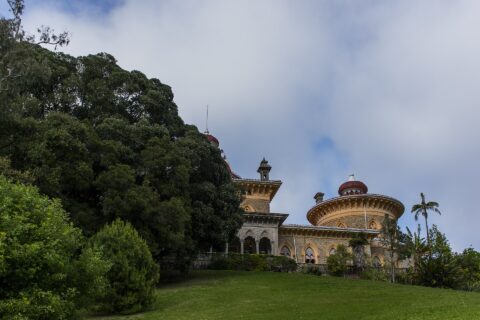
Four kilometres west of town: a Moorish-Indian-gothic villa built for a Victorian textile heir, surrounded by what is arguably the best botanical garden in Portugal — Mexican, Australian, Japanese and Himalayan planting zones running down a valley.
€12 adult, €10 youth and senior, €33 family. Park 09:00–19:00; palace 09:30–18:00.
Note for 2026: the palace roof is under restoration, with scaffolding and temporary covering in place, scheduled to run into the first quarter of 2027. The gardens are unaffected and are the main reason to come anyway — but if the building’s exterior is what you wanted, wait.
Details in our Monserrate guide.
Monserrate is the answer to “Sintra was too crowded.” It takes the 435 bus, it is never full, and on a weekday in March you can have the fern valley to yourself.
Convent of the Capuchos — €11
A 16th-century Franciscan hermitage deep in the forest, where friars lived in cells hacked out of the granite and lined with cork. It is tiny, damp, extraordinary, and the exact opposite of Pena — which is why the two make such a good pairing if you have the time.
€11 adult, €9 youth and senior, €29 family. Open 09:00–17:30, last admission 17:00.
Hard to reach without a car or taxi; no scheduled bus serves it directly. Budget €25–€30 each way in a taxi from Sintra Vila, or fold it into a private half-day.
The Smaller Sites
- Chalet and Garden of the Countess of Edla — Ferdinand II’s Swiss-style retreat inside Pena Park, built for his second wife. Included in some Pena ticket types; check what yours covers before paying twice.
- Villa Sassetti — a walking route between the town and the hilltop through the grounds of a 19th-century villa. The civilised alternative to trudging up the main road.
- Seteais Palace — now a luxury hotel. You cannot tour it, but you can walk the terrace and have a drink with the view.
- Queluz National Palace — the Portuguese Versailles, technically a separate town on the Sintra train line. Worth its own trip rather than a squeeze.
Tickets: How the System Actually Works
This is where most Sintra plans come apart, so it is worth being precise.
Parques de Sintra runs Pena, the Moorish Castle, the National Palace, Monserrate, Capuchos, the Chalet of the Countess of Edla, Villa Sassetti, Queluz and the Cabo da Roca lighthouse. One website, one basket, one set of QR codes on your phone. Combination tickets across two or three of these sites exist and save a few euros against the individual prices — Pena plus the Moorish Castle is the pairing most people want.
Quinta da Regaleira is a separate foundation with its own booking system, its own timed slots and no relationship to the Parques de Sintra basket. It appears in no combination ticket. You will buy it twice if you are not paying attention.
The Lisboa Card does not cover Sintra’s palaces. It covers the train to Sintra, which is worth €5.10, and that is the extent of it. Do not buy one on the strength of a Sintra day.
Third-party resellers — the “skip-the-line Sintra tickets” sites that dominate search results — sell the same timed slots with a markup, typically 20–40%. There is no faster queue to skip to; the timed slot is the mechanism. Buy direct from parquesdesintra.pt and regaleira.pt unless you specifically want a guided tour bundled in.
Free entry applies to under-6s everywhere, and Portuguese residents get reduced rates at Parques de Sintra sites on Sundays and public holidays — bring a residence card if that applies to you.
Getting to Sintra from Lisbon
By Train — Take the Train
The CP suburban line runs from Rossio Station in central Lisbon to Sintra in 40 minutes, every 15–20 minutes on weekdays and every 30 minutes at weekends. CP prices urban trains by zone, so check the Rossio–Sintra fare on cp.pt — or pay €2.05 per journey if you load Zapping pay-as-you-go credit onto a Navegante card, which costs €0.50 and works on the metro, trams and buses too.
No booking, no reservations, no seat classes. You can also board at Oriente or Entrecampos, which adds about ten minutes but suits anyone staying in Parque das Nações or northern Lisbon. Our Lisbon to Sintra train guide covers platforms, ticket machines and timetables in detail.
By Car — Generally a Mistake
Driving takes about 40 minutes via the IC19, and then the problems start. Private vehicles are restricted on the hilltop roads to Pena and the Moorish Castle, the historic centre is largely closed to through traffic, and the lower-town car parks fill by mid-morning in summer. You end up parking at Estefânia and boarding the same bus as everyone who took the train — having paid for a car and a parking space to do it.
A car is genuinely useful for exactly one itinerary: Capuchos, Monserrate, Cabo da Roca and the coastal beaches in a single day, ignoring the hilltop entirely. For anything else, take the train.
By Tour
Group day tours run roughly €55–€110 per person and typically pair Sintra with Cabo da Roca and Cascais. Private drivers are €140–€280 for the vehicle. The case for a tour is mobility, small children, or a genuine dislike of logistics — not speed, because a tour bus queues at the same gate you would. Our Sintra tours guide compares the operators.
Getting Around Once You Arrive
Bus 434 — the Pena circuit
Scotturb’s hop-on-hop-off loop: Sintra Station → Sintra Vila → Moorish Castle → Pena Palace → back down. Roughly every 15 minutes, about 09:00 to 20:00 in summer with a shorter winter span. A single ride is €4.10; the day pass covering both 434 and 435 is €13.50, and is around 8% cheaper bought online.
The 434 runs one way only — it will not carry you back down from Pena to the castle, only onward round the loop. Plan the hilltop top-down: Pena first, walk down to the castle, then rejoin the bus.
Bus 435 — the Monserrate circuit
Sintra Station → Sintra Vila → Quinta da Regaleira → Seteais → Monserrate. Roughly every 20 minutes, 09:30–19:50 in summer and 09:30–18:10 the rest of the year. €5.50 hop-on-hop-off, or included in the €13.50 combined pass.
Bus 1253 — Cabo da Roca
Leaves from outside Sintra station, two to three departures an hour, about 45 minutes and €2.60–€2.70 paid in cash to the driver. Navegante and Viva Viagem cards are not accepted — it is a different operator. It runs a circular route through Sintra and does not continue to Cascais; for that you need the 1624 from Cabo da Roca. Check your return before you set off, because the headland takes twenty minutes to see and the wait can be an hour.
Full logistics in our Cabo da Roca guide.
Walking and tuk-tuks
Station to Sintra Vila is a pleasant ten minutes downhill. Sintra Vila to Quinta da Regaleira is fifteen minutes on a road with a narrow pavement. Sintra Vila to Pena is four kilometres of steep climbing and 60–90 minutes — do it via the Villa Sassetti path if you do it at all. Tuk-tuks charge €10–€20 for the run up the hill and are a reasonable buy if the bus queue is thirty deep.
How Long to Spend in Sintra
One day (the standard trip). Two monuments done properly, three if you skip a real lunch. Pena plus Regaleira is the classic pairing; Pena plus the Moorish Castle is the efficient one, because they share a hilltop. Our Sintra day trip guide has the hour-by-hour version.
Two days. The whole hilltop and town on day one; Monserrate, Capuchos and the coast on day two. This is the version where Sintra stops feeling like a queue.
For slotting Sintra into a longer Lisbon trip rather than treating it separately, see our combined Lisbon and Sintra itinerary.
Overnight. The strongest argument in this guide. The day-trip crowd arrives around 10:30 and is gone by 18:00. Stay in Sintra Vila and you get the town on either side of that window — the palaces at opening with almost nobody in them, the streets at dusk with the mist coming in, and dinner somewhere that is not serving four hundred covers. It costs a hotel night and it roughly doubles what you see.
Our where to stay in Sintra guide covers the areas and the trade-offs.
Four Itineraries That Actually Work
The classic one day
Pena at the earliest slot, the Moorish Castle straight after, lunch in Sintra Vila, Quinta da Regaleira in the afternoon. Take an early train from Rossio, be at the Pena gate for your first slot, and you will be walking into Regaleira in the afternoon with time in hand. This is the maximum a day can absorb, and it only works if all three tickets are bought before you leave Lisbon.
The no-queue day
Skip the hilltop entirely. National Palace at opening, coffee and a travesseiro, then the 435 out to Monserrate for the gardens, then back for Quinta da Regaleira in the late afternoon when the day-trip crowd has started leaving. Three monuments, no timed-entry stress, and roughly half the walking. This is the itinerary to recommend to anyone visiting in August.
The two-day version
Day one: Pena, the Moorish Castle, the National Palace, dinner in São Pedro. Day two: Monserrate in the morning, the Convent of the Capuchos by taxi around midday, then out to Cabo da Roca and down the coast to Cascais for the evening train back. This covers essentially everything most visitors want, and it is the itinerary an overnight stay unlocks.
The rainy day
Sintra gets a lot of weather, and half the sights are outdoors. When it turns: National Palace first, Pena palace interiors second (the park is miserable in rain but the state rooms are not), then Monserrate, where the palace interior and the sheltered valley planting are both improved by wet. Leave the Moorish Castle and Regaleira’s tunnels for a dry day.
Sintra with Children
Sintra is better for children than most heritage destinations, but unevenly. Quinta da Regaleira is the winner — the tunnels, the well and the grottoes are a genuine adventure, and children who would refuse a third palace will happily spend two hours underground. Pena works on colour and towers alone. The Moorish Castle is a long walk on exposed ramparts with drops on both sides, which suits confident older children and no one under about six. The National Palace is a hard sell.
Practical points: pushchairs are close to useless on Sintra’s cobbles and gradients, so bring a carrier for small children. Family tickets exist at every Parques de Sintra site and at Regaleira, and they save real money — the Regaleira family ticket is €60 against €70 bought individually. The 434 bus is where children get most tired, because the queue is standing in the sun; the tuk-tuk is worth the €15 on a bad day.
The Coast: Sintra’s Other Half
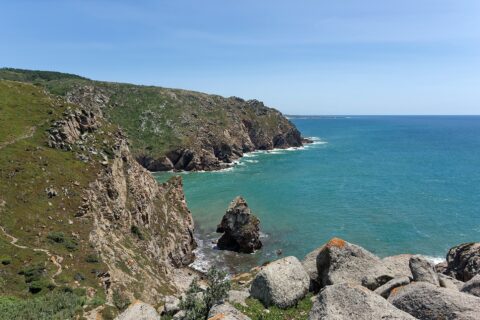
Most visitors never leave the town, which means they miss the half of the UNESCO landscape that faces the Atlantic. The serra drops into the sea along one of the wildest stretches of coast in western Europe, all of it inside the Sintra-Cascais Natural Park.
- Cabo da Roca — the westernmost point of mainland Europe, a lighthouse, a stone marker with a line of Camões on it, and a great deal of wind. Twenty minutes to see, and worth it.
- Praia da Ursa — a dramatic, difficult-to-reach cove below Cabo da Roca, reached by a steep unmarked scramble. Spectacular; not for everyone.
- Praia Grande and Praia das Maçãs — the accessible beaches, both served by bus from Sintra, both with proper surf and a full set of cafés. Praia das Maçãs is the terminus of the historic Sintra tram, which runs seasonally.
- Azenhas do Mar — a white village stacked on a cliff above a seawater pool. Twenty minutes from town and one of the best photographs in the region.
None of this fits into a day that also includes two palaces. Treat the coast as the reason to give Sintra a second day, or as a separate excursion combined with Cascais.

Where to Photograph Sintra
The postcard shot of Pena floating above the treeline is taken from the Cruz Alta, the highest point of Pena Park, or from the walls of the Moorish Castle — both included in tickets you are probably already buying. The classic view of the castle, meanwhile, is from Pena’s own terraces, which is why doing the hilltop in that order works so well.
In town, the two chimneys of the National Palace read best from the small square below them, in the early morning before the square fills. At Regaleira, the Initiation Well is shot from the bottom looking up; the queue moves, so wait for the gap rather than shooting over heads. And the single most reliable atmospheric shot in Sintra is any of the forest paths at around 09:00 in autumn, when the mist has not yet burned off the trees.
Common Mistakes
- Arriving without a Pena time slot. The most common and the most expensive. In July it can cost you the palace entirely.
- Starting at 11:00. By then the 10:30 wave from Lisbon is on the bus and every queue in town has doubled.
- Trying for four monuments. You will rush all four and enjoy none. Two is the number.
- Assuming the 434 goes both ways. It is a one-way loop, and people regularly wait at the wrong stop for a bus that is never coming back.
- Driving up the hill. Access is restricted and enforced, and you will end up in a lower-town car park anyway.
- Eating in the first restaurant past the palace. Five minutes’ walk in any direction is materially better and cheaper.
- Wearing the wrong shoes. Sintra’s cobbles are polished granite, and they are slippery whenever it is damp, which is often.
Best Time to Visit
Sintra runs several degrees cooler and considerably wetter than Lisbon. The forest is why you should care: in August the capital is hot, dusty and full, while the serra stays green.
- April to early June — the best window. Everything is in flower, the gardens at Monserrate are at their peak, and the crowds have not fully arrived.
- Mid-September to October — the second-best window. Warm, quieter, and the light is better for photographs.
- July and August — busiest and hottest. Timed slots sell out days ahead. If you must come then, be at the first Pena slot of the day.
- November to March — genuinely atmospheric. Mist, no queues, low prices. But this is also when Sintra earns its rainfall reputation, and a fogged-in Moorish Castle is a wall with nothing behind it.
For the wider seasonal picture, see the best time to visit Lisbon.
What to Eat
Sintra has two famous pastries and they are not the same thing. Travesseiros — flaky “pillows” of puff pastry filled with almond and egg cream — come from Piriquita on Rua das Padarias, which has been baking in the town since 1862. Queijadas are small cheese tarts with cinnamon, and they predate the travesseiro by several centuries.
Restaurants: the streets immediately around the National Palace are priced for people who will never come back. Walk five minutes to São Pedro de Sintra, or ten down to Estefânia, and both the price and the cooking improve.
Our where to eat in Sintra guide names the places worth the walk.
Practical Notes
- Book Pena’s timed slot first, then build the day around it. Every other decision is downstream of that one.
- Buy the €13.50 bus day pass online if you are using both circuits — it is cheaper and you skip the kiosk queue.
- Ticket offices close 12:00–13:00 at the Parques de Sintra sites. Vending machines work through lunch.
- Wear real shoes. Wet granite cobbles, unrailed castle walls, and dim tunnels at Regaleira.
- Bring a layer. Sintra is reliably cooler than Lisbon, and the hilltop is cooler again, even in July.
- Toilets and water are inside the paid sites and scarce between them. Fill up before you go up the hill.
- Last trains back run until well after midnight, so an evening in Sintra is possible even without a hotel.
How Sintra Compares to Lisbon’s Other Day Trips
Sintra is the default recommendation, and mostly it deserves to be — but it is not the right answer for every traveller.
- Versus Cascais. Cascais is easier: one direct train, no buses, no timed tickets, a beach and a seafront. It is also a much smaller idea. Take Cascais if you want a relaxed day; take Sintra if you want a significant one.
- Versus Óbidos. Óbidos is a walled medieval town an hour and a half north, and it is a single, coherent, walkable experience — arguably more charming and definitely less logistically demanding. It has nothing on Sintra’s scale.
- Versus Évora. Roman temple, bone chapel, Alentejo food, and about a third of the crowds. The better choice for a second or third day trip, not a first.
- Versus Setúbal and Arrábida. Beaches, dolphins and wine, and the least touristed of the standard options. A summer alternative rather than a competitor.
The honest ranking: if you have one day outside Lisbon, take Sintra. If you have two, add Cascais and the coast. If you have three, go to Évora rather than doing Sintra twice — unless you decided to stay overnight, in which case Sintra twice is exactly right. The full comparison is in our day trips from Lisbon pillar.
Frequently Asked Questions
Is Sintra worth visiting?
Yes — it is the single best excursion from Lisbon, and for many people the best day of a Portugal trip. The caveat is that it rewards planning more than almost anywhere else in the country. Arriving without a Pena time slot in July is how people end up saying Sintra was overrated.
How much does a day in Sintra cost?
For one person doing the classic Pena-plus-Regaleira day: €5.10 train, €13.50 bus pass, €20 Pena, €20 Regaleira, €15–€20 lunch — around €75–€80. Add €12 for the Moorish Castle. Two adults with a couple of children will find the family tickets cut this meaningfully.
Which two monuments should I pick?
Pena and Quinta da Regaleira if you want the two most distinctive experiences — one is a spectacular exterior, the other is a place you explore. Pena and the Moorish Castle if you want the most efficient day, because they are a ten-minute walk apart.
Do I need to book tickets in advance?
For Pena, yes, always — it is timed-entry and it sells out. For Quinta da Regaleira, yes in summer and at weekends. For the Moorish Castle, the National Palace, Monserrate and Capuchos you can usually walk up, though booking online still saves you the queue.
Can I visit Sintra and Cascais in one day?
You can, and the standard tour does exactly this, but you will see one Sintra monument rather than two. If the coast is the priority, do Sintra Vila plus Cabo da Roca plus Cascais and skip the hilltop entirely — it is a more coherent day than trying to have both. See our Cascais day trip guide.
Is Sintra good in the rain?
Partly. The National Palace and the Pena interiors work fine. The Moorish Castle and the Regaleira tunnels do not — one loses its entire point and the other becomes slippery. If the forecast is bad, reweight toward the indoor palaces and Monserrate’s sheltered fern valley, which is arguably better wet.
Is Sintra accessible for limited mobility?
Partially. Pena Palace runs a shuttle from the park gate to the palace door and has step-free routes through much of the interior; the National Palace and Monserrate are largely manageable. The Moorish Castle, Quinta da Regaleira’s tunnel network and the Convent of the Capuchos are not. Sintra Vila’s cobbles and gradients are hard work with a wheelchair or a pushchair.
Is one day in Sintra enough?
Enough for two monuments and a sense of the town, which is what most people mean by “enough.” Not enough for the coast, Monserrate, Capuchos or an evening in Sintra Vila. If your Portugal trip has any slack in it at all, an overnight here buys more than an extra night in Lisbon does.
Does the Lisboa Card cover Sintra?
Only the train. The palaces are all excluded — Parques de Sintra and Quinta da Regaleira both charge full price to Lisboa Card holders. The card is a good buy for Lisbon’s own museums and transport, not for a Sintra day.
How early should I get to Pena Palace?
Aim to be at the park gate when it opens at 09:00, which means an early slot booked and an early train out of Rossio. The first hour is quiet, the palace is photographable, and the terraces are not three deep. By 11:00 the difference is dramatic.
What is a travesseiro?
A rectangular puff-pastry “pillow” filled with almond and egg cream, dusted with sugar, and served warm. Piriquita in Sintra Vila is the original and still the reference. Do not confuse it with the queijada, which is a small, dense cinnamon-and-cheese tart and is the older Sintra speciality of the two.
Can I leave luggage in Sintra?
Sintra station has lockers, and several shops in Estefânia and Sintra Vila run paid left-luggage. Useful if you are coming from Lisbon with bags on the way to somewhere else — but note that hauling a suitcase around Sintra’s gradients is a genuinely bad afternoon.
Can I do Sintra without using the buses?
Only if you accept a hard day’s walking or spend the difference on taxis and tuk-tuks. The town-level sites — National Palace, Quinta da Regaleira, Seteais — are walkable from the station. The hilltop is not, in any realistic sense.
Bottom Line
Sintra deserves more than the six hours most people give it. Book Pena’s earliest timed slot, take an early train from Rossio, carry the €13.50 bus pass, and pick two monuments rather than four. Then, if the trip allows it at all, stay the night — because the version of Sintra that exists at 08:30 and at 19:30, when the day-trip coaches are somewhere back on the IC19, is a genuinely different and better town.
If you are coming out from Lisbon for the day and going back the same evening, our one-day Sintra itinerary has the hour-by-hour plan, and the Lisbon to Sintra train guide covers the journey itself. For the wider set of options outside the capital, start at our day trips from Lisbon pillar.
Planning the logistics in detail? See our Sintra tickets and bus 434 guide.