Day Trips from Lisbon
Évora Day Trip from Lisbon: Roman Ruins & the Chapel of Bones 2026
Plan a day trip to Évora from Lisbon—the Roman Temple, Chapel of Bones, Cathedral, Alentejo cuisine, and how to get there by train.
In this guide
- Quick Answer: Is Évora Worth a Day Trip?
- Why Évora Is Worth the Trip
- Quick Reference
- Getting to Évora from Lisbon
- Top Things to Do in Évora
- Eating in Évora
- Évora Wine
- Full-Day Itinerary: Évora from Lisbon
- Best Time to Visit
- Practical Tips
- Évora vs Sintra: Which Day Trip?
- FAQ: Évora Day Trip from Lisbon
- Bottom Line
An Évora day trip from Lisbon is one of Portugal’s most rewarding excursions — a UNESCO World Heritage city built on Roman foundations, packed with a 1st-century temple, a medieval cathedral, the macabre Chapel of Bones, and Alentejo’s earthy cuisine and wine country surrounding it. 90 minutes by train, and a full day of history unlike anything on the Sintra or Cascais circuits.
If you liked Évora’s layers of history, our Tomar day trip guide is the northern equivalent — nine hundred years in one hilltop complex.
This guide covers everything: how to get there, what to see, where to eat, a tested full-day itinerary, and what to know about Alentejo wine. Updated for 2026.
Quick Answer: Is Évora Worth a Day Trip?
| Évora vs other day trips | Notes |
|---|---|
| vs Sintra | Less crowded, more history, different feel — both are worth doing |
| vs Cascais | Deeper history and cuisine; Cascais is beaches and coast |
| vs Óbidos | Évora is significantly larger, denser sights, better food |
| Difficulty | Easy — direct train, walkable old town, English widely spoken |
| Best for | History, architecture, Alentejo cuisine, wine |
Why Évora Is Worth the Trip
Évora has been continuously inhabited for over 2,000 years. The Romans called it Ebora Liberalitas Julia and made it a colonial administrative centre. The Moors held it from 715 until the Christians retook it in 1166. The Portuguese crown used it as a royal residence through the 14th–16th centuries. What remains is a whitewashed medieval old town — still enclosed by ancient Roman walls — where you can walk from a Roman temple to a Gothic cathedral to a chapel literally decorated with human bones in under 30 minutes.
It’s also surrounded by Alentejo wine country and sits near the Cromeleque dos Almendres — a megalithic stone circle older than Stonehenge, if you have a car.
Day-trip options from Lisbon tend to crowd around Sintra and Cascais. Évora draws fewer visitors, moves at a different pace, and serves better food. It’s the most underrated easy escape from the capital.
Quick Reference
- Distance from Lisbon: 130 km / 90 min by train, ~90 min by car
- UNESCO World Heritage: Yes — listed 1986
- Best for: History, architecture, Alentejo cuisine, Alentejo wine
- Time needed: Full day from Lisbon (6–7 hours in the city)
- Cost: ~€25–€60 per person DIY (transport + entry + lunch); €70–€110 on a guided tour
Getting to Évora from Lisbon
By Train (Recommended)
The most practical option for a day trip. CP Intercidades trains run from Lisbon Oriente, Entrecampos, Sete Rios, and Pragal stations to Évora. Check current timetables at cp.pt — schedules change seasonally and booking in advance is recommended, especially in summer.
- Journey time: approximately 1 hour 30 minutes
- Cost: ~€9.50–€13 second class; ~€16–€17 first class
- Frequency: 4–6 trains per day in each direction
- Recommended departures: First morning train (around 7 AM from Oriente) or the mid-morning option (~9 AM). This gives you 6–7 hours in Évora before the last comfortable return.
- Best return: Mid-to-late afternoon — check cp.pt for exact times on your travel date
Book tickets online at cp.pt or at station machines. Seats are reserved on Intercidades trains — it’s worth booking ahead rather than showing up and hoping.
By Car
~90 minutes via the A6 motorway. Tolls run approximately €15 return. Best option if you want to combine Évora with Alentejo wineries along the route, or visit the Cromeleque dos Almendres megalithic stones (13 km west of Évora, no public transit). Drive gives flexibility; the train gives simplicity.
By Guided Tour
Various Lisbon-based operators run full-day Évora tours at €70–€110 per person. Typically includes hotel pickup, transport, a guide, and major site entries (Chapel of Bones, Cathedral, Roman Temple). Some add wine tasting or an Alentejo lunch. A good option if you want context without navigation.
By Bus
Rede Expressos operates coach services from Lisbon (Sete Rios terminal) to Évora. Slightly cheaper than the train (~€8–€12 one way) but slower and less punctual. Train is the better choice.
Top Things to Do in Évora
1. Roman Temple of Diana (Templo Romano)
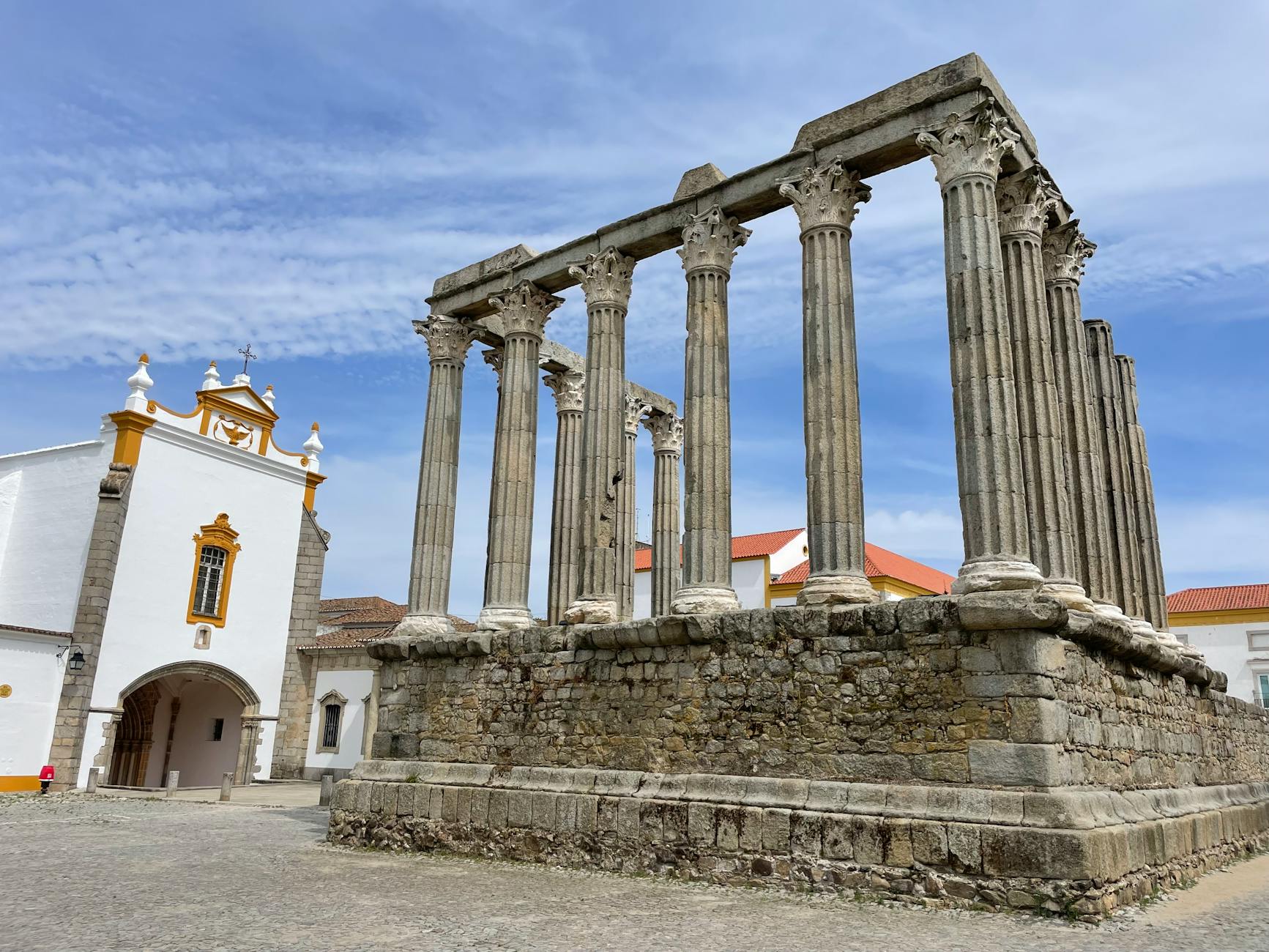
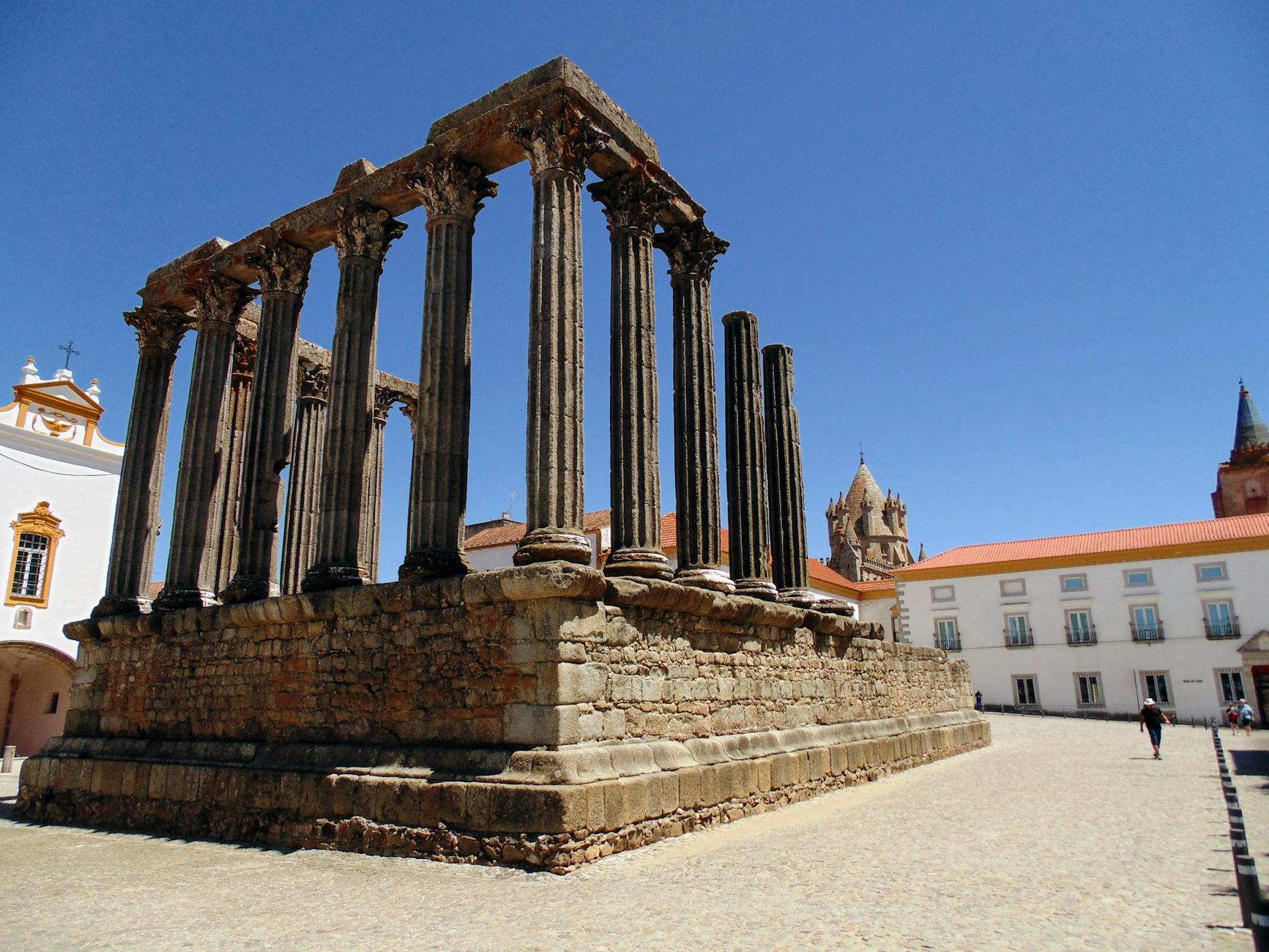
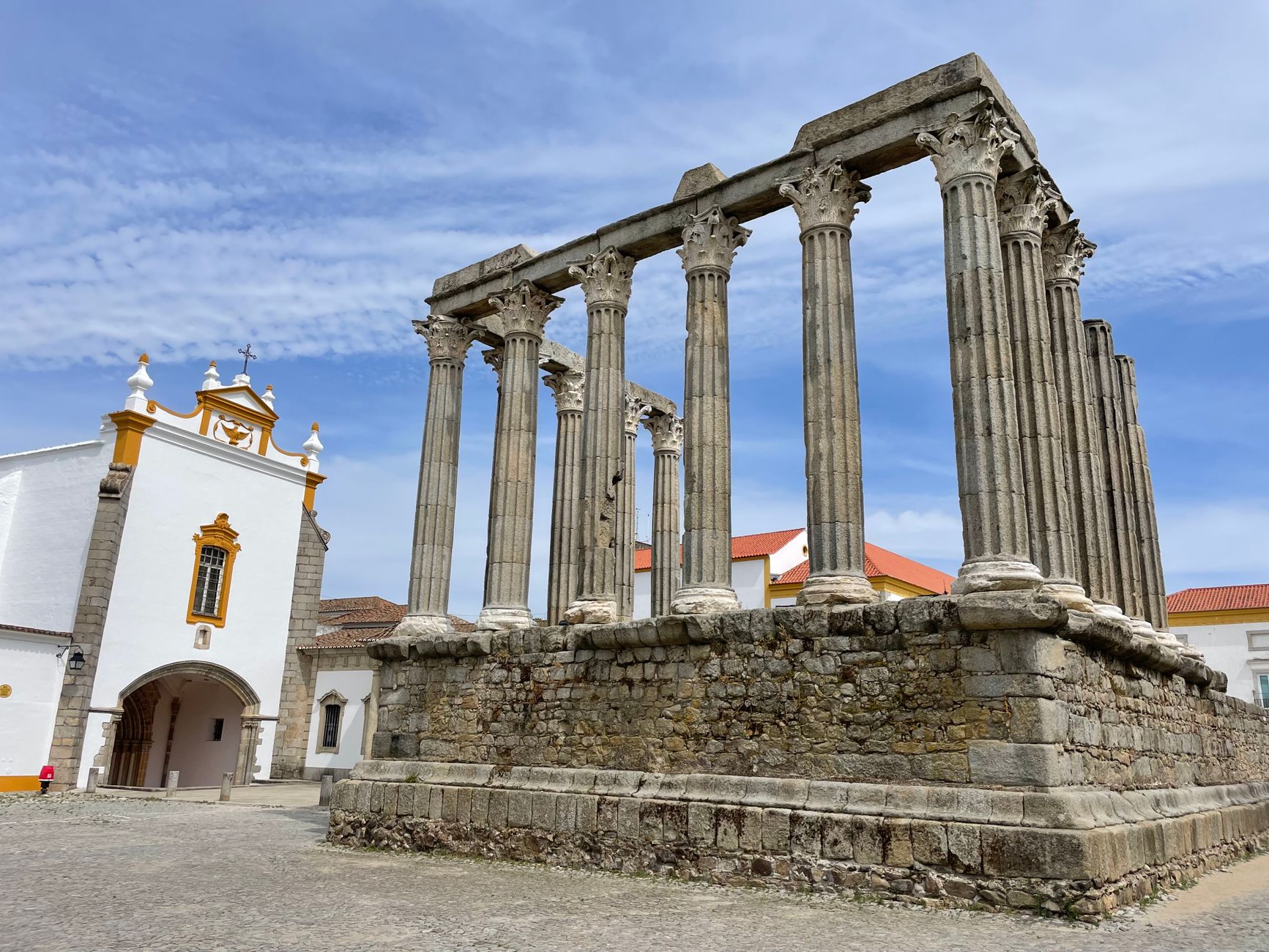
A 1st-century AD Corinthian temple, the best-preserved Roman structure on the Iberian Peninsula. Fourteen columns still standing — fluted granite shafts on marble bases, Corinthian capitals intact. The “Diana” name is a 16th-century misattribution; it was almost certainly dedicated to Emperor Augustus, part of the imperial cult.
The reason it survived: in the medieval period it was walled up and used as a slaughterhouse, then adapted into a fortress. That inadvertent protection kept the columns from being quarried for other buildings. The enclosing walls were removed in 1871, revealing what had been preserved inside them for 600 years.
Location: Largo do Conde de Vila Flor, at the top of the old town
Cost: Free — exterior only; no entry fee
Time needed: 20–30 minutes, including walking around the perimeter
2. Cathedral — Sé de Évora
Portugal’s largest medieval cathedral. Construction began in 1186 and was completed around 1250 — Romanesque-Gothic transitional, with a Manueline-Renaissance cloister added later. The granite exterior is spare and fortress-like; the interior is cool, atmospheric, and genuinely impressive at scale.
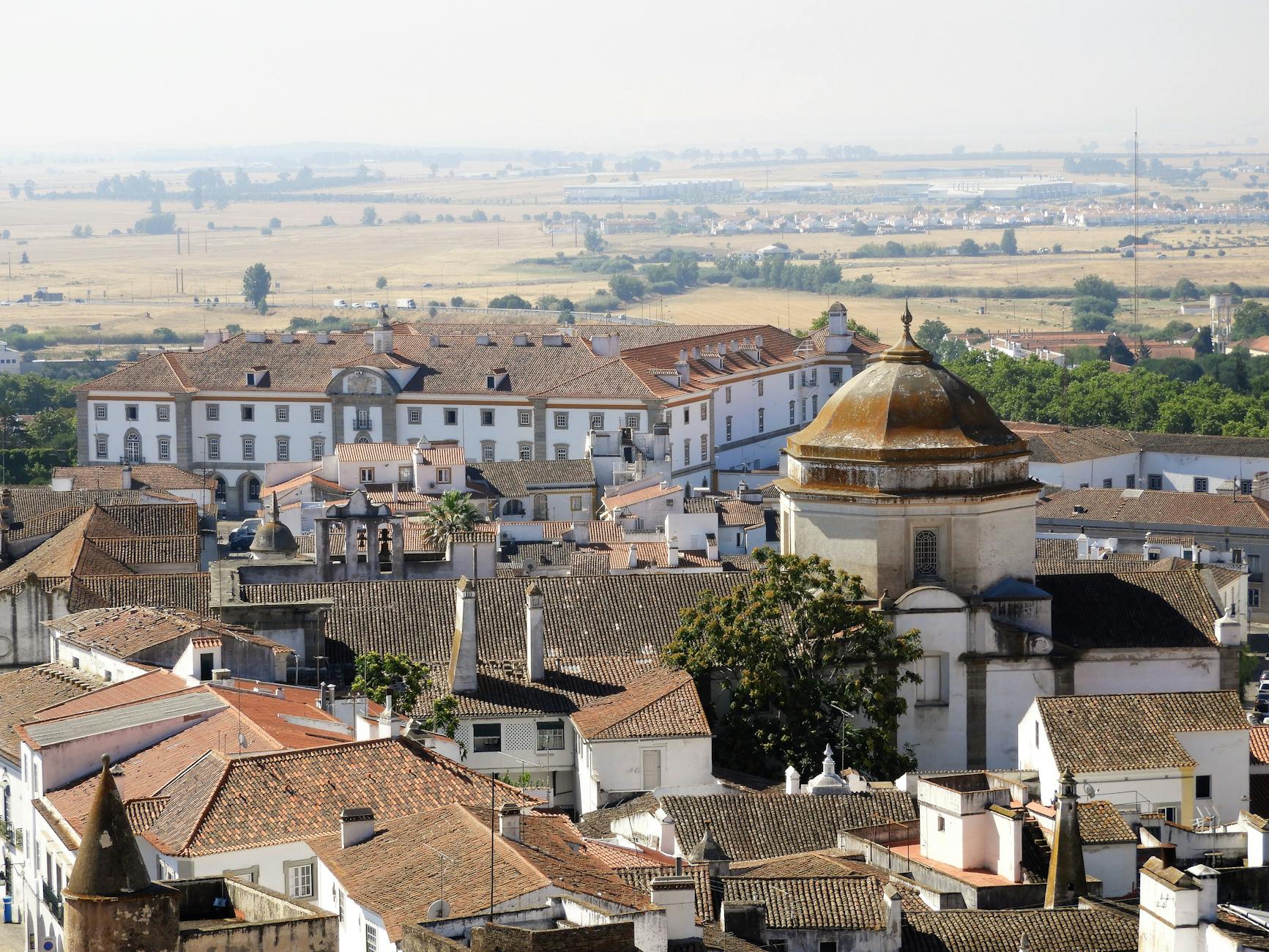
The roof terrace is the most underrated part: climb the bell towers for 360-degree views over Évora’s whitewashed old town to the flat Alentejo plains stretching to the horizon. On a clear day the view carries for miles.
Cost: ~€4 cathedral; ~€6 cathedral + cloister + treasury
Hours: Approximately 9 AM–6 PM — confirm current hours before visiting
Time needed: 45–60 minutes including the roof
3. Chapel of Bones (Capela dos Ossos)
Built by 16th-century Franciscan friars from the exhumed bones of approximately 5,000 medieval Évora residents — the churchyards had run out of space, so the solution was to build a chapel using what the exhumations produced. Walls, columns, and ceiling supports are formed from tibia, femur, and skulls arranged in geometric patterns.
The inscription above the entrance reads: “Nós ossos que aqui estamos pelos vossos esperamos” — “We bones that are here await yours.”
The effect is not grotesque in the way you might expect. It’s quiet, meditative, and genuinely medieval in its matter-of-fact relationship with mortality. One of the most singular rooms in Portugal.
Location: Inside Igreja de São Francisco, 10–15 minutes on foot from the Roman Temple
Cost: ~€6 (church + chapel + viewing tower)
Hours: Approximately 9 AM–5:30 PM (sometimes to 6 PM)
Time needed: 30–45 minutes
4. Praça do Giraldo
The main square at the heart of the old town. Italian Renaissance arcade, a 16th-century marble fountain, café terraces. Coffee here between sights. In the late 16th century, it was also the site of auto-da-fé Inquisition proceedings — the marble Renaissance elegance and its darker history coexist in the same square.
5. Évora University
Founded 1559 — one of the oldest universities in the Iberian world, established by the Jesuits at the height of Portugal’s empire. The cloister is lined with azulejo tile panels depicting scenes from classical antiquity and the sciences. Free to enter. An easy 10-minute detour from the Roman Temple.
6. City Walls
Évora’s walls incorporate Roman foundations, with medieval additions over the top. Walk a section for views over the surrounding countryside. Several gates (portas) punctuate the circuit — Porta de Avis and Porta de Alconchel are the most photogenic.
7. Cromeleque dos Almendres (Car Required)
13 km west of Évora. Ninety-five menhirs (standing stones) arranged in an oval and a circle — dated to approximately 5000–4000 BC, predating Stonehenge by a millennium or more. Free access, often deserted even in summer. The surrounding cork oak landscape adds to the atmosphere. Only accessible by car or taxi; no public transit serves the site.
Eating in Évora
Alentejo is one of Portugal’s great food regions — honest, peasant-rooted cooking built around bread, olive oil, garlic, pork, and lamb. Lisbon’s best restaurants import Alentejo ingredients and charge accordingly. In Évora you eat them in context, at local prices.
Alentejo Cuisine Specialties to Order
- Açorda Alentejana — the region’s defining dish: torn bread in a garlicky, coriander-heavy broth finished with olive oil and a poached egg. Simple and remarkable.
- Migas — bread crumbs sautéed with garlic and pork fat, served alongside meat
- Carne de porco à alentejana — pork with clams and potatoes in a white wine and paprika sauce. One of Portugal’s great combinations.
- Borrego (lamb) — stewed, roasted, or grilled; lamb here is better than almost anywhere else in Portugal
- Queijo de Évora — the local hard sheep’s milk cheese, often served as a starter
- Doces conventuais — convent sweets, including Pão de Rala (almond cake) and Sericaia (egg and cinnamon pudding)
Where to Eat
- Tasquinha do Oliveira — petisco-style small plates, traditional Alentejo, casual. A reliable choice that doesn’t require planning weeks ahead.
- Botequim da Mouraria — six seats, no printed menu, the chef cooks whatever is best that day. Widely regarded as one of the finest dining experiences in the Alentejo. Reserve weeks in advance; they’re frequently booked out.
- Restaurante Cozinha de Santo Humberto — atmospheric mid-range restaurant in the old town, consistent traditional Portuguese cooking.
- Adega do Alentejano — cheap, big portions, local clientele. The right choice if you want value over refinement.
- Café Alentejo — casual, central, good for a quick lunch between sights.
Évora Wine
The Alentejo DOC (Denominação de Origem Controlada) covers most of southern Portugal’s interior. The wines are predominantly red — bold, full-bodied, fruit-forward, often structured by the extreme heat of Alentejo summers. International recognition has grown steadily since the 1990s. Main grape varieties: Aragonez (the Portuguese Tempranillo), Trincadeira, Alicante Bouschet, and Touriga Nacional blends.
Alentejo wine is one of Portugal’s best-value categories — quality has risen sharply while prices have stayed behind the Douro and Vinho Verde regions. Buying a bottle in Évora costs a fraction of what the same wine costs on a Lisbon restaurant list.
Where to Taste and Buy
- Cartuxa Winery — the most prominent Évora-based producer, with tours and tastings (~€10–€20). Set in the former Carthusian monastery grounds outside the old town walls.
- Adega Cooperativa de Évora — the local co-operative winery; less formal, more accessible for an hour’s visit.
- Garrafeiras (wine shops) in the old town — several within a short walk of Praça do Giraldo offer tasting flights and will let you try before buying.
Full-Day Itinerary: Évora from Lisbon
Morning
Early train — depart Lisbon Oriente on the first morning service (~7 AM depending on season; check cp.pt the day before)
Arrive Évora — approximately 90 minutes later; the station is 1.5 km from the old town walls (taxi €5–€7, or 20 min on foot)
Coffee at Praça do Giraldo — get your bearings over a bica and a pastel or local pastry
Roman Temple — 20–30 minutes; the light is best in morning
Évora Cathedral — climb the roof terrace for views, 45–60 minutes
Évora University cloister — quick 15-minute detour on the way south
Midday and Afternoon
Walk to Chapel of Bones via the old town streets, 15-minute walk
Chapel of Bones — 30–45 minutes
Lunch — at Tasquinha do Oliveira or a reserved table at Botequim da Mouraria (~12:30–2:30 PM)
Wine tasting — Cartuxa or an old-town garrafeira (2:30–4:00 PM)
Walk the city walls — late afternoon, when the light on the Alentejo plains is exceptional
Return train — mid-to-late afternoon; check cp.pt for times on your travel date
Best Time to Visit
| Season | Notes |
|---|---|
| April–May | Best overall — wildflowers, mild temperatures, low crowds |
| June–August | Hot (often 35°C+), dusty; all sights are shaded but the streets are exposed |
| September–October | Excellent — harvest season, food festivals, cooler than summer |
| November–March | Cool, quiet, atmospheric; some reduced opening hours |
Mid-summer heat in the Alentejo is serious — 35–40°C is common in July and August. The sights themselves are largely indoor, but moving between them involves direct sun on cobblestoned streets. Spring and autumn are the better choices.
Practical Tips
- Book the train in advance — Intercidades seats are reserved; walk-ups work off-peak but can leave you standing in summer
- Wear comfortable shoes — old town streets are cobblestoned, with some gradient near the cathedral
- Book restaurants — Botequim da Mouraria especially requires weeks of advance notice; Tasquinha do Oliveira is easier but still benefits from a reservation at lunch
- Bring water in summer; limited drinking fountains once you’re away from the squares
- Sundays: Some secondary sights close or reduce hours; restaurants may have shorter service
- Consider an overnight — Évora after dark, when day-trippers have left, is a different and better city. Several good guesthouses and a pousada (government heritage hotel) inside the walls.
Évora vs Sintra: Which Day Trip?
Both are easily done from Lisbon. They’re different experiences:
- Sintra: 19th-century Romantic palaces (Pena, Moorish Castle, Quinta da Regaleira) in forested hills. More photogenic, more crowded, higher entry costs. Train from Rossio (40 min). See our Sintra day trip guide and our guide to visiting Pena Palace.
- Évora: Roman ruins, medieval cathedral, bone chapel, Alentejo food and wine. Less crowded, slower pace, deeper history, better eating. Train from Oriente (90 min).
If you have two days for day trips, do both. If you have one, the choice depends on whether you want UNESCO-protected natural/palatial landscape (Sintra) or a compact UNESCO city with 2,000 years of layered history (Évora). Neither is wrong. See also our Cascais day trip guide and day trips from Lisbon overview for the full picture.
FAQ: Évora Day Trip from Lisbon
Is Évora worth a day trip from Lisbon?
Yes — a UNESCO city with a 1st-century Roman temple, medieval Gothic cathedral, macabre Chapel of Bones, and the best food of any Portuguese day-trip destination. Less crowded than Sintra, more historically layered than Cascais.
How long is the train from Lisbon to Évora?
Approximately 1 hour 30 minutes on a CP Intercidades train. Trains depart from Lisbon Oriente, Entrecampos, Sete Rios, and Pragal. Book at cp.pt — seats are reserved on this service.
What is the Chapel of Bones in Évora?
The Capela dos Ossos — a 16th-century chapel decorated with the bones and skulls of approximately 5,000 medieval Évora residents, exhumed when local cemeteries reached capacity. Inside Igreja de São Francisco, about 15 minutes on foot from the Roman Temple. The entrance inscription translates as: “We bones that are here await yours.”
Can I visit Évora and the megalithic stones in one day?
Only with a car (the Cromeleque dos Almendres is 13 km west, no public transit). Tight but doable: 2 hours at the stones, 4 hours in the old town. By train, you can only cover the city itself.
What is Alentejo cuisine like?
Bread-based, olive-oil-heavy, pork and lamb focused. Açorda alentejana (garlic and coriander bread soup with egg) and carne de porco à alentejana (pork with clams) are the defining dishes. Excellent cheese and convent sweets. One of Portugal’s most distinctive regional cuisines.
Should I overnight in Évora rather than day-trip?
If you can manage it — the city at night, when day-trippers have left, is quieter, more atmospheric, and the restaurants have room for a proper dinner. It’s an easy base for exploring further into Alentejo wine country the following morning.
Bottom Line
Évora delivers ancient Roman ruins, medieval cathedral, the most singular bone chapel in Europe, and Alentejo wine and cuisine in a single day from Lisbon. Take the morning CP train, walk the compact old town in the right order (Temple → Cathedral → Bones Chapel → lunch → wine), and return in the afternoon. It’s less crowded than Sintra, more historically rich than Cascais, and easily Portugal’s most underrated day trip from the capital.
Évora is the day trip for people who have already done the obvious one. The day trips guide compares them properly: Sintra and Pena Palace are the busier, closer, more photographed option, and Cascais is the one you can do on a whim with a train ticket and no plan.