Where to Stay in Lisbon
Baixa & Rossio: Guide to Lisbon’s Downtown Historic Center
Explore Lisbon's Baixa district—the elegant downtown rebuilt after the 1755 earthquake. Architecture, shopping, restaurants, and practical tips.
In this guide
Baixa Lisbon is the city’s elegant downtown — a grid of grand 18th-century streets running between Rossio Square and the river, completely rebuilt after the 1755 earthquake to a revolutionary urban plan. It’s where most travelers start their Lisbon visit: a flat, walkable district packed with historic squares, pedestrianized shopping streets, century-old cafés, and trams threading through Pombaline architecture.
This guide covers everything you need to know — what to see, where to eat, where to stay, and how to navigate Baixa & Rossio like a local. Updated for 2026.
Baixa & Rossio at a Glance
- What it is: Lisbon’s downtown commercial and historic core, rebuilt after the 1755 earthquake on a grid plan
- Best for: First-time visitors, walking tourism, shopping, café culture, central accommodation
- Highlight squares: Praça do Comércio, Rossio (Praça Dom Pedro IV), Praça da Figueira, Praça dos Restauradores
- Iconic streets: Rua Augusta (pedestrian shopping spine), Rua Áurea, Rua da Prata
- Metro: Rossio (green line), Baixa-Chiado (green/blue), Restauradores (blue), Terreiro do Paço (blue)
- Vibe: Touristy but historic — busiest area of central Lisbon
The History: Why Baixa Looks Different from Old Lisbon
On November 1, 1755 — All Saints’ Day — a massive earthquake estimated at 8.5–9.0 magnitude struck Lisbon. A subsequent tsunami and six days of fires destroyed most of the lower city. An estimated 30,000–50,000 people died, and roughly 85% of the city’s buildings collapsed.
King José I’s prime minister, the Marquês de Pombal, took charge of reconstruction. Rather than rebuild medieval Lisbon as it was, Pombal commissioned an entirely new urban plan: a rigid grid of standardized buildings with wide streets, designed to be earthquake-resistant.
The result — completed over the following decades — is what tourists today call “Pombaline” Baixa: uniform 4–5 story buildings with iron balconies, identical wooden window frames, and a wood-and-mortar internal cage system (the gaiola pombalina) designed to flex during seismic activity. The entire district is a candidate UNESCO World Heritage Site as one of Europe’s earliest examples of urban planning at scale.
This is why Baixa looks completely different from Alfama (which survived the earthquake and retains its medieval Moorish street pattern) or even Bairro Alto (rebuilt on its existing footprint). Baixa is a planned city — laid out in months, built over decades, still standing as designed.
The Five Squares of Baixa
Praça do Comércio (Terreiro do Paço)
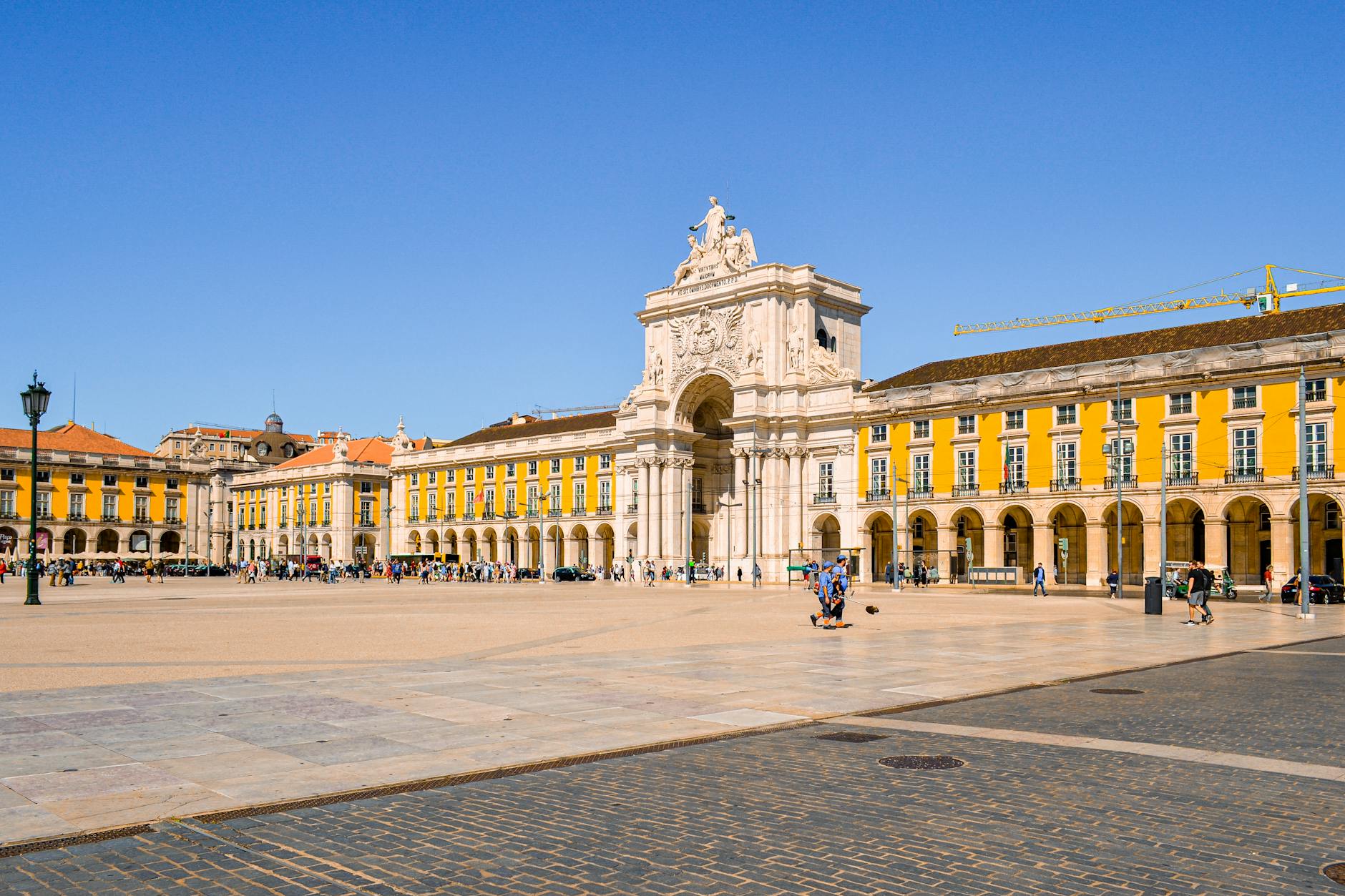
The monumental waterfront square at the southern edge of Baixa. 175 meters wide, opening directly onto the Tagus River. Surrounded on three sides by yellow neoclassical arcaded buildings (originally government ministries; now offices, restaurants, and the Lisbon Story Centre).
The centerpiece is the equestrian statue of King José I (1775), and the northern entrance is the magnificent Arco da Rua Augusta — climb to the top (€3.50–€4.50, verify on arrival) for one of central Lisbon’s best elevated views of the Baixa grid and the Tagus. Free with Lisboa Card.
This was where the royal palace stood before the earthquake (hence “Terreiro do Paço” — “Palace Yard”). After the quake, Pombal made it a public square — a deliberate symbol of post-earthquake civic modernism.
Rossio (Praça Dom Pedro IV)
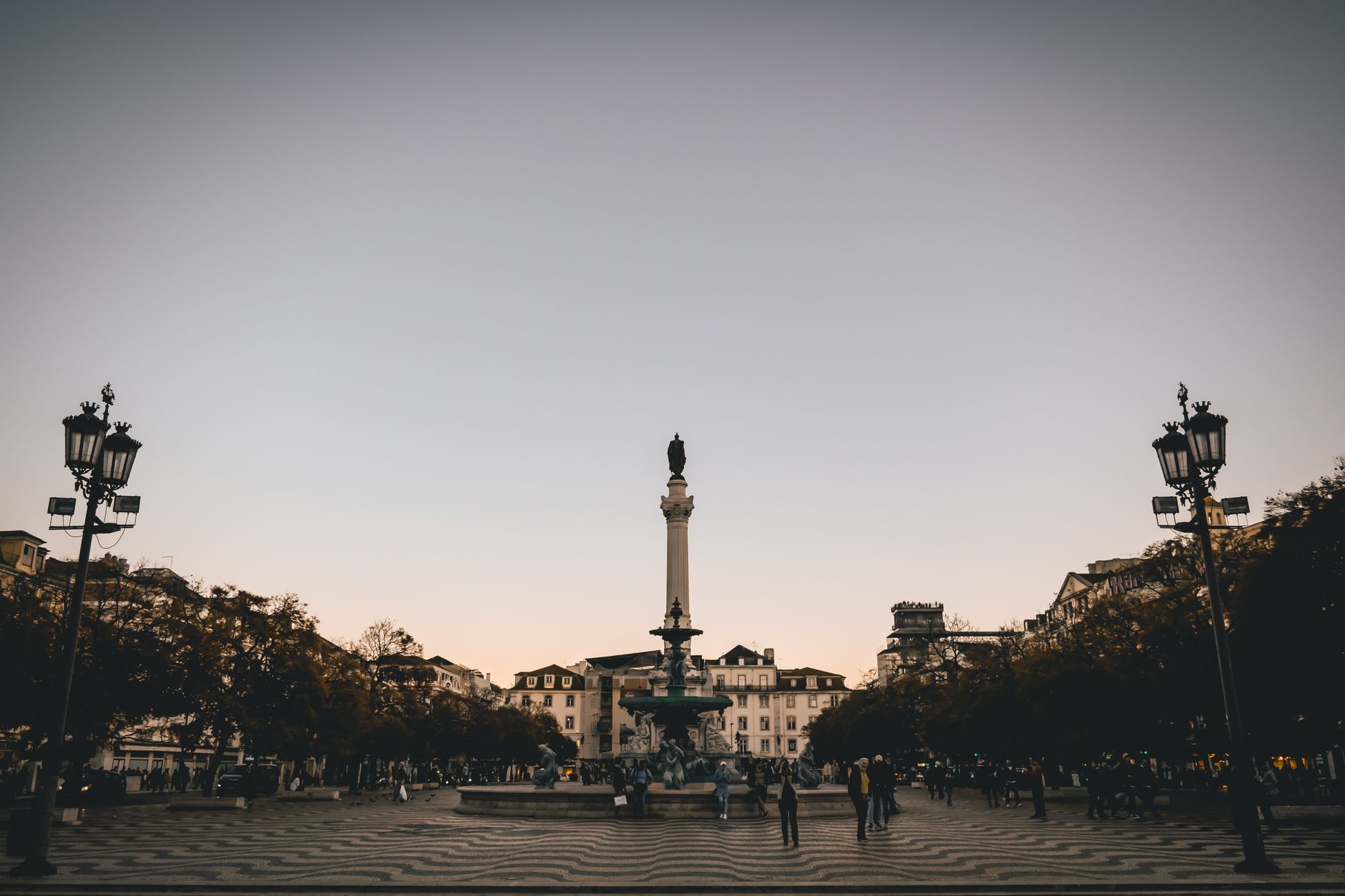
The traditional heart of Lisbon. Distinctive black-and-white wave-pattern calçada (Portuguese pavement). Two baroque fountains and the column-mounted statue of Pedro IV in the center. Rossio has been a public square since the medieval era — it’s been a marketplace, a bullfighting ring, a public execution ground, and is now the city’s living room.
Today it’s surrounded by:
- Rossio Train Station (1892) — elaborate neo-Manueline architecture with horseshoe-arch doorways; trains to Sintra depart from here
- National Theatre D. Maria II (1840s) — neoclassical theatre on the north side, the most prominent building on the square
- Café Nicola — historic 18th-century café on Rossio’s west side, once a literary meeting place for writers including Manuel Bocage
Praça da Figueira
Adjacent to Rossio, just to the east. Smaller, slightly more everyday. The equestrian statue at center is King João I. Tram 12 and 28 stops are here — board Tram 28 very early morning if you want a seat and fewer pickpocket risks. Several decent cafés and the Hotel Mundial face the square.
Praça dos Restauradores
North of Rossio, marked by the obelisk commemorating the 1640 restoration of Portuguese independence from Spain. Restauradores metro station is here. The square sits at the base of Avenida da Liberdade — Lisbon’s grand luxury-shopping boulevard. The elegant Palácio Foz, now a cultural center, anchors the west side.
Praça Martim Moniz
At the eastern edge of Baixa, transitioning toward Mouraria. Recently redeveloped with a multicultural market and food kiosks. Less touristy, more diverse, a good place for cheap Asian and African food. Tram 28 boards here at the eastern terminus.
Top Things to Do in Baixa & Rossio
Walk Rua Augusta
The pedestrian-only spine of Baixa, running 600 meters from the Rua Augusta Arch (Praça do Comércio) up to Rossio. Lined with chain stores, restaurants with terraces, street performers, and gift shops. Most travelers walk this at least once — it’s the easiest way to feel central Lisbon’s pulse. Best before 9 AM or after 8 PM when the daytime crowds thin.
Climb the Rua Augusta Arch
The triumphal arch at the river end of Rua Augusta. Climb via elevator (included in ticket) to a viewing platform with sweeping views of Baixa, the Tagus, and Alfama on the hill to the east. Entry €3.50–€4.50; free with Lisboa Card. The view is different from — and in some ways better than — the Santa Justa Elevator view: you’re looking straight down Rua Augusta rather than across at it.
Visit Bertrand Bookshop
Founded in 1732, certified by Guinness World Records as the world’s oldest continuously operating bookstore. Located on Rua Garrett in Chiado (technically just above Baixa, five minutes uphill). Multiple rooms, English-language books, a café in back. Worth a stop for the history alone.
Drink Coffee at a Historic Café
Café Nicola on Rossio (founded 1796) — old-world atmosphere, formerly a meeting place for poets and writers including Manuel Bocage. Sit on the terrace facing the square in the evening, when the crowds thin and the pavement pattern catches the last light.
Confeitaria Nacional on Praça da Figueira (founded 1829) — Lisbon’s oldest pastry shop. Famous for traditional Portuguese sweets and pastries. Ground floor is takeaway; upstairs has table service.
Café Martinho da Arcada on Praça do Comércio (founded 1782) — Lisbon’s oldest restaurant, regular haunt of poet Fernando Pessoa. The arcaded terrace facing the square is one of the city’s better lunch spots if you’re already in the square.
Ride the Santa Justa Elevator
The 1902 wrought-iron lift connecting Rua de Santa Justa (Baixa) to Largo do Carmo (upper Chiado). When operating: round-trip ticket around €6 including viewing platform. Smarter move: walk to Largo do Carmo and access just the viewing deck for less. Note the elevator is currently on periodic maintenance closures — check carris.pt before planning around it. See our full Santa Justa Elevator guide.
Browse Independent Stores on the Side Streets
Side streets off Rua Augusta — particularly Rua da Conceição and Rua dos Bacalhoeiros — have more interesting independent shops than the main drag: leather goods, ceramics, vintage clothes, niche bookshops. The tourist shops on Rua Augusta itself are largely identical to each other.
See the Lisboa Story Centre
Located in Praça do Comércio. A multimedia museum walking through Lisbon’s history — earthquake, age of discoveries, modern era. Good for a rainy hour or as a genuine orientation to the city’s history before you explore. Entry around €7.
Visit the Núcleo Arqueológico da Rua dos Correeiros
Free (with advance reservation) underground archaeological site beneath the Millennium Bank. Roman-era fish-salting tanks (1st century AD), medieval Moorish wall fragments, and post-earthquake construction layers — over 2,000 years of history under a working bank. Tours run weekday mornings; book via the bank’s website. One of Lisbon’s best-kept secrets in plain sight.
People-Watch at Praça do Comércio
The square is so large that even at peak tourist hours you can find a quiet bench. Riverside steps along the Tagus are popular for sunset — and the light on the yellow arcaded buildings in late afternoon is warm and specific to Lisbon. Worth the fifteen minutes.
Where to Eat in Baixa
Budget Lunch (€8–€14)
- Cervejaria Trindade (just off Baixa, upper Chiado) — a 19th-century beer hall with azulejo tile panels covering the walls, traditional Portuguese food, and generous portions
- O Trevo on Praça Luís de Camões — perfect bifana sandwiches
- Any tasca on the side streets — look for handwritten menus in Portuguese, no standing host outside, plastic chairs: these serve the actual prato do dia at €9–€12
Mid-Range Restaurants
- Bonjardim (just off Restauradores) — famous for piri-piri chicken, queues are routine but move fast
- Solar dos Presuntos (Restauradores) — high-end traditional Portuguese, smoked meats and stews done well, prices €25–€60
- Casa do Alentejo (just north of Rossio) — traditional Alentejo cuisine served in a building with a stunning Moorish courtyard interior; a genuinely surprising place to stumble into
Pastel de Nata
- Manteigaria Baixa (Rua do Loreto, near the Chiado-Baixa border) — consistently rated best in central Lisbon; they pull them out warm every few minutes
- Confeitaria Nacional on Praça da Figueira — traditional sweets and all Portuguese pastry classics
Avoid the Tourist Traps
Restaurants with hosts standing outside with menus, photos of food in the window, or “TOURIST MENU €12” signs are best skipped. Real Portuguese food is on the side streets, not Rua Augusta. A €5 bifana from a counter-service café is a better meal than a €15 tourist menu bacalhau.
See our best restaurants guide and our traditional Portuguese food guide for the broader picture.
Where to Stay in Baixa
Baixa is the most central neighborhood for first-timers, with the best metro and tram access in the city. It’s louder than Chiado or Alfama — the pedestrian streets fill until midnight in summer — but the convenience is unmatched.
Luxury
- Pousada de Lisboa on Praça do Comércio — a converted government ministry directly on the square, river views from some rooms
- The 7 Hotel on Rua dos Sapateiros — boutique 5-star in a restored Pombaline building
Mid-Range
- Hotel Avenida Palace next to Restauradores — historic 1892 hotel with grand European elegance, well-preserved original interiors
- My Story Hotel Rossio on Rossio Square — modern hotel with direct square views, well-located
- Internacional Design Hotel on Rossio — themed rooms, good central position
Budget
- Lisbon Destination Hostel in Rossio Station — atmospheric heritage-building hostel inside the neo-Manueline train station, consistently well-rated
- Hotel Mundial on Praça da Figueira — large, decent value, rooftop bar with castle views
See our best hotels guide and best hostels guide. For the broader where-to-stay decision, see our Where to Stay in Lisbon pillar.
Getting Around Baixa
Metro
Three metro lines converge in Baixa, making it Lisbon’s best-connected district:
- Green line: Rossio, Baixa-Chiado
- Blue line: Baixa-Chiado, Restauradores, Terreiro do Paço
- Trams 12, 15, 24, and 28 all stop within Baixa
Walking
Baixa is flat — rare for Lisbon — and perfectly walkable. From Praça do Comércio to Rossio is 600 meters, about 8 minutes. From Baixa to Bairro Alto requires either the Santa Justa Elevator, the Glória Funicular (Restauradores), or a steep walk up via Rua do Carmo. From Baixa to Alfama, it’s a 15-minute walk east. See our Lisbon transportation guide.
Tram 28
The famous yellow heritage tram passes through Baixa at Praça da Figueira en route from Martim Moniz to Estrela. Board early in the morning for a seat and far fewer pickpocket risks. Mid-afternoon Tram 28 is packed beyond comfort and specifically targeted by thieves. See our trams guide.
A Day in Baixa — Suggested Flow
Morning
Coffee and pastel de nata at Confeitaria Nacional. Walk the empty Rua Augusta before 9 AM — the scale of the Pombaline grid is much clearer without the crowds. Book a Núcleo Arqueológico tour for 10 AM if you’re interested (weekdays only).
Late Morning / Lunch
Climb the Rua Augusta Arch for the river and city view. Walk to the riverfront at Praça do Comércio. Sit at Café Martinho da Arcada for coffee or lunch. Walk the riverside promenade east toward Alfama.
Afternoon
Take the Santa Justa Elevator up to Chiado (check carris.pt for current status). Browse Rua Garrett. Coffee at Café A Brasileira and a photo with the Pessoa statue. Bertrand bookshop.
Evening
Sunset drinks on a Praça do Comércio terrace or on the Tagus stone steps. Dinner at Solar dos Presuntos or a side-street tasca. Walk back through lit-up Rua Augusta.
Practical Tips
- Pickpocketing is the main concern — Tram 28, crowded streets, restaurant queues. Keep bags in front, use inside pockets. See our Alfama neighbourhood guide for the parts of Baixa that bleed into tourist-dense Alfama streets.
- Restaurant scams: olives, bread, and butter brought to your table aren’t free. Either accept the couvert (€2–€4 per person) or wave them away politely.
- Best photos: Praça do Comércio at sunrise (empty, golden light on yellow buildings), Rossio at night (lit up, calçada shimmering), Rua Augusta from the Arch viewing platform looking north.
- Crowds: Rossio and Rua Augusta peak 10 AM–5 PM. Visit early morning or after dinner for a calmer experience.
- Public bathrooms are limited — use a café (order something small) or the facilities at the Lisboa Story Centre.
- Avoid ATMs on Rua Augusta itself — use bank-lobby ATMs on side streets for better rates and less shoulder-surfing risk.
FAQ: Baixa & Rossio
What is the Baixa district in Lisbon?
Lisbon’s downtown commercial and historic core, completely rebuilt after the 1755 earthquake on a revolutionary grid plan by the Marquês de Pombal. Centered on Praça do Comércio, Rossio, and Rua Augusta.
Is Baixa a good area to stay in Lisbon?
Yes — the most central and best-connected neighborhood in Lisbon. Ideal for first-time visitors. Slightly louder and more touristy than Chiado or Alfama, but the transit access and walkability are unmatched.
What’s the difference between Baixa and Chiado?
Baixa is the flat downtown grid below; Chiado is the upscale shopping and theatre district on the hill to the west. They blend together and are often referenced as one area (Baixa-Chiado, after the metro station). Chiado is quieter, more sophisticated; Baixa is more commercial and touristy.
How do I get from Baixa to Sintra?
Walk to Rossio Train Station and take the Sintra-line train (€2.30 one-way, about 40 minutes to Sintra town). See our Sintra day trip guide.
What’s Pombaline architecture?
The standardized 4–5 story building style commissioned by the Marquês de Pombal for post-earthquake Baixa reconstruction. Identical facades, iron balconies, and an internal wood-cage seismic resistance system (gaiola pombalina) designed to flex rather than collapse during earthquakes.
What’s the best square in Baixa?
Praça do Comércio for grandeur; Rossio for atmosphere and daily life; Praça da Figueira for a more local, everyday feel. Each is different enough to be worth visiting separately.
Bottom Line
Baixa & Rossio is the obvious starting point for any Lisbon trip — central, walkable, and packed with history. Walk Rua Augusta, climb the Arch, drink coffee at Café Nicola, and ride the Santa Justa Elevator when it’s operating. Stay nearby for the best transit access. The crowds and tourist traps are real, but the historical depth — post-earthquake reconstruction, world’s oldest bookstore, 18th-century cafés, a 2,000-year archaeological site under a bank — make it essential Lisbon regardless.
Baixa is the most convenient place to sleep in Lisbon and the least characterful, which is the trade-off the where to stay pillar exists to talk you through. The hotel roundup and hostel guide cover what is actually available on these blocks, and Alfama is the neighbourhood immediately uphill that most people are really picturing when they imagine staying in old Lisbon.