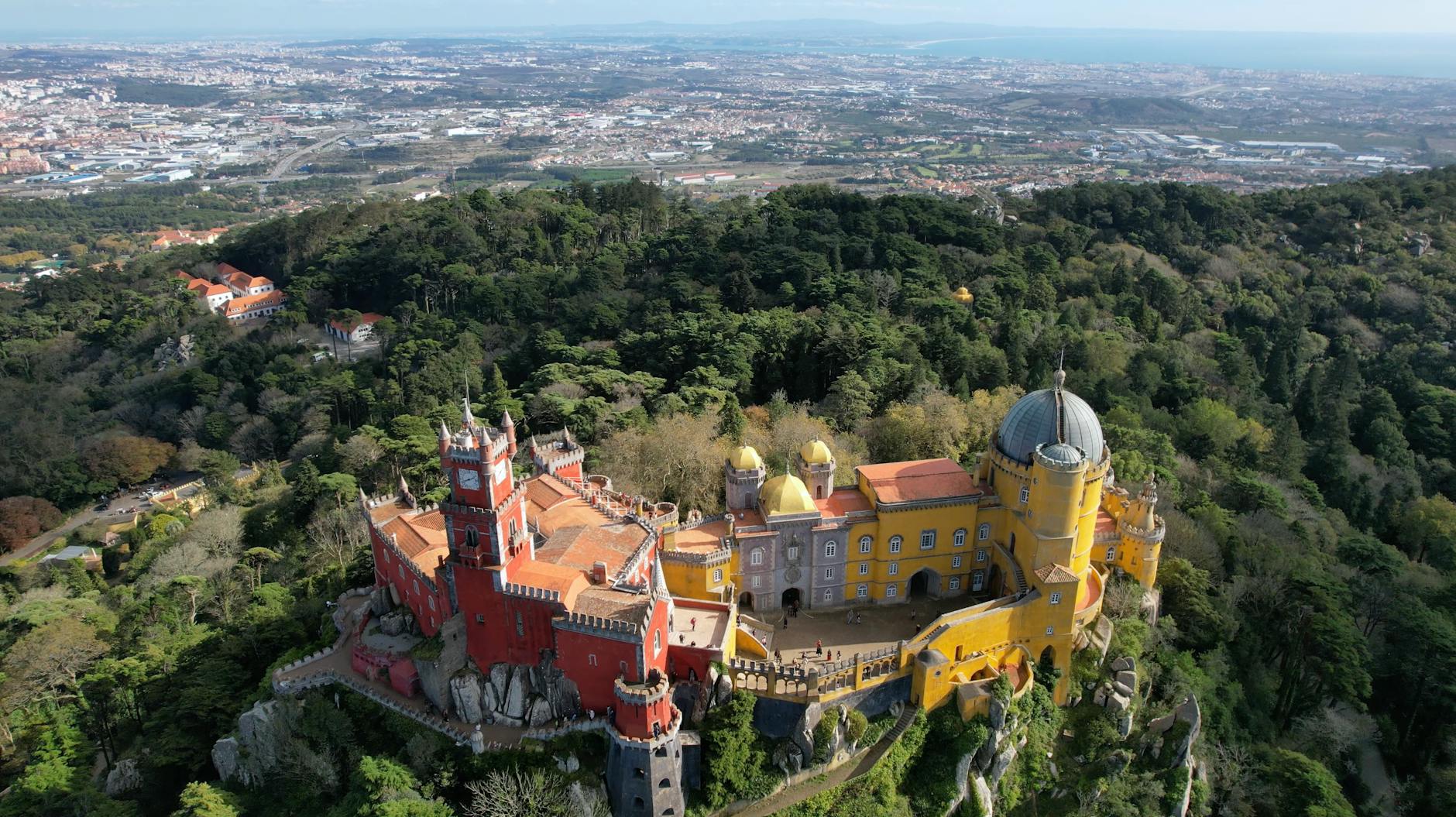
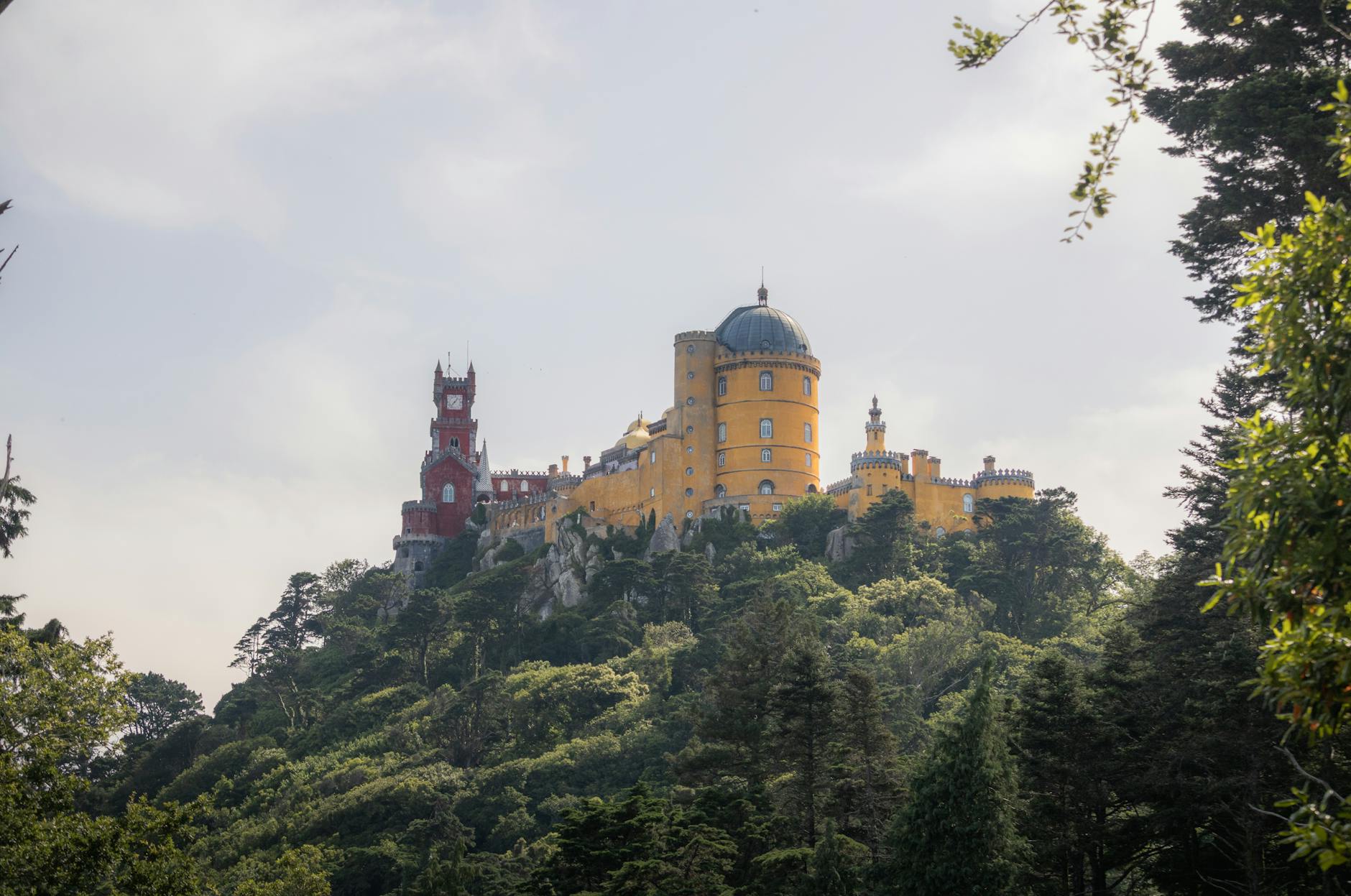
Pena Palace Sintra is the showpiece of Portugal’s most-visited day trip — a wildly colorful 19th-century Romantic palace perched on a hilltop above the Sintra hills, its red and yellow facades visible from miles in every direction. With 1.5 million annual visitors, it’s the most-photographed monument in Portugal and one of Europe’s earliest examples of Romantic-era palace architecture.
This guide covers everything you need to plan a great visit: tickets, opening hours, the 2025–2026 access rules, the optimal arrival time, what to see inside (and what to skip), the history that makes the building so distinctive, and how to get the iconic photo without the crowds. Updated for 2026.
Pena Palace at a Glance
The Palácio Nacional da Pena sits at the top of the second-highest peak in the Sintra mountains, about 480 meters above sea level. Built between 1842 and 1854 on the ruins of a 16th-century monastery, it was the summer residence of the Portuguese royal family until the abolition of the monarchy in 1910. UNESCO inscribed the broader Sintra Cultural Landscape on the World Heritage List in 1995.
The palace consists of three distinct sections: a colorful upper palace with restored royal apartments, the older Manueline-Gothic former monastery (the lower palace), and a 200-hectare park with exotic trees, hidden fountains, and the smaller Chalet of the Countess of Edla.
Pena Palace Sintra Tickets, Hours & Practical Info (2026)
Opening Hours
- Park (gardens): 9:00 AM – 7:00 PM (last entry 6:00 PM) April–October; 9:30 AM – 6:30 PM (last entry 5:30 PM) November–March
- Palace interior: 9:30 AM – 6:30 PM (last entry 5:30 PM) summer; 9:30 AM – 6:00 PM (last entry 5:00 PM) winter
- Closed: January 1 and December 25
Ticket Prices
- Pena Palace + Park: €20 adult, €14 youth/senior, €10 child (6–11), free under 6
- Pena Park only: €10 adult, €8 youth/senior, €5 child
- Family pass (2 adults + 2 children): €52
- Combined Pena + Castle of the Moors: €27, saves €5
Buy tickets at Parques de Sintra — the official booking platform for Pena Palace and all other Sintra monuments managed by the same authority. Online tickets add €2–€5 above gate prices but skip 30–60+ minutes of queueing in peak season.
Lisboa Card: Does NOT include Pena Palace (unlike most Lisbon attractions). Buy your Pena ticket separately.
Timed Entry
Since 2024, the palace interior requires a timed-entry slot. The park is unrestricted, but the palace itself only admits visitors at scheduled windows. Walk-up tickets are subject to availability and can sell out for the day on busy summer weekends.
How to Get to Pena Palace
From Sintra Town
Bus 434 (Scotturb) runs a hop-on-hop-off loop: Sintra Station → historic centre → Castle of the Moors → Pena Palace → back. Every 15–20 minutes, 9:15 AM – 7:50 PM (varies by season). Cost: €13.50 for an unlimited day pass — buy at the Scotturb kiosk at Sintra station, not from the bus driver. Travel time: 20–25 minutes from Sintra station to Pena Palace.
From Lisbon
Train from Rossio Station (€2.30, 40 minutes) to Sintra Station, then bus 434 to Pena Palace. Total travel time about 90 minutes door-to-door from central Lisbon. For full Sintra trip planning, see our Sintra day trip from Lisbon guide.
By Walking
You can walk from Sintra town up to Pena Palace — a steep 4 km uphill climb taking 60–90 minutes. Only do this in cool weather and if you enjoy hiking. Most visitors arrive sweaty and exhausted.
By Car (Limited)
Since June 2024, private vehicles are NOT allowed to park near Pena Palace. Park in lower-town Sintra lots and use bus 434.
The Best Time to Visit
Arrive at 9:00 AM right when the gate opens, or after 4:30 PM for the most relaxed experience. The middle of the day — 10:30 AM to 2:30 PM — is when tour buses arrive in waves and the palace interior queues can stretch 60–90 minutes even with valid tickets.
Best months: April, May, October. Mild weather, manageable crowds, lush gardens. Skip August weekends — the combination of heat and peak-season crowds makes it the worst window by some margin.
What to See
The Upper Palace (Royal Apartments)
The colorful mid-19th-century section everyone photographs. The royal apartments have been restored to their 1910 condition — exactly as Queen Amélia left them when the royal family fled into exile. Key rooms:
- The Arabic Room — extraordinary trompe-l’oeil ceiling painting evoking Granada’s Alhambra
- The Stag Room — Manueline ceiling depicting a hunting scene
- The Great Hall — main reception room with original 19th-century furnishings
- The Chapel — preserved from the original monastery, the oldest part of the palace
- The Kitchen — fully equipped 19th-century royal kitchen with original copper utensils
- The Queen’s Terrace — sweeping views down toward the coast
Allow 60–75 minutes for the palace interior with audio guide.
The Lower Palace (Old Monastery)
Built by King Manuel I in 1511 on the site of an even older medieval chapel, this section preserves the original Hieronymite monastery cloister and chapel. Smaller and quieter than the upper palace.
The Park (Parque de Pena)
200 hectares of forested gardens around the palace, designed by King Ferdinand II as a Romantic naturalistic landscape. Highlights:
- The Chalet of the Countess of Edla — a small Swiss-Alpine-styled chalet built by Ferdinand for his second wife. Beautifully restored. Open to visitors with separate ticket (€10).
- The High Cross (Cruz Alta) — the highest point in the Sintra hills, with 360-degree views to the ocean and Lisbon
- The Valley of the Lakes — series of small artificial ponds connected by paths
- The Royal Tribune — small stone pavilion with views toward Lisbon
- Exotic plant collection — King Ferdinand introduced trees from Australia, North America, China, Japan, and Mexico; many are now mature specimens
Allow 60–90 minutes minimum for the park; longer if you want to reach the Cruz Alta or the Chalet.
The Iconic Photo: How to Get It
The classic wide shot of Pena Palace — showing the entire colorful exterior against the surrounding hills — is taken from a viewpoint about 150 meters up the hill from the palace entrance, via a small footpath. Look for the bench area marked on most park maps near the “Miradouro da Cruz Alta” path (different from the actual Cruz Alta high cross).
Best light: late afternoon (3:30–5:30 PM), when warm western sun illuminates the colored facades. Cloudy days actually work better for color photography — direct sun creates harsh shadows on the eastern walls.

The History of Pena Palace
The story begins in the early 16th century when King Manuel I built a small Hieronymite monastery on this hilltop, dedicated to Our Lady of Pena. The community remained for over 200 years until the 1755 Lisbon earthquake severely damaged the building. The monks rebuilt partially, but the monastery never fully recovered and was finally abandoned in 1834 when Portugal’s liberal government dissolved all male religious orders.
In 1838, King Ferdinand II — German-born husband of Queen Maria II — acquired the ruined monastery and surrounding land. Ferdinand was deeply influenced by German Romanticism, and especially by the contemporary fashion for Romantic castles. He commissioned German architect Baron Wilhelm Ludwig von Eschwege to design a new Romantic palace incorporating the monastery ruins.
Construction ran from 1842 to 1854. Eschwege created a deliberately eclectic mix of Gothic, Renaissance, Manueline, Moorish, and Romantic elements. The red and yellow exterior colors were Ferdinand’s personal choice, intended to make the palace visible from miles away and to evoke the bright tones of medieval Mediterranean architecture.
The royal family used Pena as their primary summer residence from the 1850s until the 1910 republican revolution, when King Manuel II fled into exile and the new Republic confiscated the palace. It has been a national museum ever since.
Pena Palace Mistakes to Avoid
1. Arriving without timed-entry tickets. Walk-up tickets can sell out by 11 AM in summer. Always pre-book online via parquesdesintra.pt.
2. Going on a weekend in July or August. Palace interior queues of 90+ minutes, packed buses, uncomfortable crowds. Tuesday–Thursday is dramatically calmer.
3. Trying to drive your own car. No longer allowed near the palace. You’ll waste an hour finding alternative parking.
4. Walking up from Sintra. 4 km of steep uphill takes 60–90 minutes and exhausts most visitors before they even start the tour. Take bus 434.
5. Skipping the park. The 200-hectare park is included in your palace ticket and arguably as good as the palace itself. Allow at least an hour.
6. Doing the palace and Castle of the Moors back to back without eating. Both involve a lot of walking. Eat lunch in Sintra town in between.
7. Wearing the wrong shoes. Sintra is steep, cobbled, and often wet. Comfortable closed-toe walking shoes are not optional.
8. Forgetting layers. The hilltop is 5–8°C cooler than central Lisbon and frequently windier. Bring a jacket even in summer.
Combining Pena Palace with Other Sintra Sights
Most visitors combine Pena with one or two other Sintra attractions:
Pena + Castle of the Moors — adjacent on the next peak; 10-minute walk between them. Best if Pena’s queues clear by midday.
Pena + Quinta da Regaleira — Pena in the morning, lunch in Sintra town, Quinta da Regaleira in the afternoon. The most-recommended single-day combination.
Pena + Quinta da Regaleira + Castle of the Moors — ambitious but doable starting at 9 AM and finishing by 5 PM. Bring snacks and skip the sit-down lunch.
Pena + National Palace of Sintra — Pena morning, town center National Palace afternoon. Less rushed than the three-stop option.
For broader trip planning, see our Sintra day trip from Lisbon guide.
Practical Tips
Photography: Permitted throughout without flash. Drones are not allowed.
Bag policy: Large backpacks must be left at the entrance.
Bathrooms: Available at the park entrance and in the palace lower courtyard. Both clean and accessible.
Food: Small café in the lower courtyard with sandwiches, salads, and drinks (€5–€12). Better to eat in Sintra town before or after.
Accessibility: The lower park is wheelchair accessible, but the palace ascent involves steep cobbled paths. Limited wheelchair access via shuttle from the lower entrance to the palace level. Check ahead.
Children: Well-suited for older kids (5+) who can manage the walking. Younger children may struggle with the climbs and crowds.
Audio guide: €4 rental at the entrance, or download the official Parques de Sintra app for free. Genuinely helpful for understanding the rooms.
Pena Palace vs Other Sintra Palaces
vs Quinta da Regaleira: Pena is the bigger, more theatrical exterior. Regaleira is the smaller, more atmospheric experience. Most travelers do both.
vs Castle of the Moors: Castle is older, smaller, and focused on outdoor wall-walking. Pena includes both interior and exterior experiences.
vs National Palace of Sintra: National Palace has the most extraordinary preserved medieval interiors. Pena has the more dramatic exterior. Different experiences entirely.
vs Monserrate Palace: Monserrate is much quieter and has the best botanical gardens. Worth considering on return Sintra visits.
FAQ: Pena Palace Sintra
Is Pena Palace worth visiting?
Yes. Most travelers rate it the highlight of their Portugal trip. The combination of architectural extravagance, hilltop position, and well-preserved interiors makes it Portugal’s signature palace experience.
How long do you need at Pena Palace?
2.5–3 hours for palace + park. Add another 1–2 hours if you want to explore the broader 200-hectare park or visit the Chalet of the Countess of Edla.
How much does Pena Palace cost?
€20 for palace + park (adult), €10 for park only, €27 for combined Pena + Castle of the Moors. Online tickets add €2–€5 but include skip-the-line access.
Do I need to book Pena Palace tickets in advance?
Strongly recommended — timed-entry slots regularly sell out by 11 AM in summer. Book at least 24–48 hours ahead through parquesdesintra.pt or GetYourGuide.
What’s the best time to visit Pena Palace?
Right at 9 AM opening, or after 4:30 PM. April–May and September–October offer the best combination of weather and crowds. Skip August weekends.
Can you walk to Pena Palace from Sintra?
Yes, but it’s a steep 4 km uphill taking 60–90 minutes. Most visitors take bus 434 instead.
Is Pena Palace included in the Lisboa Card?
No — buy your ticket separately.
Can you drive to Pena Palace?
No — since June 2024, private vehicles cannot park near Pena Palace. Park in lower-town Sintra lots and use bus 434.
Is Pena Palace suitable for kids?
Yes for older kids (5+). The colorful exterior, towers, and views work for all ages who can handle the climb. Younger children may struggle with walking and crowds.
How do I avoid crowds at Pena Palace?
Arrive at 9 AM right at opening. Visit on weekdays (Tuesday–Thursday best) outside school holidays. Avoid August. The palace is significantly quieter from 4 PM onward.
Bottom Line
Pena Palace is the centerpiece of any Sintra day trip from Lisbon — visually unforgettable, historically rich, and worth every kilometer of the journey. Pre-book a timed-entry ticket for 9:30–10:00 AM, take bus 434 from Sintra station, allow 2.5–3 hours for palace and park, and consider combining with the Castle of the Moors next door for the full hilltop experience. Skip the car, skip walking up from Sintra, and bring layers — the hilltop is colder and windier than you’d expect.
Continue planning with our Sintra day trip from Lisbon guide, our Day Trips from Lisbon pillar, our Cascais day trip guide, and our Óbidos day trip guide.