Things to Do in Lisbon
Jerónimos Monastery: Complete Visitor Guide (Tickets, Hours & Tips for 2026)
Everything you need to know about visiting Jerónimos Monastery including tickets, skip-the-line tips, best times, history, and what to see inside.
In this guide
- Jerónimos Monastery at a Glance
- Tickets, Hours & Prices (2026)
- How to Get to Jerónimos Monastery
- What to See Inside
- The History — Why This Place Exists
- The Hieronymite Monks: Who Lived Here
- The 1755 Earthquake: How Jerónimos Survived
- Decoding the Manueline Style: A Visitor’s Cheat Sheet
- Hidden Details Worth Looking For
- Common Mistakes Visitors Make
- Best Time to Visit
- Combining Jerónimos with Other Belém Sights
- Practical Tips
- FAQ
- Bottom Line
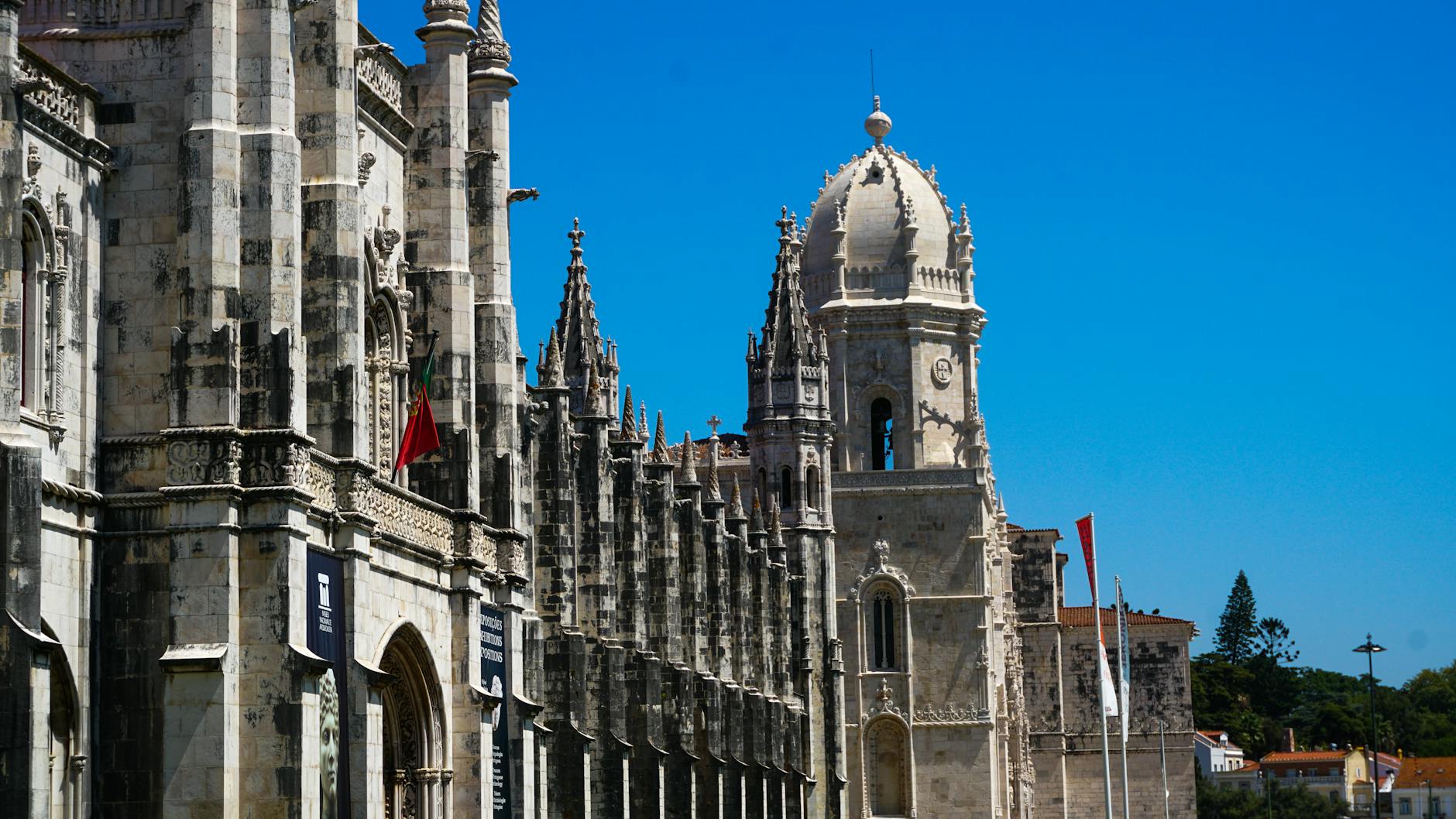
Jerónimos Monastery is the single most extraordinary building in Lisbon — a UNESCO World Heritage masterpiece in limestone that took a century to build, recorded more than a million admissions in 2025, and somehow still manages to leave first-time visitors quietly speechless when they step into its cloister. If you only have time for one historic site in Lisbon, this is the one.
This guide covers everything you need to plan a great visit: how to buy tickets and skip the line, current opening hours, how to get there from central Lisbon, what’s actually inside (and what most visitors miss), the best times to go, the history that makes it all matter, and the small practical details — bathrooms, food, photography rules — that turn a confusing visit into a smooth one. Updated for 2026.
Jerónimos Monastery at a Glance
The Mosteiro dos Jerónimos sits in Lisbon’s western Belém district, about eight minutes by stopping train from Cais do Sodré. Construction began in 1501, funded in part by a 5-percent levy on Portugal’s trade with Africa and the East, and continued in waves until well into the seventeenth century. UNESCO inscribed it on the World Heritage list in 1983 alongside the nearby Belém Tower — both sites are covered by UNESCO World Heritage listing 263.
The visit has two parts: the Church of Santa Maria de Belém (free to enter) and the famous two-story cloister (paid ticket). Plan on roughly 90 minutes to two hours for both if you want to take the carving in properly.
Tickets, Hours & Prices (2026)
Opening Hours
Jerónimos Monastery is open Tuesday through Sunday and closed every Monday. The cloister and the church keep different hours:
- Cloister: 9:30 AM – 5:30 PM, Tuesday to Sunday (last entry at 5:00 PM)
- Church: 10:30 AM – 5:00 PM, Tuesday to Saturday; 2:00 PM – 5:00 PM on Sunday
The site is also closed on January 1, Easter Sunday, May 1 (Workers’ Day), June 13 (Lisbon’s municipal holiday — Santo António), and December 25.
Ticket Prices
Standard admission is €18 per adult and gets you into the cloister. Children aged 12 and under enter free, and visitors aged 13–24 or 65+ pay half price, €9.
Two important details:
- The Church of Santa Maria is free to enter, from 10:30 AM Tuesday to Saturday and from 2:00 PM on Sunday. You can see the soaring nave, the tombs of Vasco da Gama and Luís de Camões, and the ribbed columns without paying anything. Most visitors don’t realize this.
- Residents of Portugal get in free on up to 52 days a year, on days of their choosing. Visitors from abroad have no free Sunday morning, so budget for the cloister ticket; the church costs nothing whenever it is open.
Skip-the-Line Options
The standard ticket queue is the single biggest pain point of a Jerónimos visit, and its length changes from one day to the next. Three ways to bypass it:
1. Pre-book a timed-entry skip-the-line ticket online. Timed-entry tickets are sold on the official museusemonumentos.pt site and through online resellers. Expect to pay €25–€30 — €7–€12 above the €18 gate price, well worth it.
2. Book a guided tour. Licensed tour groups enter through a separate door, which functionally bypasses the queue. Tours run €30–€55 and add genuinely useful context — the symbolism of the maritime carvings, the political backstory of the Manueline style, and the small details (mermaids, sea monsters, ropes) most visitors walk past. Worth it for first-time visitors.
3. Use the Lisboa Card. The 24-, 48-, and 72-hour Lisboa Card includes free entry to the monastery, the Belém Tower and 51 museums and monuments in all, plus public transport. The monastery needs a date and time reserved with the card number. If you’re visiting more than 2–3 paid attractions, the card pays for itself.
Whichever route you choose, arrive for the 9:30 AM opening if you can. If you leave it until the afternoon, remember that last entry to the cloister is at 5:00 PM.
How to Get to Jerónimos Monastery
The monastery sits at Praça do Império in Belém, west of central Lisbon along the river. Four ways to get there:
By Tram (Tram 15E)
The most scenic option. Tram 15E runs from Praça da Figueira through Praça do Comércio and Cais do Sodré, then along the riverfront through Alcântara to Belém. Get off at the “Mosteiro dos Jerónimos” stop directly across from the entrance. A single ride costs €1.90 on a Navegante occasional card (€1.72 with Zapping) or €3.30 bought on board, and the 24-hour Carris/Metro ticket (€7.25) covers unlimited rides.
By Train (Cascais Line)
The fastest option. Trains leave Cais do Sodré about every 15 minutes at weekday peaks and every 20 minutes through much of the day, with longer gaps early and late; stopping trains reach Belém station in about eight minutes. From the station it’s a short walk to the monastery. Single tickets are priced by zone from €1.50, or €2.05 a trip with Zapping.
By Bus
Bus 728 from the Praça do Comércio area and bus 714 from Cais do Sodré both stop at Belém. Journey times depend on traffic, so check Carris’s real-time information before you set off.
By Uber, Bolt, or Taxi
Costs €8–€15 from central Lisbon. Useful if you have luggage, mobility constraints, or are traveling with small children, but rush-hour traffic on Avenida da Índia can slow the trip.
Our full Lisbon transportation guide covers tickets, passes, and routes in more detail.
What to See Inside
The Church of Santa Maria de Belém (Free)
The church is one of Lisbon’s largest and a landmark of Manueline architecture. The Latin-cross plan rests on six immense Manueline columns, each carved with marine ropes, palm fronds, vines, and small medieval figures. Look up: the ribbed vaulting spans the nave as a single uninterrupted ceiling.
The most-photographed elements:
- The tombs of Vasco da Gama (1460s–1524) and Luís de Camões (1524–1580), the navigator and the poet who together shaped Portugal’s maritime self-image. Both are mounted on stone elephants — a nod to da Gama’s expeditions to India — in the lower choir near the entrance.
- The royal tombs of King Manuel I (who commissioned the monastery), Queen Maria, King João III, and Queen Catarina, framed by elephant figures in the apse.
- The South Portal, the elaborate side entrance, with Santa Maria de Belém at its center and the Archangel Michael above. Spend five minutes here before going in — most visitors miss it.
- The tomb of Fernando Pessoa, Portugal’s most beloved 20th-century poet, whose remains were moved to Jerónimos in 1985. You’ll find it in the cloister rather than the church.
The Cloister (Paid Ticket)
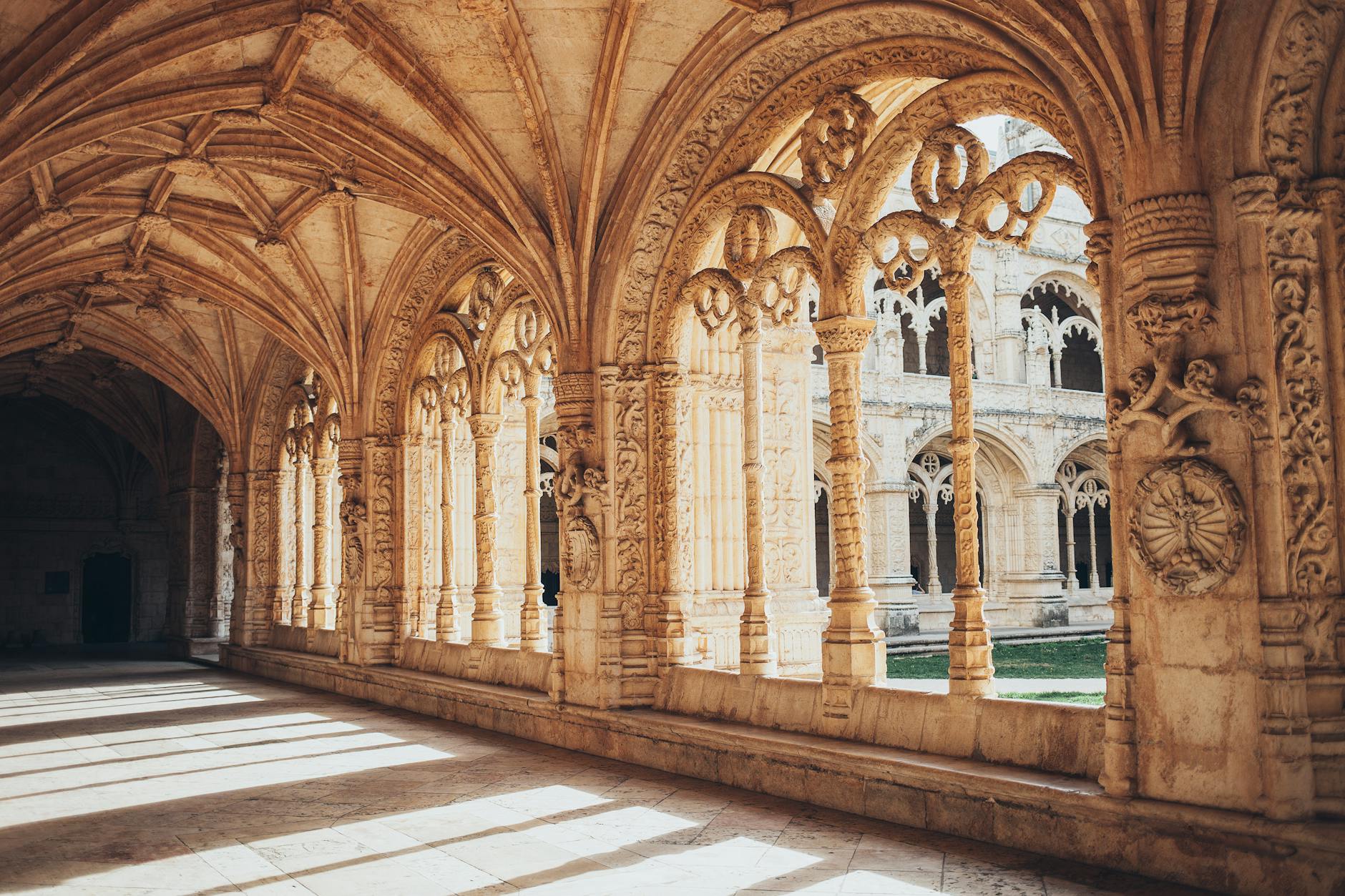
The two-story cloister is, on its own, worth the price of admission. Each of the four sides runs about 55 meters long, framed by wide stone arches resting on lacy carved columns, with dense, ornate carving across arches and columns alike.
This is a masterpiece of Portuguese architecture and a major example of the Manueline style. Manueline emerged during the reign of King Manuel I (1495–1521) and blends late Gothic verticality with Renaissance proportion and explicit Portuguese-discoveries iconography — ropes, ships, coral, seaweed, exotic plants, twisted columns suggesting both Indian temples and the ropes of ocean-going ships. You’ll find more of it at Belém Tower a few hundred meters away, but Jerónimos is the canonical example.
The upper level of the cloister gives you elevated views across the monastery and good angles on the carved columns. Before heading up, look for Fernando Pessoa’s tomb in the cloister itself; many visitors walk straight past it.
The Refectory
The monks’ dining hall, dating to the early 1500s, is lined with eighteenth-century blue-and-white azulejo tile panels depicting scenes from the life of Joseph. The barrel-vaulted ceiling is ribbed in stone.
The Chapter House
The room where monks gathered to read the day’s chapter of the Rule of St. Jerome. It holds the tomb of Alexandre Herculano, a 19th-century historian whose work re-shaped Portuguese national memory. The vaulted ceiling here is the most refined in the complex — small, but extraordinary.
The Archaeological Wing
This wing houses the National Archaeology Museum, which is closed for works, so it is not part of a visit for now. Check museusemonumentos.pt for its reopening.
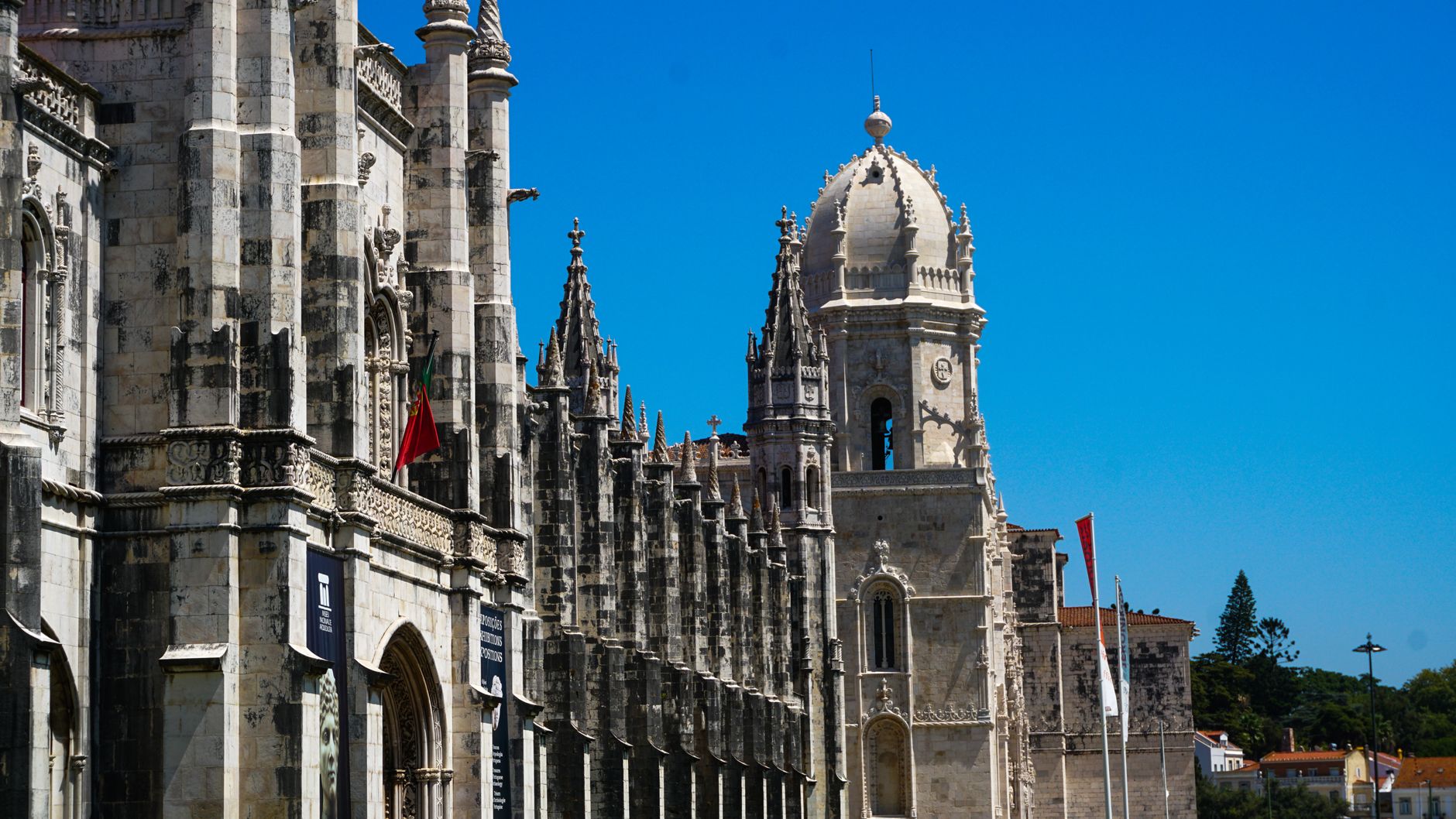
The History — Why This Place Exists
To understand why Jerónimos feels so different from other European monasteries, you need to understand the moment it was built.
In July 1497, Vasco da Gama and his men spent the night in prayer at a small chapel in Belém — almost exactly where the monastery now stands — before sailing from Lisbon on the voyage that would open the sea route to India. Two years later, he returned with cargo so valuable it remade the Portuguese economy overnight. King Manuel I had already asked the Pope in 1496 for permission to found a monastery on the Belém site, and the riches of the new sea routes helped him build it on a grand scale, to house the Hieronymite monks who would pray for departing sailors and the souls of those who never returned.
Construction began on January 6, 1501. The first architect, Diogo de Boitaca, established the Manueline style; later masters — including João de Castilho, Diogo de Torralva, and Jerónimo de Ruão — refined and expanded it over the next century. Funding came in part from a 5-percent levy (the so-called vintena) on commerce with Africa and the East. In other words: every pepper, clove, and cinnamon stick that reached Lisbon paid for a piece of this monastery.
The monks stayed until 1834, when the Liberal government dissolved Portugal’s religious orders. Jerónimos had survived the catastrophic 1755 earthquake, though the shock weakened its structures and part of the vault above the high choir collapsed early the following year. It became, and remains, a symbol of Portuguese cultural memory.
Three details worth knowing:
1. The monastery was where Portugal signed its 1985 treaty joining the European Economic Community (now the EU).
2. Vasco da Gama is the building’s spiritual anchor, but he wasn’t actually buried here in 1524 — his remains were moved into the monastery in 1880. The poet Camões got the same treatment.
3. The complex was originally several times larger. The eastern wings were demolished in the 19th century and replaced by what is now the Maritime Museum and the National Archaeology Museum. The Maritime Museum is an excellent stop if you have time; the Archaeology Museum is closed for works, so check museusemonumentos.pt for its reopening.
The Hieronymite Monks: Who Lived Here
The men who actually inhabited Jerónimos for three centuries are often overlooked. The Hieronymites — formally the Order of Saint Jerome — were a contemplative Catholic order recognized in Spain in 1373. They followed an austere version of the Rule of St. Augustine modified to emphasize silence, intellectual labor, and hospitality.
King Manuel I gave the new monastery to the Hieronymites for two practical reasons. First, the order had a reputation for educational rigor and was already running successful Spanish monasteries; second, the king wanted monks who would specifically pray for sailors heading out from Belém and provide spiritual hospitality to those returning. Hieronymite monks lived and prayed at Jerónimos until the order’s dissolution in 1834.
Their daily rhythm was structured by the canonical hours — Matins before dawn, Lauds at sunrise, Prime, Terce, Sext, None, Vespers, and Compline after dark. Between offices, monks copied manuscripts in the cloister scriptorium, tended a small medicinal garden, taught at an attached school, and ran a hospital for departing sailors. Several Portuguese kings made annual retreats here.
The end came in 1833–34. Jerónimos was secularized by decree on 28 December 1833, and in 1834 Portuguese liberal politician Joaquim António de Aguiar — nicknamed Mata-Frades, “the friar-killer” — pushed through the law dissolving all male religious orders and confiscating their property. The Portuguese state then handed the building to the Real Casa Pia (Royal Pious House), which used it as an orphanage and school until the late 19th century, when it transitioned to its current role as a museum and national monument.
The 1755 Earthquake: How Jerónimos Survived
On the morning of November 1, 1755 — All Saints’ Day — a powerful earthquake struck the Atlantic seafloor southwest of Lisbon. Its magnitude is still debated, and a commonly quoted epicenter lies about 290 km offshore. Three shocks, a 12-meter tsunami, and six days of fire destroyed most of central Lisbon and killed an estimated 30,000–40,000 people. The cathedral, the royal palace, the Carmo Convent, and dozens of churches were leveled.
Belém was different. It lies a short tram or train ride west of the destroyed center. The monastery sustained damage — the quake weakened its structure and part of the vault above the high choir collapsed early the following year — but the building as a whole held.
That survival mattered enormously. As Portuguese architects reconstructed Lisbon along entirely new neoclassical lines (the so-called Pombaline style of central Baixa), Jerónimos became one of the few intact pre-earthquake monumental buildings left in the city. It anchored Portuguese architectural memory and gave 19th-century Romantic-era thinkers a tangible link to Portugal’s pre-disaster Golden Age. When the country was looking to define a national identity in the late 1800s, Jerónimos — Manueline, maritime, intact — was the obvious choice.
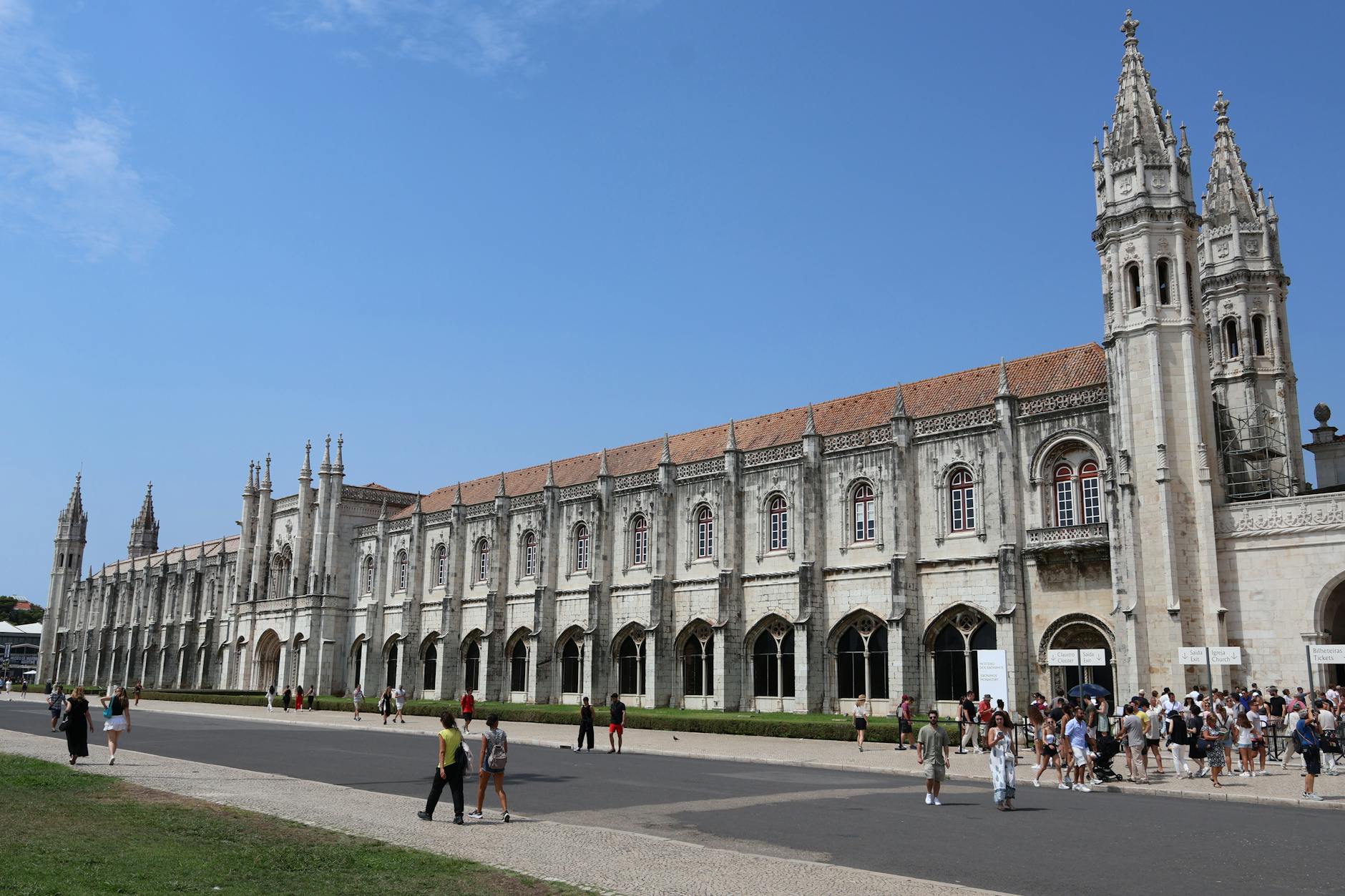
Decoding the Manueline Style: A Visitor’s Cheat Sheet
The Manueline style is unusual enough that even seasoned travelers sometimes struggle to “read” what they’re looking at. A quick guide to the symbols you’ll see carved across Jerónimos:
Armillary spheres — wire-frame globes with rings representing celestial coordinates. The personal emblem of King Manuel I, who saw himself as ruler of the sea. They’re carved on facades, columns, and the keystone above the south portal.
The Cross of the Order of Christ — a red Templar-derived cross with a smaller white cross inside. The flag carried by Portuguese ships, including those of Vasco da Gama and Pedro Álvares Cabral (who reached Brazil in 1500). You’ll see it on the church doors, the tombs, and most facade reliefs.
Ropes and chains — twisted around columns and arches, evoking ship’s rigging. The columns of the south portal are wrapped with carved ropes; the cloister’s lower gallery uses rope motifs as molding.
Anchors and astrolabes — actual navigational instruments carved into door frames and arches.
Coral, seaweed, and exotic plants — flora the Portuguese encountered in India, Africa, and Brazil. Look closely at the cloister capitals; you’ll see species that don’t grow in Europe.
Mermaids, sea monsters, and fantastical creatures — represent both the dangers and wonders of long-distance ocean travel. The corner capitals of the upper cloister are particularly rich in these.
Once you start spotting the patterns, the cloister stops feeling like generic Gothic decoration and starts reading like a coded autobiography of an imperial maritime power. It’s why guided tours are genuinely useful — even a 60-minute primer changes how you see the rest of the building.
Hidden Details Worth Looking For
The “tear” in the south portal. One of the figures in the elaborate Madonna scene has a small carved tear running down her cheek — almost invisible until pointed out. Some scholars argue it commemorates the sailors who died on Da Gama’s first voyage; others say it’s a much later 17th-century addition.
The carved lions. Six small lions are scattered throughout the cloister at the base of corner pillars. Lions were a personal symbol of King Manuel I and a common Manueline motif borrowed from earlier Portuguese heraldry.
The marble lectern in the refectory. A small carved limestone lectern at the head of the dining hall is where one monk would read aloud during meals — silence and reading were both monastic rules. The lectern is original to the 16th century.
The acoustic anomaly. Stand at the very center of the lower cloister and clap once. The square’s geometry creates a brief, tightly focused echo that doesn’t happen anywhere else in the building. Locals call it the “monk’s echo.”
The graffiti. Pilgrims and visitors over five centuries have left small carved initials, dates, and crosses on the inner walls of the cloister and the church entrance. Most are protected behind glass now, but several panels are still visible — some date to the 1600s.
Common Mistakes Visitors Make
Skipping the church because they think it costs €18. The church is free and arguably more impressive than the cloister. Even visitors on tight schedules should walk in.
Coming on a Monday. The monastery is closed every Monday, full stop. Many visitors arrive only to discover this on the spot.
Counting on a free day. Free entry to the cloister is for residents of Portugal, who get up to 52 free days a year; there is no free Sunday morning for visitors from abroad. Budget for the €18 ticket and go on a Tuesday morning instead.
Eating at Pastéis de Belém’s main dining room. The legendary bakery sits near the monastery, but the seated dining room can mean a long wait. Use the takeaway counter — same custard tarts, same recipe (since 1837), no wait. Eat them warm in Praça do Império across the street.
Underestimating travel time. Belém is farther from central Lisbon than the metro maps suggest. Check the journey from your own door before you set off, and leave extra time if you’re staying in Alfama or the eastern neighborhoods.
Not seeing the rest of Belém. Most travelers visit Jerónimos and leave. Belém’s other sites — Belém Tower, MAAT, the Maritime Museum, the Discoveries Monument, and the National Coach Museum — are all walkable and easily fill a full day.
Best Time to Visit
The cloister opens at 9:30 AM, and getting there for opening leaves the rest of the day free for Belém. Avoid the entire month of August (cruise-ship and family-holiday peak).
For broader trip planning, see our guide to the best time to visit Lisbon. April, May, September, and October give you the best combination of weather and manageable crowds for Belém specifically.
Combining Jerónimos with Other Belém Sights
Belém is dense with major attractions, and most visitors plan a half- or full-day “Belém loop”:
9:45 AM — Jerónimos Monastery (1.5–2 hours). Start here while you’re freshest and the queues shortest.
11:30 AM — Pastéis de Belém (15–30 minutes). The original 1837 pastel de nata bakery is two minutes’ walk from the monastery. Use the takeaway counter, not the dining room.
12:00 PM — Padrão dos Descobrimentos (Monument to the Discoveries) and Tagus riverfront walk. The 56-meter Discoveries Monument, the giant compass-rose pavement, and the working marina make a great 30-minute walk along the river.
1:00 PM — Lunch. Versailles Belém, a relaxed café, is close by.
2:30 PM — Belém Tower. A riverside walk west of the monastery. Allow 45–60 minutes inside.
4:00 PM — MAAT (Museum of Art, Architecture & Technology). The wave-form modern building between the monastery and the tower is an excellent end-of-day art stop with a riverside roof terrace.
If you want to skip Belém Tower (or it’s closed Mondays), the Coach Museum and Maritime Museum are nearby in Belém.
Practical Tips
Photography
Photography is allowed throughout the monastery without flash or tripods. Drones are not permitted. Wedding-style or commercial photography requires advance written permission from the Direção-Geral do Património Cultural.
Accessibility
The monastery is partially wheelchair accessible. The church and lower cloister are reachable via ramps; the upper cloister and chapter house are reachable only by stairs. Wheelchair-accessible bathrooms are at the visitor center near the entrance. Free admission for visitors with disabilities and one accompanying person — bring documentation.
Bag Policy
Large backpacks, suitcases, and oversized bags must be left at the cloakroom (free). Small purses and daypacks are allowed inside.
Food and Bathrooms
There’s a small café inside the visitor center selling coffee, water, and pastries (€4–€8). Bathrooms are at the visitor center entrance and inside the cloister. Both are clean and well-maintained.
Dress Code
The church is an active place of worship. Shoulders should be covered when attending Mass; for general visits, casual dress (shorts, T-shirts) is fine. No swimwear or beachwear.
Visiting With Kids
Kids under 12 enter free. The cloister is a good place for older children — the carvings turn into a “find the sea monster” game — but younger kids may struggle in the church’s quieter sections. Belém’s wide promenades, the Discoveries Monument, and Pastéis de Belém make great post-monastery rewards.
FAQ
Is Jerónimos Monastery worth visiting?
Yes — it’s the single most important historic monument in Lisbon and one of the finest examples of late Gothic architecture in Europe. Most travelers rate it the highlight of their Lisbon visit.
How long do you need at Jerónimos Monastery?
Plan for 1.5–2 hours. Add another 30–45 minutes if you’re taking a guided tour.
Can you visit Jerónimos Monastery for free?
The Church of Santa Maria is free year-round. The cloister is free for residents of Portugal on up to 52 days a year of their choosing; everyone else pays the €18 ticket, with half price for ages 13–24 and 65+ and free entry for children 12 and under.
Is Jerónimos Monastery the same as Belém Tower?
No, but they’re near each other and both UNESCO sites. The tower is a short riverside walk west of the monastery, and the two are easy to combine in one visit. See our Belém Tower visitor guide for details.
What is the dress code for Jerónimos Monastery?
No strict dress code for the cloister; shorts and T-shirts are fine. The church requests covered shoulders during Mass. Otherwise casual attire is acceptable.
Can you take pictures inside Jerónimos Monastery?
Yes, photography is permitted without flash or tripods. Drones, professional video equipment, and commercial photography require advance permission.
Where is Vasco da Gama buried?
Inside the Church of Santa Maria de Belém at Jerónimos Monastery, in a stone tomb mounted on carved elephants in the lower choir. His remains were moved here in 1880.
Is Jerónimos Monastery still a working monastery?
No. The monastery was secularized in December 1833, and in 1834 the Portuguese government dissolved the country’s religious orders. The Church of Santa Maria still functions as an active Catholic parish.
Bottom Line
Jerónimos Monastery is the rare case where the hype is justified — a building that’s both a national symbol and an architectural anomaly you won’t find anywhere else in Europe. Book skip-the-line tickets, arrive at 9:45 AM, and pair the visit with Pastéis de Belém and either Belém Tower or MAAT for one of the best half-days in Lisbon.
Planning the rest of your trip? Don’t miss our Things to Do in Lisbon pillar guide, our São Jorge Castle guide, and our Lisbon viewpoints guide for more iconic stops in the city.